
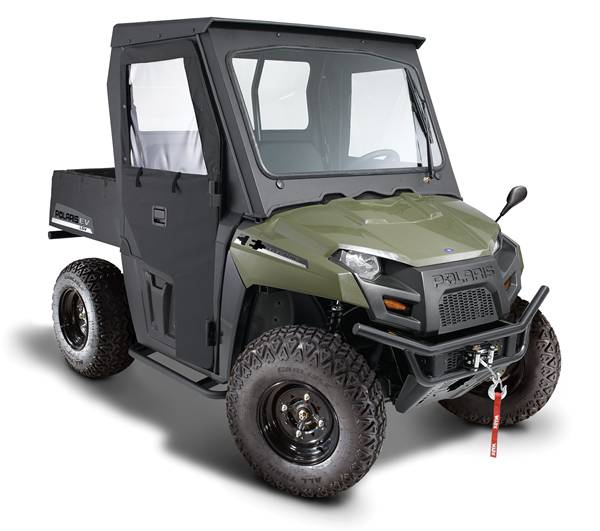
Minneapolis, January 6, 2010 – Polaris Defense today announced the introduction of their Low Speed Vehicle, the Polaris EV LSV, designed for on and off-road use. “We are excited to introduce the Polaris EV LSV to the military market,” said Mark McCormick, managing director of Polaris Defense. “The features and superiority of our product will greatly benefit applications that require vehicles with on and off-road capabilities.”
Based off the RANGER EV platform, Polaris’ first off-road, electric vehicle, the Polaris EV LSV includes the necessary features including horn, turn signals, automotive-quality windshield and rear view mirror, for on-road use. With its 30 horsepower electric motor, quiet operation, 50 mile range and 25 mph top speed, the Polaris EV LSV is the most-capable LSV available for military use. The unit features three modes; High for speed, Low for towing and hauling, and Max for maximum range to ensure the best use of power and battery life for any application.
The Polaris EV LSV was built to be tough and reliable. Its 1,000-pound payload capacity, 1,250 lbs. of towing and On-Demand True All-Wheel Drive for harsh terrain makes it a strong work partner; and its exclusive 48-volt, AC Induction motor provides high performance with low maintenance for maximum reliability. For recharging ease, the unit can be charged using a standard 110 volt AC outlet.
Polaris Defense also is offering the Polaris EV LSV to all Federal Government Agencies. Available colors include Red, Blue and Green. More information regarding the new Polaris EV LSV can be found at www.polarislsv.com.
Ranger EV LSV Specifications:
| Motor Configuration | Single 48 Volt, High Efficiency, AC Induction motor |
| Motor Peak HP | 30hp |
| Controller | 650 – Amp Sevcon Gen IV controller with multi-mode driving and regenerative braking |
| Battery Pack | 11.7kW battery pack at 48V DC; Eight 12-volt, US12VXC batteries in series-parallel configuration |
| Range | Up to 50 miles *Range is in ‘Max Range’ driving mode, flat ground and may vary depending on driving conditions |
| Throttle | Redundant, Non-contact, inductive sensing pedal |
| Onboard Charger | Delta Q 120-volt AC input; 48-volt DC output |
| Charge Time | 8 hours (Dependent on depth of discharge) |
About Polaris With annual 2008 sales of $1.9 billion, Polaris designs, engineers, manufactures and markets off-road vehicles (ORVs), including all-terrain vehicles (ATVs) and the Polaris RANGER™, snowmobiles and Victory motorcycles for recreational and utility use and has recently introduced a new on-road electric powered neighborhood vehicle. Polaris is a recognized leader in the snowmobile industry; and one of the largest manufacturers of ORVs in the world. Victory motorcycles, established in 1998 and representing the first all-new American-made motorcycle from a major company in nearly 60 years, are rapidly making impressive in-roads into the cruiser and touring motorcycle marketplace. Polaris also enhances the riding experience with a complete line of Pure Polaris apparel, accessories and parts, available at Polaris dealerships. Polaris Industries Inc. trades on the New York Stock Exchange under the symbol “PII,” and the Company is included in the S&P Small-Cap 600 stock price index. Information about the complete line of Polaris products, apparel and vehicle accessories are available from authorized Polaris dealers or anytime from the Polaris homepage at www.polarisindustries.com. |
||||||||||||||||||||||||||||||||||||||||||||

No Comments