


The Kawasaki MULE reached the American market for the 1988 model year after production began at Kawasaki’s Lincoln, Nebraska, plant in 1987. Short for Multi-Use Light Equipment, the original MULE 1000 combined the maneuverability of an ATV with a small pickup-style cargo bed and helped establish the modern utility side-by-side category.

The original 1988 Kawasaki MULE helped establish the modern utility side-by-side category.
Nearly four decades later, the MULE name covers everything from compact work vehicles to diesel-powered machines and the more powerful MULE PRO family. Although the vehicles have become larger, faster and more comfortable, their underlying purpose has remained remarkably consistent: carry people, haul cargo and work reliably in places where a conventional pickup is too large.
This article follows the MULE’s development from the original 1988 MULE 1000 through its compact, diesel, Trans Cab and modern MULE PRO generations. For a model-by-model comparison of the machines available today, see our complete Kawasaki MULE lineup guide.
The Napkin Sketch That Started the Kawasaki MULE
The idea behind the Kawasaki MULE reportedly began with a sketch on a cocktail napkin in August 1980. Kawasaki engineers were discussing the agricultural industry’s need for a small, rugged vehicle that could travel off-road while carrying more than an ATV.
Their concept called for a vehicle that was durable, comfortable and easy to operate, with meaningful hauling and towing capabilities. It needed the agility to work around farms and ranches but also required a cargo bed more like a small pickup.
That combination seems ordinary today because the side-by-side market is filled with utility vehicles. At the time, however, the vehicle did not fit neatly into an established category. It was not an ATV, tractor, golf cart or truck. It borrowed useful characteristics from each without being a direct replacement for any one of them.
Kawasaki eventually named the concept MULE, an acronym for Multi-Use Light Equipment. The name also fit the vehicle’s intended personality: a dependable working machine built to carry loads and perform jobs day after day.

1988 Kawasaki MULE brochure
1987–1988: The Original Kawasaki MULE 1000
Kawasaki began producing the original MULE 1000 at its Lincoln, Nebraska, manufacturing plant in 1987. The vehicle was introduced to customers for the 1988 model year.
The first MULE used a liquid-cooled 454cc two-cylinder engine and a continuously variable transmission. It featured rear-wheel drive, an open operator compartment and a rear cargo bed that made it useful for hauling tools, feed and supplies.
Its design placed two occupants beside one another behind a steering wheel rather than using the straddle seating and handlebars found on an ATV. That layout made the MULE approachable for workers who might not have been comfortable operating an ATV, while the compact dimensions allowed it to reach areas inaccessible to a pickup.
Farmers and ranchers were natural early customers, but the MULE soon spread into other industries. Golf courses, factories, parks, sports facilities, maintenance departments and emergency-response organizations found uses for a compact vehicle that could carry both people and equipment.
The original MULE did not merely add another model to Kawasaki’s lineup. It helped establish the basic formula still used by utility side-by-sides today: steering-wheel controls, side-by-side seating, off-road tires and suspension, a cargo bed and the ability to haul or tow.
Kawasaki MULE Models by Year
The MULE family has included too many individual trims and model-year variations to list every one, but the following timeline covers its most important platforms and milestones.
| Year | Kawasaki MULE milestone |
|---|---|
| 1980 | Original utility-vehicle concept sketched on a napkin |
| 1987 | Production of the MULE 1000 begins in Lincoln, Nebraska |
| 1988 | MULE 1000 reaches the market |
| 1990 | MULE 2010 adds selectable 2WD/4WD and a Hi/Lo transmission |
| 1991 | Turf-oriented MULE 2020 and compact MULE 500 introduced |
| 1992 | MULE 2510 introduces a 617cc liquid-cooled V-twin |
| 2000 | MULE 2510 Diesel introduced |
| 2001 | MULE 3000, 3010 and 3020 generation arrives |
| 2005 | Compact MULE 600 and MULE 610 4×4 introduced |
| 2005 | MULE 3010 Trans4x4 introduces convertible seating and cargo space |
| 2010 | MULE 610 4×4 XC expands the compact model’s off-road capability |
| 2015 | MULE PRO-FXT begins the modern MULE PRO era |
| 2016 | MULE PRO-FX and diesel MULE PRO models expand the family |
| 2017 | MULE SX succeeds Kawasaki’s compact MULE models |
| 2018 | MULE PRO-FXR adds a more recreation-oriented configuration |
| 2019 | MULE PRO-MX establishes a midsize MULE PRO platform |
| 2024 | Full-size gas models transition to the 999cc MULE PRO 1000 platform |
| 2026 | MULE PRO-FX 820 and PRO-FXT 820 continue the 812cc three-cylinder branch alongside the MULE PRO 1000 family |
| Today | MULE lineup spans compact, traditional, midsize, full-size gasoline and diesel-powered models |
Four-Wheel Drive and Turf-Friendly Operation

Kawasaki began expanding the MULE concept only a few years after the original vehicle entered production.
The 1990 MULE 2010 combined selectable two-wheel drive and four-wheel drive with a Hi/Lo transmission. These features allowed the driver to use four-wheel drive and low range when traction or slower-speed control was needed, then return to two-wheel drive for easier conditions.
In 1991, Kawasaki introduced the MULE 2020. Sometimes called the “turf MULE,” it was designed for golf courses, sports fields and other properties where traction mattered but ground disturbance had to be minimized.
Its dual-mode rear differential could be locked when additional traction was required or left unlocked to allow the rear wheels to rotate independently. The unlocked setting reduced tire scrubbing and damage to sensitive grass.
Versions of this idea remain important across the utility side-by-side market. Today, the ability to unlock a rear differential is especially valuable for landscaping, property maintenance and farm work performed on established lawns.
The Compact Kawasaki MULE Begins
Kawasaki introduced the smaller MULE 500 in 1991. Its compact dimensions and straightforward controls brought the MULE concept to owners who did not need the size or payload of a full-size utility vehicle.
The MULE 500 was small enough to transport in the bed of some full-size pickup trucks, making it useful for customers who wanted to carry a utility vehicle to remote properties or job sites without using a separate trailer.
Kawasaki continued developing this branch with models such as the MULE 520 and 550. These compact vehicles established a formula the company would later carry into the MULE 600, MULE 610 and MULE SX families.
While larger utility side-by-sides continued gaining power and passenger capacity, the compact MULE retained an important advantage: it could work in narrow areas and take up less space in a garage, barn or trailer.
The MULE 2510 Brings V-Twin Power
In 1992, the MULE 2510 moved the larger utility platform forward with a liquid-cooled 617cc V-twin engine. It also offered four-wheel drive, a tilting cargo bed and increased work capability.
The V-twin engine became closely associated with Kawasaki’s traditional full-size MULE models. It emphasized smooth, dependable power rather than the high speeds that would eventually become common in recreational UTVs.
Kawasaki added specialized models throughout the 1990s, including machines tailored to commercial, industrial and turf applications. This broadening customer base demonstrated the value of treating a utility vehicle as equipment rather than simply as another recreational powersports product.
Diesel Power Comes to the Kawasaki MULE

The MULE 2510 Diesel arrived in 2000 with a liquid-cooled 953cc three-cylinder diesel engine.
Diesel power made sense for farms, industrial facilities and construction sites that already stored diesel fuel for tractors and other equipment. Customers could operate several types of machinery from the same fuel supply while gaining the low-speed character and fuel economy associated with a small diesel engine.
Diesel would become a lasting part of the MULE family. Modern Kawasaki MULE PRO-DX and PRO-DXT diesel models continue to serve customers who prioritize work capability, fleet compatibility and durability over outright speed.
The PRO-DX uses a single-row cab and long cargo bed, while the PRO-DXT combines diesel power with Kawasaki’s convertible Trans Cab seating system.
2001 Kawasaki MULE 3000 Series

Kawasaki introduced a redesigned generation for 2001 consisting of the two-wheel-drive MULE 3000 and four-wheel-drive MULE 3010 and 3020 models.
The new vehicles adopted more pronounced pickup-truck styling, improved ergonomics and updated continuously variable transmissions. Kawasaki promoted them with the phrase, “Looks like a truck. Works like a MULE.”
The 617cc V-twin continued to provide power in the gas models. More important than any single specification was how recognizable the basic utility-vehicle layout had become. By this point, the MULE was no longer an unusual combination of ATV and pickup features. It was part of an increasingly established vehicle category.
Older MULE 3000-series models also developed long service lives. Many remain in use on farms and properties today, which helps explain the continuing search interest in the MULE 3010, 3020 and related diesel models.
The MULE 3010 Trans4x4 Changes Passenger and Cargo Flexibility
One of the most important developments in MULE history arrived with the 2005 MULE 3010 Trans4x4.
A conventional crew utility vehicle gains passenger capacity by adding a permanently extended cab, but that arrangement leaves the owner with a shorter cargo bed even when the rear seats are empty. Kawasaki approached the problem differently.
The MULE 3010 Trans4x4 could be configured with two rows of seating for four occupants or converted to a two-passenger layout with a larger cargo area. Owners could carry a work crew, hunting party or family when necessary, then prioritize bed capacity for another job.
Kawasaki later refined this idea into the Trans Cab system used by modern MULE PRO-FXT and PRO-DXT models. The passenger count, cargo-bed design and conversion process evolved, but the underlying goal remained the same: allow one vehicle to perform the jobs of both a single-row utility model and a crew machine.
The Trans4x4 was therefore more than another trim. It introduced one of the MULE family’s most enduring and recognizable features.
MULE 600, MULE 610 and MULE SX

Kawasaki added the MULE 600 and MULE 610 4×4 for 2005. Powered by 401cc single-cylinder engines, these “baby MULEs” renewed the company’s commitment to compact utility vehicles.
The Kawasaki MULE 610 4×4 added selectable two-wheel drive and four-wheel drive while remaining small enough to fit in the bed of some full-size pickup trucks. Its combination of modest dimensions, simple construction and useful cargo capacity made it a popular choice for farms, ranches, industrial facilities and private-property owners.
In 2010, the Kawasaki MULE 610 4×4 XC added 26-inch tires, 12-inch wheels, additional ground clearance and more aggressive styling. It gave the compact platform better off-road capability without turning it into a full-size machine.
Kawasaki introduced the MULE SX family for 2017 as the next step in this compact lineage. The SX maintained the accessible size and work-first personality of the earlier MULE 500, 600 and 610 models while adding updated styling and available features.
That continued demand is significant. As much of the UTV market has moved toward larger, wider and more powerful vehicles, Kawasaki has preserved a small MULE for customers who value maneuverability and simplicity.
2015 MULE PRO-FXT: The Modern Turning Point
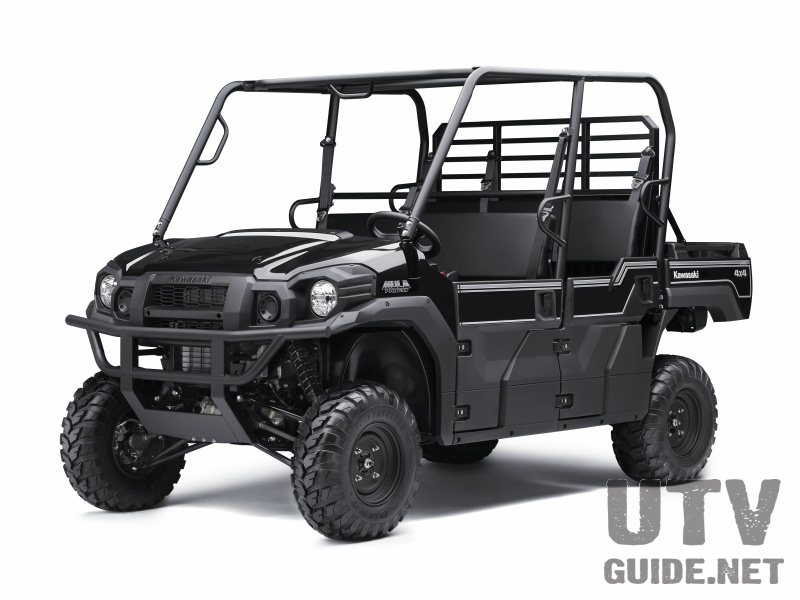
The 2015 MULE PRO-FXT represented the biggest change in the family’s history since the original MULE 1000.
Its liquid-cooled 812cc three-cylinder engine produced substantially more power and torque than Kawasaki’s traditional V-twin MULE platforms. Independent suspension at all four corners, four-wheel disc brakes, power steering on applicable trims and a more spacious cab made it faster and more comfortable without abandoning its utility mission.
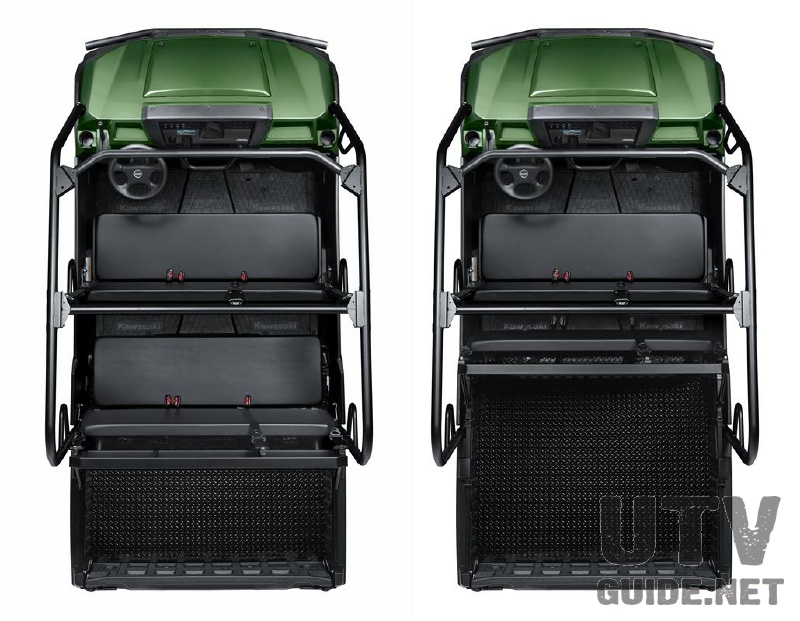
The PRO-FXT also introduced a new Trans Cab system that could carry three or six occupants. In its three-passenger configuration, the vehicle provided a larger cargo bed. Converting the rear portion of the cab created a second row for additional passengers.
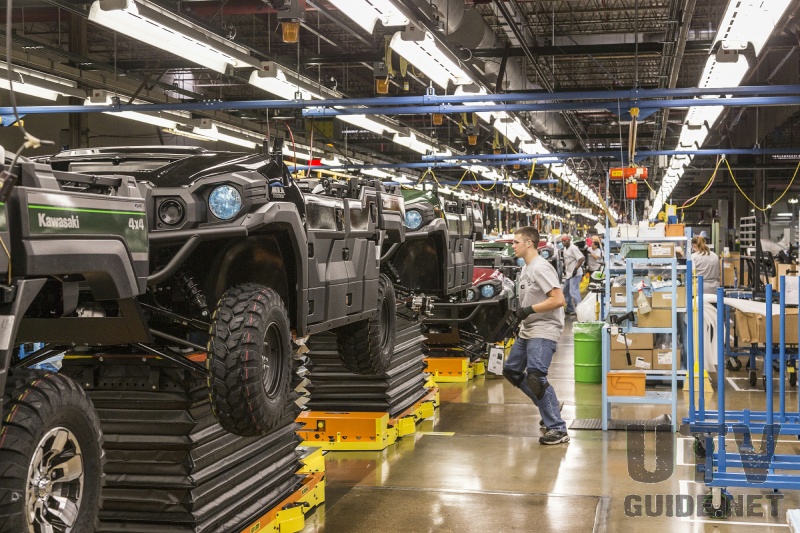
I traveled to Lincoln, Nebraska, for the original MULE PRO-FXT introduction in 2015. Before driving it, I toured the Kawasaki manufacturing plant and watched MULE PRO-FXT models moving down the assembly line.
The visit provided a much closer look at how extensively Kawasaki manufactures these vehicles in Nebraska. Inside the plant, Kawasaki cut, formed and welded steel, molded and painted plastic components, manufactured steel wheels and assembled complete vehicles. I also watched camouflage being applied to MULE bodywork.
After the factory tour, my 2015 Kawasaki MULE PRO-FXT first-ride review showed how dramatically the new platform expanded the MULE’s capabilities. It was still designed to haul, tow and work, but it could also cover rough terrain more comfortably and operate at speeds that made it far more suitable for recreational trail use.
The MULE PRO-FXT did not replace every traditional MULE. Instead, it created a new upper branch of the family.
Expansion of the MULE PRO Family
Kawasaki expanded the PRO platform quickly after introducing the PRO-FXT.
The Kawasaki MULE PRO-FX used the same basic 812cc three-cylinder platform but substituted a single-row cab and full-length cargo bed for the convertible Trans Cab. It was aimed at customers who consistently prioritized cargo space over carrying six people.
Diesel-powered PRO-DX and PRO-DXT models applied the more comfortable independent-suspension chassis to work environments where diesel remained preferable.

For 2018, the Kawasaki MULE PRO-FXR gave the family a more recreation-oriented personality. It featured more distinctive styling, contoured seating, premium equipment and a slightly more compact feel while retaining a steel cargo bed and meaningful towing and hauling capability.

The 2019 Kawasaki MULE PRO-MX added a midsize option. Its 695cc single-cylinder engine and two-passenger layout placed it between the compact MULE SX and the full-size PRO models.
By the end of the decade, MULE no longer referred to one basic vehicle available in different trims. It described a broad utility family with compact, midsize, full-size, convertible-cab and diesel branches.
The Kawasaki MULE PRO 1000 Generation

The next major full-size update brought a 999cc liquid-cooled parallel-twin engine to Kawasaki’s gas-powered MULE PRO lineup.
The larger engine increased torque while retaining the controlled power delivery expected from a work-focused vehicle. Kawasaki continued offering single-row, Trans Cab and premium recreation-oriented configurations, including the MULE PRO-FX 1000, PRO-FXT 1000 and PRO-FXR 1000.
Our 2024 Kawasaki MULE 1000 lineup overview explains the major configurations introduced with this newer generation.

The MULE PRO-FX 1000 HD Edition pushed the single-row platform toward heavier work with features including self-leveling rear suspension and a hydraulic cargo-bed lift.
Premium Ranch and Platinum Ranch editions added appearance and convenience features, but the important historical development was not a particular trim package. It was Kawasaki’s ability to give the MULE more power, comfort and refinement without moving it out of the utility category.
Unlike performance-oriented sport UTVs, the MULE PRO 1000 platform remains centered on predictable power, passenger and cargo capacity, towing and long working days.
The MULE PRO 820 Continues the Three-Cylinder Platform
The arrival of the 999cc MULE PRO 1000 family did not end Kawasaki’s use of the earlier 812cc three-cylinder platform. The 2026 MULE PRO-FX 820 and PRO-FXT 820 continued that branch as work-focused full-size models positioned alongside the more powerful MULE PRO 1000 series.
The MULE PRO-FX 820 uses a three-passenger cab and full-length cargo bed, while the PRO-FXT 820 applies Kawasaki’s three-to-six-passenger Trans Cab system. Both retain the 812cc three-cylinder engine associated with the original MULE PRO generation and are rated to tow as much as 2,000 pounds.
The coexistence of the 820 and 1000 platforms illustrates how broad the MULE family had become. Rather than replacing every earlier configuration with one flagship engine, Kawasaki continued offering distinct combinations of price, power, seating and cargo capacity.
Built in Lincoln, Nebraska
The Kawasaki MULE has a particularly strong connection to American manufacturing.
Kawasaki opened its Lincoln, Nebraska, manufacturing operation in 1974. Production of the original MULE began there in 1987, and Lincoln has remained central to the MULE story ever since.
By July 2017, Kawasaki reported that 534,444 MULEs had been produced at the facility. The plant has also built many of Kawasaki’s other powersports products and now plays an important role in production of the company’s broader side-by-side lineup.
I returned to the plant in 2023 for a second tour. During that visit, the facility employed more than 3,000 people and covered approximately 2.4 million square feet on about 330 acres. Those figures describe the operation at the time of that visit, but even numbers of that scale do not fully convey how much manufacturing occurs inside the plant.
Multiple production lines handled different vehicles. The MULE PRO line was building PRO-FX 1000, PRO-FXR 1000 and PRO-FXT 1000 models. Manufacturing operations included metal forming and welding, plastics production, painting, component preparation, final assembly and quality-control processes.
You can see that process in our tour of Kawasaki’s Lincoln, Nebraska, manufacturing plant.
More recent Kawasaki models, including the RIDGE, TERYX H2, TERYX KRX and MULE, continue the company’s Nebraska side-by-side manufacturing story. Our feature on how Kawasaki side-by-sides are built in Lincoln provides a broader look at the current operation.
The vehicles are assembled in Lincoln using foreign and domestic components. Still, “assembled in Nebraska” does not fully describe what I saw during my visits. Kawasaki performs substantial manufacturing work inside the facility before the individual parts become completed side-by-sides.
MULEs at Work
The MULE’s significance cannot be measured only through model introductions and engine specifications. Its lasting success comes from the number of jobs owners have found for it.
MULEs have worked on farms, ranches, golf courses, construction sites, industrial facilities, parks and large private properties. They have carried tools at racetracks, supported hunting operations and moved personnel at sports facilities.
They have also served public-safety and emergency organizations. Fire departments and other first responders have equipped Kawasaki MULEs to move personnel, medical equipment and supplies into places that are difficult to reach with full-size vehicles.
The convertible Trans4x4 and Trans Cab models have been particularly well suited to these roles because they can alternate between carrying additional occupants and creating more cargo space.
This adaptability explains why many older MULEs remain in service. Owners did not necessarily purchase them as recreational vehicles to replace every few years. They bought them as working equipment and often kept them as long as the machines continued doing the job.
How the Current MULE Family Reflects Its History
Kawasaki’s current MULE lineup still contains several distinct interpretations of the original idea.
| MULE family | Historical role it continues |
|---|---|
| MULE SX | Compact, straightforward utility descended from the MULE 500, 600 and 610 |
| MULE 4000/4010 | Traditional lower-speed work platform, including convertible Trans Cab models |
| MULE PRO-MX | Midsize two-passenger balance of work capability and trail use |
| MULE PRO 820 | Full-size work platform powered by Kawasaki’s proven 812cc three-cylinder engine |
| MULE PRO 1000 | Full-size 999cc platform with single-row, Trans Cab and recreation-oriented configurations |
| Diesel MULE PRO | Work-focused PRO-DX and convertible PRO-DXT for diesel fleets and heavy-duty use |
The compact MULE SX continues the lineage that began with the MULE 500 and later included the 600 and 610. It is intended for owners who value a small footprint and straightforward utility.
Traditional MULE 4000 and 4010 models preserve more of the older work-focused architecture. The 2027 MULE 4000 and 4010 lineup demonstrates the longevity of this platform, including fixed two-passenger models and convertible Trans Cab configurations.
The MULE PRO-MX occupies the middle of the range with two seats, a midsize chassis and more trail capability than the smaller models. Full-size gasoline models are divided between the 812cc MULE PRO 820 branch and the more powerful 999cc MULE PRO 1000 family. Diesel-powered PRO-DX and PRO-DXT models remain available for farms, commercial operations and fleets that prefer diesel equipment.
The 2026 MULE PRO 1000 lineup demonstrates how far the flagship gas-powered platform has evolved, while the 2026 MULE PRO-MX and diesel MULE PRO overview covers the continued importance of Kawasaki’s midsize and diesel branches.
For specifications and a direct comparison of all these platforms, visit our Kawasaki MULE lineup buyer’s guide.
Despite their differences in size, power and equipment, every branch traces back to the same objective: build a vehicle that is easier to maneuver than a pickup but more capable of carrying people and cargo than an ATV.
Why the Kawasaki MULE Matters
The Kawasaki MULE was not the first small off-road vehicle with side-by-side seating, and the history of utility vehicles includes machines that predate it. Its importance comes from helping define and popularize the modern work-focused side-by-side.
The original MULE combined several ideas into a format that proved useful to an unusually broad range of customers. It offered automotive-style controls, a pickup bed, off-road capability and a compact footprint in a purpose-built vehicle sold through an established powersports company.
Kawasaki then continued refining that format rather than abandoning it as the market changed. Four-wheel drive improved its mobility. The dual-mode differential made it friendlier to turf. Diesel engines expanded its commercial appeal. The Trans4x4 addressed the conflict between passenger capacity and cargo space. Compact models served owners who did not want a full-size UTV, while the MULE PRO family added the power and comfort expected of a modern side-by-side.
The result is a vehicle family that spans multiple generations of UTV design. A compact MULE SX, traditional 4010 Trans4x4, diesel PRO-DXT and gas-powered PRO-FXT 1000 are very different machines, yet each reflects part of the original napkin-sketch concept.
That continuity—and nearly four decades of production in Lincoln, Nebraska—is what makes the Kawasaki MULE one of the most important names in utility side-by-side history.
Kawasaki MULE History FAQ
What year did the Kawasaki MULE come out?
Kawasaki began producing the original MULE 1000 in Lincoln, Nebraska, in 1987. It was introduced to customers for the 1988 model year.
What does Kawasaki MULE stand for?
MULE stands for Multi-Use Light Equipment. The name describes the vehicle’s original mission as a compact, versatile working machine.
Where are Kawasaki MULEs built?
Kawasaki MULE side-by-sides are assembled using foreign and domestic components at Kawasaki’s manufacturing plant in Lincoln, Nebraska. The original MULE entered production at the Lincoln facility in 1987.
Was the Kawasaki MULE the first side-by-side?
The MULE was not the first vehicle ever built with side-by-side seating or a small cargo bed. However, the 1988 MULE 1000 helped establish and popularize the modern utility side-by-side format.
When was the Kawasaki MULE Trans4x4 introduced?
Kawasaki introduced the MULE 3010 Trans4x4 for 2005. Its convertible layout allowed the vehicle to switch between two rows of seating and a larger cargo bed.
When did the Kawasaki MULE PRO-FXT debut?
The MULE PRO-FXT debuted for the 2015 model year. It introduced an 812cc three-cylinder engine, independent suspension and a three-to-six-passenger Trans Cab system.
Does Kawasaki still make a diesel MULE?
Yes. Kawasaki continues to offer the single-row MULE PRO-DX and convertible-cab MULE PRO-DXT with 993cc three-cylinder diesel engines.
What is the difference between a MULE and a MULE PRO?
Traditional MULE models emphasize straightforward, lower-speed work capability. MULE PRO models generally offer more power, independent suspension, greater comfort and a more modern chassis. The PRO family includes midsize, full-size gasoline and full-size diesel models.
Explore more Kawasaki UTV news, reviews, model guides and history from UTV Guide.


