


Originally published in 2008. This report covers the 10th annual Sand Sports Super Show, held September 19–21, 2008, at the Orange County Fairgrounds in Costa Mesa, California. It has been rebuilt using a curated selection of the original full-size photographs.
The 2008 Sand Sports Super Show arrived at a pivotal point in UTV history. The Yamaha Rhino had already created a thriving customization industry, the Polaris RZR was rapidly moving performance expectations forward and the new Kawasaki Teryx was giving builders a V-twin alternative with substantial development potential.
Nearly every major UTV fabricator and accessory company seemed to be developing long-travel suspension, cages, seats, exhaust systems, steering parts, lighting and performance upgrades for these platforms. Arctic Cat introduced the powerful Prowler 1000 XTZ, Polaris displayed the wider RZR S and smaller manufacturers continued experimenting with alternative performance UTV concepts.
UTVGuide.net had two project vehicles at the show. Our Kawasaki Teryx appeared in the SDR Motorsports booth, while our first-generation Polaris RZR was displayed by Fullerton Sand Sports.

The UTV Industry Expands Beyond the Yamaha Rhino
The Sand Sports Super Show had long been associated with sand rails, ATVs and dune equipment, but UTVs occupied an increasingly prominent part of the 2008 event.
The Yamaha Rhino remained a major platform for fabricators. Builders displayed long-travel suspension, turbo systems, engine swaps, race cages, replacement bodywork and increasingly elaborate lighting systems.
However, the show also demonstrated how quickly the market was diversifying. The original Polaris RZR had been available for only a short time, yet dozens of companies were already producing suspension, turbo kits, cages, doors, steering components and dune accessories for it.
The Kawasaki Teryx was even newer. Nevertheless, the show floor was filled with Teryx exhaust systems, long-travel kits, replacement steering components, skid plates and multi-seat conversions.
These three platforms helped define different phases of early recreational UTV development. Learn more in our histories of the Yamaha Rhino, Polaris RZR and Kawasaki Teryx.
Jagged X #1919 Polaris RZR Desert Race Car
One of the show’s standout vehicles was the Jagged X #1919 Polaris RZR desert race car. Jagged X was already proving the new RZR in Best in the Desert competition, helping establish UTV racing as a serious part of the off-road industry.
The race car was displayed with a custom chase truck, creating a complete desert-racing presentation rather than treating the RZR as an isolated show vehicle.


Jagged X would go on to become one of the most important teams in early UTV desert racing, winning multiple Best in the Desert championships with Polaris.
SDR Motorsports Five-Seat Kawasaki Teryx
SDR Motorsports and Fabtech displayed a long-travel Kawasaki Teryx converted to carry five occupants. Multi-seat UTV conversions were common during this period because factory four-seat recreational machines had not yet become widely available.
The build combined a substantially extended cage with rear passenger seating and long-travel suspension. It retained the Teryx’s recognizable front bodywork but transformed the compact two-seat platform into a family-oriented dune vehicle.


A Collaborative Kawasaki Teryx Build
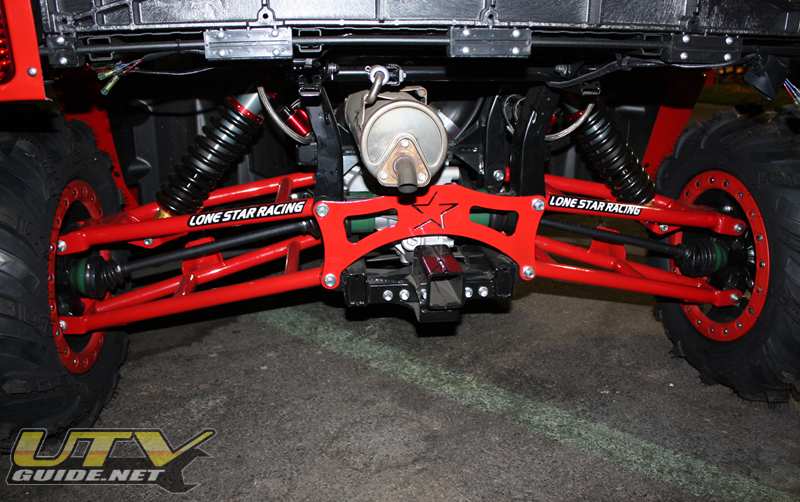
Another favorite Teryx combined components from TMW Off-Road, Lonestar Racing, Fullbore Innovations, HiPer and Rigid Industries. The vehicle demonstrated how several specialized aftermarket companies could contribute to a complete build.
Fullbore replacement bodywork dramatically changed the Teryx’s appearance. Lonestar Racing suspension widened and upgraded the chassis, while HiPer wheels and Rigid lighting completed the performance-oriented package.


Hot Ride Turbocharged Polaris RZR
Hot Ride displayed a turbocharged, long-travel Polaris RZR built with Fullbore Innovations bodywork and Bilstein suspension components. The build represented the aftermarket’s early effort to overcome the original RZR’s modest factory power and suspension travel.
Turbocharging would eventually become a factory feature on several high-performance UTVs. In 2008, it was still an ambitious aftermarket modification that required careful attention to fueling, cooling, clutching and engine durability.


The Polaris RZR S Moves Performance to the Factory
The Polaris RZR S was one of the most important production vehicles at the show. Instead of requiring owners to install an aftermarket long-travel kit immediately, Polaris offered a wider, longer-travel version of the RZR directly from the factory.
This represented a major change in the market. The aftermarket had already demonstrated demand for wider suspension and more aggressive recreational performance. The RZR S showed that manufacturers were paying attention and were prepared to incorporate those ideas into production models.

Arctic Cat Prowler 1000 XTZ
Arctic Cat displayed the Prowler 1000 XTZ, giving the utility-recreation category another high-output V-twin platform. Its large engine and substantial chassis distinguished it from the smaller single-cylinder machines that had dominated much of the early UTV market.
The Prowler 1000 XTZ also attracted immediate attention from fabricators developing cages, bumpers, nerf bars and suspension components.

Kymco UXV500 and Redline Riot
The show was not limited to the major UTV manufacturers. Kymco displayed its UXV500, a utility-oriented machine that helped broaden the number of brands competing in the category.

At the opposite end of the spectrum was the Redline Riot, a more specialized performance machine. Its low profile, exposed suspension and unusual layout stood apart from the Rhino, RZR, Teryx and Prowler platforms filling most of the show.

New Kawasaki Teryx Products
The volume of new Teryx components was one of the clearest signs of the platform’s early momentum. Products included exhaust systems, long-travel suspension, steering components, bodywork and underbody protection.
Gear One Steering Rack and Centerboard Kit
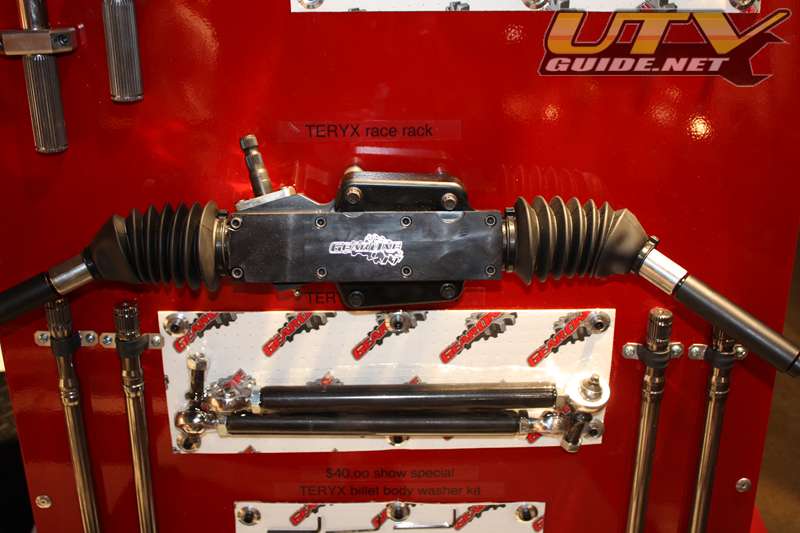
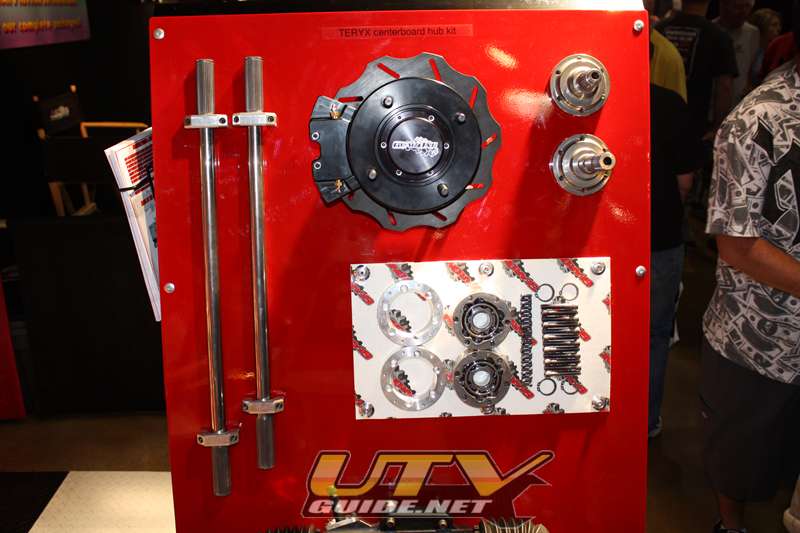
Gear One displayed replacement steering and hub components for the Teryx. Upgraded steering became increasingly important as builders added wider suspension and larger tires, both of which could increase loads on factory components.
Factory UTV UHMW Skid Plate
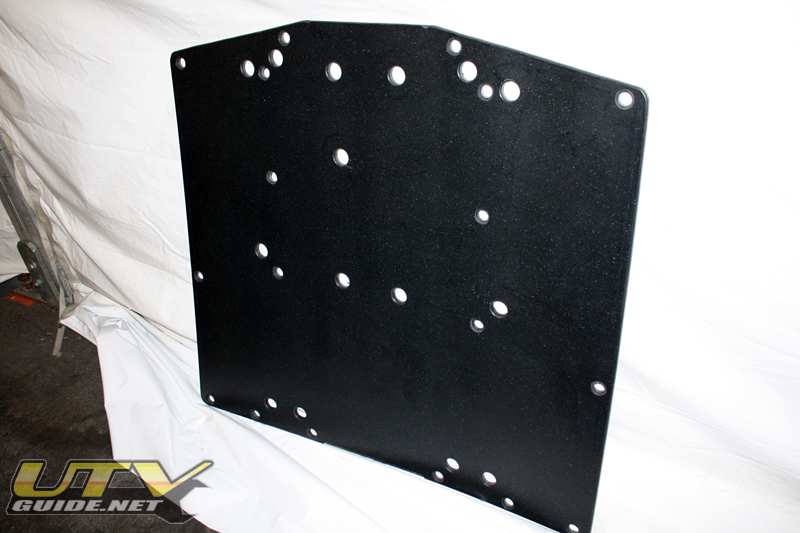
Factory UTV displayed UHMW underbody protection for the Teryx. The plastic material could slide across rocks while protecting vulnerable chassis and drivetrain components, offering an alternative to heavier metal skid plates.
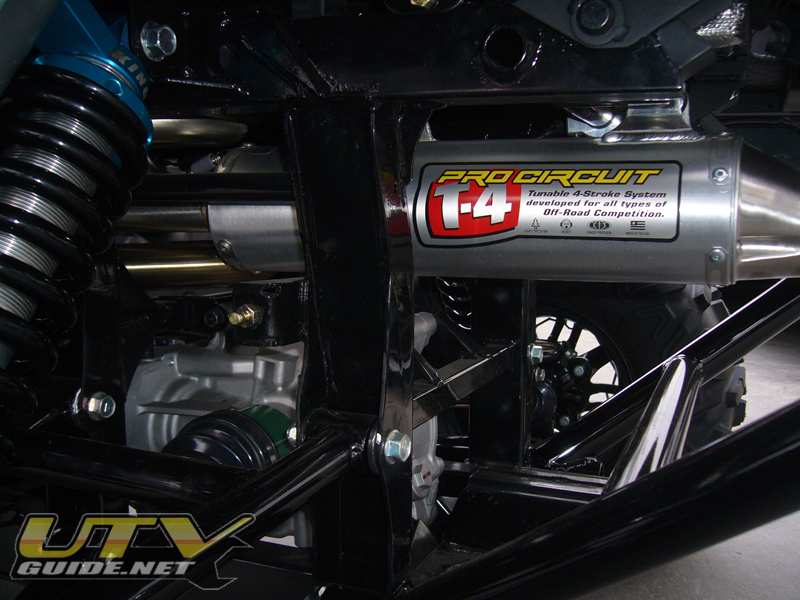
Teryx Exhaust Development
Pro Circuit, AC Racing and Alba were among the companies showing exhaust systems for the Teryx. The platform’s carbureted 749cc V-twin gave performance companies an immediate opportunity to develop exhaust, intake, ignition and engine packages.
The Yamaha Rhino Aftermarket Remains Strong
Although newer machines received much of the attention, the Yamaha Rhino continued to support the show’s largest established UTV aftermarket. CHM introduced a dual-exhaust system, and multiple companies displayed long-travel suspension, turbo systems, bodywork, seats and racing components.

The Rhino’s influence remained visible even as the RZR and Teryx gained momentum. It had created the customer base, fabrication knowledge and network of specialty manufacturers that allowed the newer platforms to develop so quickly.
Early Race-Prepared Kawasaki Teryx Builds
The Teryx was also being prepared for short-course and desert competition. These builds replaced the recreational cage and bodywork with race structures, suspension and occupant-protection equipment.


Lighting Technology Begins to Change
Large HID lamps still dominated serious off-road lighting in 2008, but LED technology was beginning to appear. Baja Designs displayed HID and LED products, while Rigid Industries was helping introduce compact LED light bars to the UTV market.
Two builds competed unofficially for the show’s most extreme lighting arrangement:
- A Taylor Motorsports Rhino with five 8-inch Baja Designs La Paz HID lights
- A TMW and Lonestar Racing Rhino with five 6-inch Vision X HID lights and a Rigid Industries LED light bar
The LED light bar was especially significant. Compact LED bars would soon become one of the most common accessories fitted to UTVs, largely replacing elaborate roof arrangements using multiple round HID lamps.

Our UTV Shopping List
With our Teryx and RZR both on display, the show also gave us an opportunity to identify the next practical upgrades for the two UTVGuide.net project vehicles.
- Rugged Race Products radio and intercom systems with headsets
- Lonestar Racing cooler rack for the RZR cargo bed
- Protective covers for the RZR and Teryx
- iTi Motorsports front and rear sway bars for the RZR
- Fullerton Sand Sports and DWT paddle tires for the Teryx
- Long Travel Industries quick-release steering-wheel hub for the Teryx
The list shows how quickly project vehicles evolved during this period. A build was rarely “finished.” Each event introduced another product that could improve communication, handling, comfort, storage or dune performance.
Why the 2008 Sand Sports Super Show Mattered
The 2008 show captured the UTV industry moving from a single dominant recreational platform into a genuine performance category.
The Yamaha Rhino remained the foundation of the aftermarket, but the original RZR was attracting racers, turbo developers and long-travel builders at an extraordinary pace. The factory RZR S showed that Polaris was already incorporating aftermarket trends into production vehicles.
Meanwhile, the new Kawasaki Teryx generated an entire ecosystem of suspension, engine, body and steering products during its first year. Arctic Cat pushed displacement higher with the Prowler 1000 XTZ, while smaller companies experimented with machines such as the Redline Riot and QSP YamaBuggy.
Many of the ideas visible at the show—factory long-travel suspension, four-seat configurations, turbocharging, integrated communication, UHMW protection and LED light bars—would eventually become standard or widely available throughout the UTV industry.
Compare this coverage with the 2007 Sand Sports Super Show and explore more historical events in the UTVGuide.net Events & Shows archive.
More Sand Sports Super Show Coverage
Explore UTVGuide.net’s complete Sand Sports Super Show coverage archive, with annual recaps, photographs and product highlights documenting the evolution of the UTV industry from 2007 through today.


