
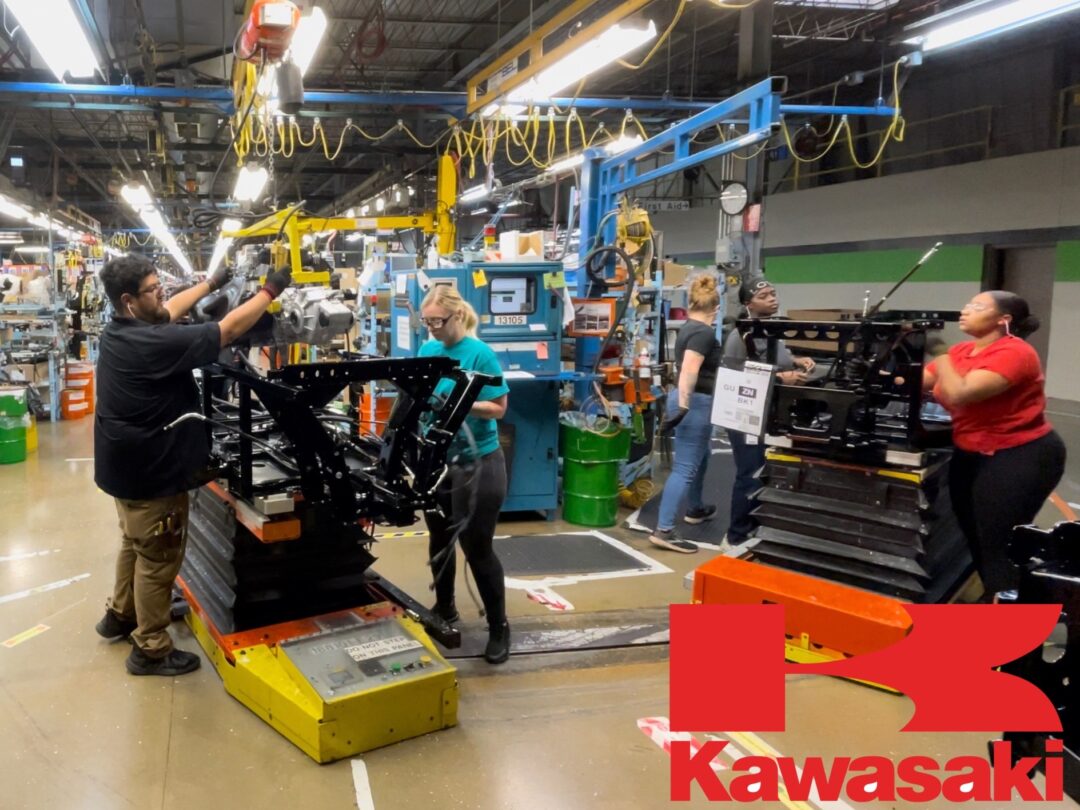
Kawasaki has assembled utility vehicles in Lincoln, Nebraska, since 1987. During our 2023 visit to Kawasaki Motors Manufacturing Corp., U.S.A. (KMM), we followed the production line responsible for assembling the Kawasaki MULE PRO-FX 1000, MULE PRO-FXR 1000 and MULE PRO-FXT 1000.
The tour offered a closer look at more than final assembly. Kawasaki forms and prepares steel components, uses automated equipment to improve repeatability and verifies critical assembly steps before a completed MULE leaves the production line.
Inside Kawasaki’s Lincoln, Nebraska, Manufacturing Plant
Kawasaki Motors Manufacturing Corp., U.S.A. was established in Lincoln in 1974 as a subsidiary of Kawasaki Heavy Industries. The original facility covered approximately 286,000 square feet, but Kawasaki’s Nebraska operation expanded considerably over the following decades.
At the time of our 2023 tour, Kawasaki Corporate Director of Administration Jason Helbush said the Lincoln facility employed more than 3,000 people and encompassed approximately 2.4 million square feet on 330 acres.
The operation included three primary divisions:
- Consumer Products Division: Side-by-sides, ATVs and other powersports products
- Rail Car Division: Passenger rail-car manufacturing
- Aerospace Division: Aerospace-related manufacturing
Those figures and divisions reflect the facility as it operated during our 2023 visit. Kawasaki has continued to expand its Nebraska manufacturing operations and side-by-side lineup since this video was recorded.
Kawasaki Manufacturing in Lincoln Since 1974
Although the Lincoln manufacturing operation was established in 1974, production began in 1975 with motorcycles and JET SKI personal watercraft. ATV production followed in 1980.
A particularly important milestone arrived in 1987 when Kawasaki began producing its first utility vehicle in Lincoln. That machine was introduced for the 1988 model year as the MULE 1000, helping establish the modern utility-vehicle category.
Kawasaki expanded its Nebraska-built side-by-side range with the Teryx in 2007. By the time of our 2023 visit, Lincoln was assembling Kawasaki side-by-sides from the traditional MULE and full-size MULE PRO families to the Teryx and Teryx KRX recreation models.
You can follow that development in our complete history of the Kawasaki MULE, which covers the major models and milestones beginning with the original MULE 1000.
Following the MULE PRO 1000 Assembly Line
Kawasaki’s Lincoln facility contains multiple production lines for different types of vehicles. Our video concentrates on the line assembling the then-new 2024 Kawasaki MULE PRO 1000 lineup.
Several related models could move through this line:
- MULE PRO-FX 1000: A three-passenger utility side-by-side with a full-size cargo bed
- MULE PRO-FXR 1000: A shorter-wheelbase, three-passenger model balancing utility capability with more recreational styling
- MULE PRO-FXT 1000: A convertible utility model using Kawasaki’s Trans Cab system to change between three-passenger and six-passenger configurations
All three shared Kawasaki’s then-new 999cc parallel-twin engine, but their different seating arrangements, wheelbases, cargo beds and trim packages required the production line to accommodate multiple configurations.
Laser Cutting Replaces Several Manufacturing Steps
One of the first processes shown in the tour is Kawasaki’s laser tube-cutting equipment. Traditional production of a steel tube component could require several separate machines and fixtures. A bandsaw might cut the tube to length, a stamping die could form specific features and drilling fixtures would add the necessary holes.
The newer laser equipment shown during the tour completes several of those operations in one machine. Consolidating these steps reduces material handling while allowing complicated cuts and openings to be made quickly and consistently.
This is an important distinction when discussing how a MULE is built. The Lincoln operation does not simply receive a nearly finished vehicle and bolt on the wheels. Manufacturing begins farther upstream with the preparation and forming of structural components that will eventually become part of the completed side-by-side.
Replacing Weld Nuts With Flow-Drilled Fastener Points
The video also demonstrates a flow-drilling process used to create mounting points in steel tubing. Under an older production method, Kawasaki might drill a hole and weld a threaded nut to the back of the tube.
Weld nuts can create problems when a vehicle is later serviced. Threads can become crossed, and a damaged or detached nut located inside a closed tube can be difficult to reach.
The flow drill uses speed, pressure and heat to deform the tube material into an inward-facing cone. That cone provides additional material depth for a self-tapping fastener without requiring a separate nut welded inside the tube.
It is a small detail on a completed MULE, but it illustrates how manufacturing decisions can affect assembly efficiency and future serviceability.
Automated Torque Verification and Quality Control
Near the end of the process, the tour shows a computerized DC torque tool tightening all four wheel lug nuts simultaneously. The tool monitors both the final torque and the degrees of fastener rotation.
If the measured results do not meet Kawasaki’s programmed specifications, the system prevents the production line from continuing. This creates a recorded, repeatable quality-control step rather than relying solely on an operator tightening each lug nut individually.
Automated verification is especially valuable on a production line building several MULE PRO configurations. Regardless of which version is moving through the station, a critical fastening operation must satisfy its specified parameters before that vehicle proceeds.
American Assembly and the Kawasaki MULE
The MULE’s connection to Lincoln stretches back to the beginning of the model. Kawasaki began utility-vehicle production in Nebraska in 1987, and the original MULE reached customers as a 1988 model.
Modern Kawasaki side-by-sides assembled in Lincoln use foreign and domestic parts. That phrasing accurately distinguishes American assembly and manufacturing from a claim that every component originates in the United States.
The MULE PRO 1000 line shown in our video represents a modern extension of that manufacturing history. More powerful engines, convertible seating systems and additional technology have transformed the vehicle, but Lincoln has remained central to the MULE story for nearly four decades.
Kawasaki’s Lincoln Plant Today
This tour documents the MULE PRO manufacturing line as we saw it in 2023. Kawasaki has subsequently introduced additional side-by-sides and expanded the range of vehicles assembled in Nebraska.
For a broader look at the processes and newer models now associated with the facility, see how more than 3,000 Americans build Kawasaki side-by-sides in Lincoln. That feature complements this firsthand MULE PRO factory tour without changing the historical context of the 2023 footage.
Frequently Asked Questions
Where are Kawasaki MULE side-by-sides built?
Kawasaki MULE side-by-sides for the U.S. market are assembled at Kawasaki Motors Manufacturing Corp., U.S.A. in Lincoln, Nebraska, using foreign and domestic parts.
When did Kawasaki begin building MULE utility vehicles in Nebraska?
Kawasaki began utility-vehicle production in Lincoln in 1987. The first vehicle was introduced as the 1988 Kawasaki MULE 1000.
Which MULE models are shown in the factory-tour video?
The 2023 video follows the production line used for the MULE PRO-FX 1000, MULE PRO-FXR 1000 and MULE PRO-FXT 1000 families.
Does Kawasaki only perform final assembly in Lincoln?
No. The video shows upstream manufacturing processes such as laser cutting steel tubing and creating flow-drilled mounting points, in addition to vehicle assembly and computerized torque verification.
How large was Kawasaki’s Lincoln facility during the 2023 tour?
Kawasaki reported that the facility covered approximately 2.4 million square feet on 330 acres and employed more than 3,000 people at the time of the visit.
Can the public tour the Kawasaki plant in Lincoln?
This video was recorded during an arranged media visit. Public-tour availability can change, so anyone interested in visiting should contact Kawasaki Motors Manufacturing directly rather than assuming regularly scheduled public tours are offered.


