

Original review by Cody Hooper. Tested near Lake Havasu, Arizona, in 2019.
How much can a tire and wheel change the way a side-by-side drives? We mounted System 3 Off-Road XCR350 X-Country radial tires on SB-3 beadlock wheels, then tested the combination on a 2019 Yamaha YXZ1000R SS and a 2015 Polaris RZR XP 4. The 30x10R14 tires met a mix of rock, hardpack, gravel, silt, sand washes and a brief dune run around Lake Havasu.

Test setup: 30-inch XCR350 tires on SB-3 beadlocks
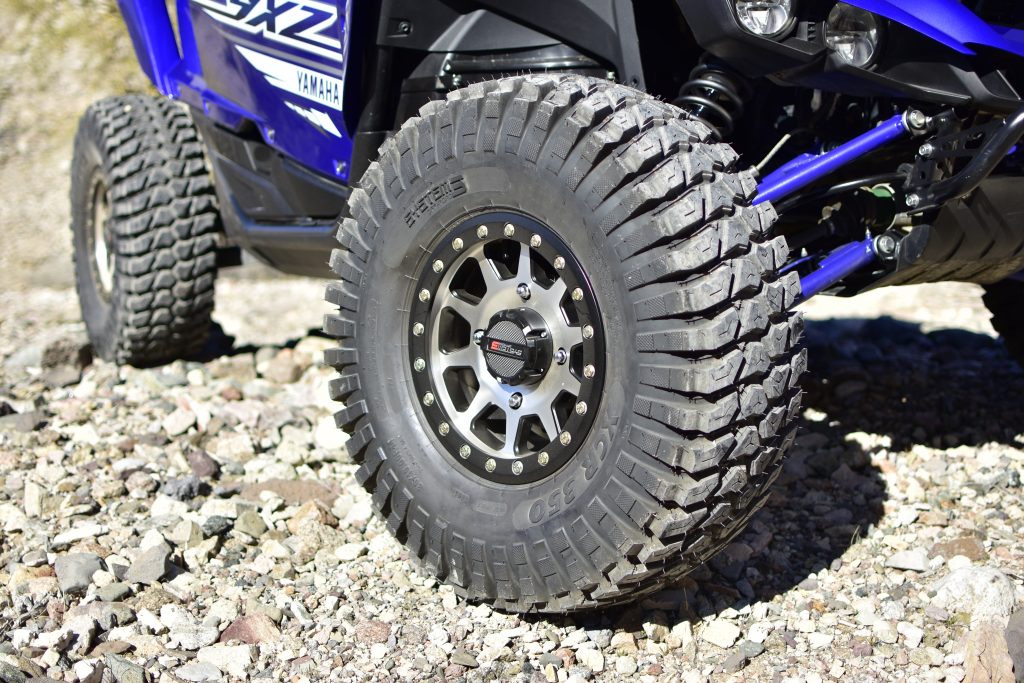
Our test tire was an 8-ply-rated 30x10R14 XCR350, with a claimed weight of 39.7 pounds per tire at the time of the review. System 3 describes the XCR350 as a flexible radial with a medium compound, stepped multi-angle tread and staggered shoulder blocks. We used black and machined SB-3 true beadlock wheels. These are the particular tires and wheels we evaluated; fitment, sizes and availability should be checked for your vehicle before ordering.

We installed the same-size tire at all four corners of the YXZ, replacing its staggered factory setup. That square arrangement gave us the option to rotate tires and carry one matching spare. On this specific 2019 YXZ and 2015 RZR XP 4, the wheel setup was interchangeable; verify bolt pattern, offset, lug hardware and clearance for any other application.


Ride comfort and steering response
Compared with the YXZ’s stock 29-inch Bighorns, the 30-inch XCR350s gave the car a taller, broader stance without a meaningful weight change that we noticed in the complete tire and wheel swap. Steering remained precise and gained a stronger on-center feel. We heard no noticeable increase in tire noise during this test.
We tried pressures from 18 down to 10 psi and preferred roughly 12–13 psi for ride comfort and sidewall flex on our test routes. That is a field observation, not a universal pressure recommendation; vehicle load, speed, terrain and wheel setup all matter. We saw no rubbing at full steering lock with the front suspension compressed on our YXZ. The larger contact patch also places more leverage on steering parts, so stronger tie rods are worth considering for this application.

Traction in desert washes and on hardpack
The clearest improvement came in the sand washes. The XCR350’s shoulder tread delivered strong side bite when the YXZ turned into a rut, while the center tread supplied enough forward traction to drive out of the corner. We enjoyed running the YXZ in two-wheel drive because its response was predictable, and our timed wash runs improved with this tire setup.
On hardpack and over square-edged bumps, the tires rolled smoothly without the carcass shake we have felt from some larger aftermarket tires. The RZR XP 4 showed the same general pattern: less abrupt wheelspin in soft corners, better forward drive and a more settled ride reported by passengers. Swapping the YXZ back to its original Bighorns after several days made the traction difference especially clear. We made only a short dune run and did not test the XCR350 in mud, so neither condition is a basis for a broader claim here.


Durability and verdict
After a few hundred miles in a little over a week, we found no punctures, tears or slow leaks. The tread still looked nearly new at the end of this short test. That is encouraging for rocky desert riding, though it is not a long-term tread-life result.
The XCR350 and SB-3 package sharpened the YXZ’s steering, boosted side bite and forward traction, and kept both test UTVs composed on rough terrain. For riders looking at an all-terrain radial and a true beadlock wheel, our 2019 experience makes this combination worth considering. The original review’s 2019 prices and catalog counts have been omitted because they do not describe current availability. Check System 3 Off-Road for current specifications and fitment.

For more context on the test vehicle, see our 2019 Yamaha YXZ1000R SS West Coast desert review. We also later used 35-inch XCR350 tires on a Rubicon Trail trip.


