


By Jon Crowley
Photos by Jon Crowley and Cody Hooper
Polaris introduced the RZR XP 1000 EPS FOX Edition for 2015 with a suspension package that appeared tailor-made for aggressive riding in the Southwest’s dunes and desert. Its defining upgrades included FOX PODIUM Internal Bypass shocks, revised dual-rate springs, the first front stabilizer bar fitted to a RZR and a softer rear stabilizer bar.
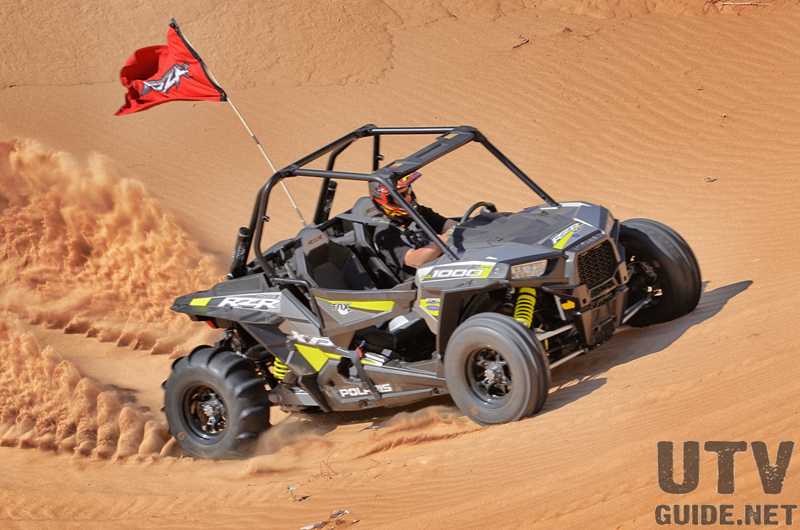
We picked up a demo unit from Placerville Polaris, briefly tested it on snow tracks and then installed GMZ sand tires before heading to Glamis. The Imperial Sand Dunes gave us exactly the terrain needed to see whether the specialized FOX Edition delivered more than a distinctive Turbo Silver finish.
What Made the RZR XP 1000 FOX Edition Different?
The FOX Edition retained the naturally aspirated engine and fundamental chassis of the standard Polaris RZR XP 1000, but Polaris concentrated its changes on suspension performance, chassis control and occupant restraint.
- FOX PODIUM Internal Bypass shocks
- 2.5-inch front shock bodies
- 3.0-inch rear shock bodies
- Revised dual-rate coil springs
- Front stabilizer bar
- Softer rear stabilizer bar
- Polaris Click-6 retractable six-point harnesses
- Turbo Silver bodywork
- Original U.S. MSRP of $22,999
The lighter progressive-rate upper springs were designed to absorb smaller impacts, while the stiffer main springs maintained ride height and handled harder hits. Combined with the massive rear shocks, the package offered exceptional bottoming resistance for a production UTV of its era.

From Snow Tracks to the Glamis Dunes
Before heading south, we installed a set of Camoplast tracks and took the FOX Edition into the snow at roughly 10,000 feet. It handled the oversized tracks surprisingly well, but snow was not the terrain we had planned for this RZR.
Three days later, we replaced the tracks with GMZ sand tires and headed to Glamis for the 2015 UTV Industry Ride.

Dune Performance
Dune carving is unlike almost any other type of UTV driving. There are no established trails or preset lines. High speeds, abrupt transitions, deep G-outs, whoops and jumps demand a suspension that remains compliant over chop without using all of its travel when the hits get big.
Bottoming through a hard G-out is one of my biggest complaints with an inadequately suspended UTV. You either slow dramatically at the bottom of every bowl or accept the unpleasant impact of the front suspension slamming through its travel or the rear skid plate hitting the sand.
FOX Internal Bypass Shocks
The RZR XP 1000 FOX Edition’s suspension put a big grin on my face. Its OEM FOX PODIUM Internal Bypass shocks used substantial 2.5-inch bodies in front and 3.0-inch bodies at the rear. For perspective, the Ford F-150 SVT Raptor of the period used 2.5-inch-body FOX shocks.
The internal-bypass design employed five progressively firmer damping zones based on shock position and shaft speed. The suspension felt plush across smaller chop, but as the shocks moved farther into their travel, the damping increased to slow the suspension rather than allowing it to blow through the stroke.
FOX also incorporated three rebound-damping zones to control pitching and harsh top-out. Proper rebound control is critical because the suspension must extend quickly enough after one impact to leave sufficient travel for the next, without extending so aggressively that it upsets the vehicle.

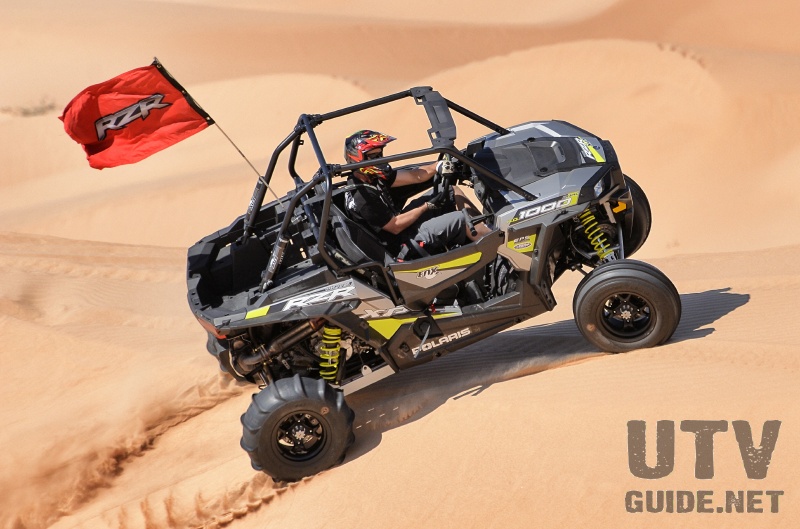
When pushed hard in the dunes, this was the best factory shock tuning I had experienced in a UTV at the time. We handed the keys to ATV racing legend Kory Ellis, and whether credit went to his technique, the suspension or a combination of both, the RZR landed the big hits exceptionally well.

Whoop Performance and Chassis Control
After carving dunes and jumping the RZR, we took it through the whoops. With one occupant and the shock settings unchanged from our dune testing, the FOX Edition performed reasonably well, although it exhibited more body movement than I wanted when the pace increased.
The rear suspension did not buck or threaten to swap ends, but I was not comfortable enough with the setup to hold it wide open through the largest whoops. The RZR felt slightly better when we repeated the test with two occupants.
Reducing the compression damping might have helped the suspension move more freely through the whoops, but that adjustment could also have reduced the bottoming resistance we valued in the G-outs. For our dune-focused testing, I was unwilling to make that tradeoff.
The revised stabilizer-bar package kept body roll under control, and the RZR remained predictable while cornering and running through rough sections. Some drivers prefer more roll and pitch because weight transfer can help the tires find traction in loose terrain. Those drivers may feel that a front stabilizer bar restricts the chassis. For my driving style, the FOX Edition felt better controlled than the standard XP 1000.

Polaris Click-6 Harnesses

The RZR XP 1000 FOX Edition also came standard with Polaris Click-6 harnesses. These unusual six-point restraints combined a single-click latch with adjustable lap and thigh straps. Retractors built into the shoulder straps provided considerably more freedom of movement than a conventional fixed harness.
I felt much more secure in the Click-6 harnesses than I did with the factory three-point automotive-style belts commonly used in UTVs at the time. They required some familiarization, and the sternum-strap mounts on the backs of the shoulder straps occasionally bothered me, but they were a worthwhile factory feature.
2015 RZR XP 1000 FOX Edition Review Verdict
Polaris and FOX hit this one out of the park. At the time of this test, the FOX Edition was the most capable and comfortable showroom-stock two-seat UTV I had driven in the dunes.
The factory Internal Bypass shocks lacked some of the tuning features offered by FOX’s aftermarket IBP shocks, but they were extremely capable. For a buyer seeking a two-seat UTV that could be driven hard in the dunes or desert immediately after leaving the dealership, the FOX Edition would have been at the top of my list.

My one suggestion for Polaris and FOX would have been an optional dune-specific valving package. A setup focused entirely on sand could have sacrificed some all-terrain versatility to provide even better control through high-speed transitions, G-outs and whoops.
The 2015 Polaris RZR XP 1000 EPS FOX Edition was offered in Turbo Silver with an original U.S. MSRP of $22,999. Although the model is now part of RZR history, its large internal-bypass shocks helped establish the increasingly sophisticated factory suspension packages found on later performance UTVs.
Related RZR XP 1000 Coverage
- Polaris RZR XP 1000 Review
- Polaris RZR XP 1000 Snow Track Test
- Polaris RZR XP 1000 Rock-Crawling Review
- History of the Polaris RZR


