


Could a pair of compact 60-inch UTVs compete against the larger, more powerful 1000cc machines at the 2015 King of the Hammers? That was the question when Dean Bulloch entered an Arctic Cat Wildcat Sport and I entered a Polaris RZR S 900 in one of the toughest UTV races in the country.

Polaris became the official side-by-side sponsor of the 2015 King of the Hammers and added a new Polaris RZR XP 1000 to the Pro UTV purse. Most competitors arrived with 1000cc race cars, but two experienced rock crawlers chose smaller and more nimble platforms.
Bulloch selected the new Arctic Cat Wildcat Sport, while I entered the new Polaris RZR S 900. Both machines measured 60 inches wide and were positioned between the traditional 50-inch trail UTVs and the wider high-performance models.
A 60-Inch Race Within the Race
Dean Bulloch had competed in motocross, trials, drag-bike racing, snowmobile racing, rock crawling and desert racing. His career included 169 victories and 21 championships across those disciplines. He had also competed in the main King of the Hammers race, finishing seventh in 2008 and 16th in 2010.
Bulloch owned D&P Performance in Cedar City, Utah, as well as Wildcat Willy’s, a fabrication and accessory company specializing in Arctic Cat Wildcats. Given those connections, the new 2015 Arctic Cat Wildcat Sport was a natural choice for his UTV race effort.

I had competed in every King of the Hammers UTV race since the inaugural event in 2009, either as a driver or co-driver. My best result had come in 2013, when Blake Van de Loo and I finished second in a Polaris RZR XP 900, just 16 seconds behind Mitch Guthrie Sr.
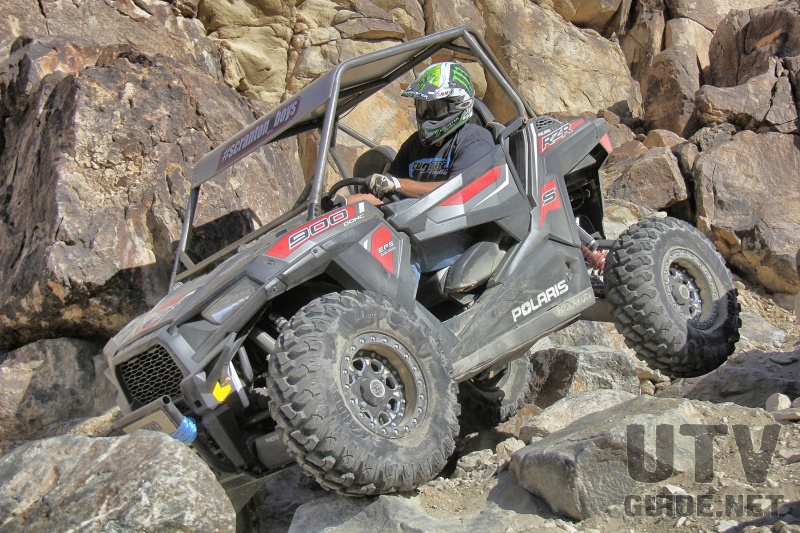
The RZR S 900 and Wildcat Sport were both introduced for the 2015 model year. Although they lacked the horsepower, wheelbase and suspension travel of machines such as the Polaris RZR XP 1000, their compact dimensions offered potential advantages in Johnson Valley’s narrow rock canyons.
“The RZR S 900 and Wildcat Sport are smaller, lighter and turn better than the XP 1000 and Wildcat,” I said before the race. “I truly believe that Dean and I will surprise the naysayers once we get to the rocks.”
Bulloch welcomed the matchup. “It will be very interesting to see how the big dogs do against us seasoned veterans in our smaller rigs,” he said. “I welcome the challenge and cannot wait to get the race underway.”
We also put a $100 side bet on the results. The money was secondary; the real prize was bragging rights between the two 60-inch machines.
Co-Drivers and Spotters
A capable co-driver is essential at King of the Hammers. The person in the passenger seat must navigate, operate the winch, move rocks, help with trail repairs and cover difficult ground on foot while remaining calm under pressure.
Karl Munford joined Bulloch in the Wildcat Sport. Dean and Karl had competed together since 1983, and Karl brought decades of rock-crawling experience to the team.
Tommy Scranton of IMG Motorsports joined me in the RZR S 900. Tommy had previously worked in the Pro Armor fabrication shop before moving to IMG Motorsports. He also raced a RZR in short-course competition and brought valuable fabrication, mechanical and racing experience.
Dean Bulloch’s Arctic Cat Wildcat Sport


Wildcat Sport build specifications:
- 2015 Arctic Cat Wildcat Sport Limited
- 2-inch Elka Stage 5 shocks
- Wildcat Willy’s cage and roof
- Maxxis 29x9R14 Bighorn tires
- Raceline beadlock wheels
- PRP seats, harnesses and tool bags
- Warn 3500 XLS winch
- Lowrance GPS
- Muzzys Performance exhaust
- Tire Balls
- SSS Off-Road skid plate and A-arm guards
- Arctic Cat LED lighting
- Stock engine, axles, clutch and A-arms
Jon Crowley’s Polaris RZR S 900
My RZR retained its stock engine, axles, clutch and suspension geometry. The build concentrated on safety, protection and durability rather than creating a dedicated long-travel race car. You can see the complete project in the Polaris RZR S 900 King of the Hammers build.


RZR S 900 build specifications:
- 2015 Polaris RZR S 900
- IMG Motorsports cage, roof and bumpers
- Pro Armor seats, harnesses, steering wheel and doors
- Rugged Radios helmet air, radio and intercom
- HCR Racing OEM-replacement A-arms
- FOX 2.5 shocks
- Lowrance Baja 540 GPS
- Diamond Wraps graphics
- Axia Alloys mirrors and fire-extinguisher mount
- HiPer Fusion beadlock wheels
- GMZ Kahuna 30x10R14 tires
- Tire Blocks run-flat system
- Factory UTV UHMW skid plate
- Vision X Solstice LED lights
- Polaris 4,500-pound winch
- Muzzys Performance exhaust
- Stock engine, axles and clutch
- Pit support from Jagged X Racing
2015 King of the Hammers Results
This section was added following the race.
The 60-inch machines delivered on their promise. Mitch Guthrie Sr. won the Pro UTV class in a Polaris RZR XP 1000 with a time of 6:20:22, but Bulloch and I completed the Pro UTV podium in machines that were smaller and less powerful than most of the field.

Bulloch finished second in the Pro UTV class with a time of 7:48:45. We reached Hammertown at 4:07 p.m. after spending 8 hours, 5 minutes and 30 seconds on course, earning third place in the Pro class.
Dean crossed the finish line 16 minutes and 45 seconds ahead of us, winning both the 60-inch matchup and our $100 side bet.

Chad Hughes finished fourth in the Pro class shortly before the cutoff, while Cody Currie was the only Sportsman-class finisher. Only five of the more than 50 starters completed the entire course within the allotted time.

What the 60-Inch UTVs Proved
The results demonstrated that horsepower and suspension travel were not the only factors at King of the Hammers. The larger RZR XP 1000 had a clear advantage across the high-speed desert, but the compact RZR S 900 and Wildcat Sport were maneuverable and effective in the rocks.
Bulloch’s second-place finish and our third-place result put two relatively stock 60-inch machines ahead of nearly the entire field. Merely completing this exceptionally difficult race was an accomplishment; putting both vehicles on the Pro UTV podium made the experiment a success.
Read the complete firsthand story in our 2015 King of the Hammers UTV race report. You can also explore the winners, results and major milestones from every era in our King of the Hammers UTV race history.
2015 Polaris RZR S 900

The 2015 RZR S 900 used a 75-horsepower ProStar 900 engine and measured 60 inches wide with a 79-inch wheelbase. It featured dual A-arm front and rear suspension with 12.25 inches of front travel, 13.2 inches of rear travel and 12.5 inches of ground clearance.
Its short wheelbase, quick steering and rear A-arm suspension made it especially maneuverable in technical terrain. For more driving impressions, see our Polaris RZR S 900 review and RZR S 900 rock-crawling review.
2015 Arctic Cat Wildcat Sport

The Wildcat Sport measured 60 inches wide and used Arctic Cat’s liquid-cooled 700cc parallel-twin engine. The engine delivered more than 60 horsepower through TEAM Rapid Response clutches, with selectable two- and four-wheel drive plus a locking front differential.
The Wildcat Sport shared its basic platform with the 50-inch Wildcat Trail but added width, suspension capability and stability. Bulloch’s performance at King of the Hammers showed how capable the new platform could be when properly prepared and driven.
More King of the Hammers Coverage
- 2015 King of the Hammers pre-run
- 2015 King of the Hammers UTV race report
- 2014 King of the Hammers UTV race
- 2013 King of the Hammers UTV race
- 2012 King of the Hammers UTV race
- 2011 King of the Hammers UTV race
- 2010 King of the Hammers UTV race
- 2009 King of the Hammers UTV race


