


By Jon Crowley
The 2008 Kawasaki Teryx established Kawasaki as a serious player in the emerging recreational UTV market. Its 749cc V-twin delivered strong torque, the chassis worked well on trails, and the cargo bed made it more versatile than a pure sport machine. However, the original carbureted engine was an obvious weakness—especially for riders dealing with elevation and temperature changes.
Kawasaki addressed that complaint only one model year later. The 2009 Kawasaki Teryx 750 FI received digital fuel injection, revised CVT calibration, drivetrain upgrades, a fuel gauge and numerous durability improvements. The Teryx 750 FI 4×4 Sport added fully adjustable Kayaba reservoir shocks and lighter aluminum wheels.
After owning and modifying a 2008 Kawasaki Teryx project vehicle, I had a useful reference point when I drove the new 2009 Teryx Sport. I had also recently spent three days in a stock 2008 model during a Kawasaki Teryx trip to the Grand Canyon.
The changes did not turn the 2009 model into an entirely different UTV, but they corrected several shortcomings and made the original Teryx platform noticeably more polished.
Kawasaki introduced the updated machine at the Boulders OHV Area near Lake Pleasant, Arizona, where the rocky desert terrain provided a useful test of its revised power delivery and Sport suspension.

The Teryx Finally Gets Fuel Injection
Digital fuel injection was easily the most important improvement for 2009.
The 749cc liquid-cooled V-twin retained the basic character that made the original Teryx enjoyable: strong low- and midrange torque with smooth, continuous power. The difference was in how consistently that power was delivered.
The fuel-injected engine started immediately and settled into a smooth idle. Throttle response felt crisper than it did in the carbureted 2008 model, and the 2009 Teryx appeared to reach its top speed a little more quickly.
It was not a dramatic horsepower increase. Instead, EFI made the engine easier and more predictable to use. That mattered during cold starts, changing temperatures and rides involving substantial elevation changes. Riders no longer needed to accept the compromises associated with carburetor jetting.
Kawasaki’s 32-bit electronic control unit monitored coolant temperature, intake-air temperature, throttle position, intake pressure, vehicle speed and crankshaft position. Fuel was delivered through two 34mm throttle bodies, allowing the system to compensate automatically for changing conditions.
In practical terms, the 2009 Teryx ran more cleanly and consistently than the first-year machine.

Revised Engine and CVT Calibration
Kawasaki did more than install fuel injection on the existing engine.
Changes to the intake ports, ignition timing and Teryx-specific throttle bodies were intended to improve low- and midrange torque. The CVT was also recalibrated for harder acceleration, giving the Teryx a more direct response when the throttle was applied.
A revised belt-protection system incorporated throttle-position data. If engine speed climbed above approximately 2,800 rpm while the wheels were no longer moving, the system could limit power and flash the belt warning light. This helped protect the CVT belt when the vehicle became stuck or encountered an obstacle that stopped wheel movement.
Kawasaki also made several changes intended to improve CVT cooling and resistance to water entry:
- The CVT exhaust opening was raised 7.7 inches compared with the 2008 design.
- The intake duct diameter increased from 53mm to 65mm.
- Heat shielding was added around the exhaust pipe below the intake duct.
- A new aluminum CVT cover helped dissipate heat.
- Revised intake and exhaust ducting improved airflow through the system.
These were meaningful changes for owners who used the Teryx in mud, water, sand or other conditions that placed additional heat and load on the drive belt.


2009 Teryx Sport Suspension Review
The Teryx 750 FI 4×4 Sport received a substantial suspension upgrade over the standard model.
Its aluminum-bodied Kayaba gas shocks used piggyback reservoirs at all four corners. The shocks offered stepless spring-preload adjustment along with adjustable rebound and both high- and low-speed compression damping. Wheel travel remained 7.5 inches at both ends.
That travel figure sounds modest compared with modern sport UTVs, but suspension travel alone does not tell the full story. The Sport shocks provided better damping control and greater resistance to fade than the standard Teryx shocks.
During the test, the suspension felt smoother through light chop and more controlled when the terrain became rough. In whoops, the Sport model inspired more confidence and resisted using all its travel as quickly as a standard Teryx.
I was still able to bottom the front suspension in a few hard G-outs. This was not a long-travel sport UTV, and aggressive drivers could find its limits. However, the impact was less frequent and better controlled than it would have been with the standard shocks.
We did not have enough time to experiment extensively with the damping adjustments. Even using the supplied settings, the Sport suspension was a worthwhile improvement.
Kawasaki also revised the stabilizer bar for 2009 to improve tracking through rough terrain.

Lighter Aluminum Wheels
The Sport model came with cast-aluminum wheels instead of the standard Teryx’s steel wheels. Kawasaki claimed each aluminum wheel was approximately 2.2 pounds lighter while also being stronger than its steel counterpart.
Reducing unsprung weight helps the suspension react more effectively to the terrain and requires less energy to accelerate the wheel-and-tire assembly. The difference was not transformative by itself, but it complemented the Sport model’s upgraded shocks and gave the machine a more finished appearance.

Stronger Drivetrain and Improved Braking
Kawasaki strengthened several drivetrain components to support the revised power delivery:
- CV joints were upgraded.
- Axle and driveshaft diameters were increased.
- Splined areas were hardened.
- U-joints were strengthened.
- More durable plastic CV boots were fitted.
- The 2WD/4WD selection system received a new electronic and vacuum-operated mechanism.
The sealed rear-brake system also gained an additional disc for increased braking capability. The enclosed wet brake was well protected from mud and debris, but the parking brake remained a concern.
It was too easy to drive away with the parking brake engaged. A “P” appeared on the digital display, but it was not especially noticeable. An audible warning or an electronic safeguard would have offered better protection against overheating and damaging the sealed rear brake.
A Fuel Gauge Was a Bigger Upgrade Than It Sounds
All 2009 Teryx models received a multifunction digital meter with a fuel-level display.
A fuel gauge may not sound exciting, but it was a valuable addition for long-distance trail rides. The original machine required the driver to estimate the remaining range. The 2009 display removed much of that uncertainty.
Fuel capacity decreased slightly from 7.9 to 7.4 gallons because the tank now had to accommodate the high-pressure fuel pump and fuel-level sending unit.

Tilting Cargo Bed Preserved the Teryx’s Utility
All Teryx models received a gas-assisted tilting cargo bed for 2009. With a 500-pound bed capacity and a 1,300-pound towing capacity, the Teryx retained considerably more utility than most sport-oriented UTVs of the period.
This blend of recreation and utility became a defining characteristic of the original Teryx. It could be driven aggressively on the trail, but it could also carry camping equipment, tools or supplies in a usable cargo box.

Reduced Intake Noise and Cabin Heat
A larger airbox and revised intake ducting reduced noise near the occupants’ heads. Kawasaki lengthened the intake duct and increased overall airbox volume while changing the shape and size of the inlet.
The rear mudguards were also revised to reduce the amount of water and mud reaching the electronics and fuel-tank area beneath the seats.
These details were not as obvious as EFI or adjustable shocks, but collectively they made the 2009 Teryx feel more refined than the first-year machine.
The Hood Was Still a Major Frustration
My largest complaint about the 2009 Teryx Sport was its one-piece hood.
The front roll cage passed through openings in the hood, preventing the hood from being removed without first dealing with the cage structure. That made access to components beneath the hood far more difficult than it should have been.
Fortunately, Kawasaki recognized the problem. The redesigned 2010 Kawasaki Teryx received a hinged, forward-tilting hood that significantly improved service access.
Lime Green Sport Styling
The Lime Green bodywork made the Sport model immediately recognizable as a Kawasaki. It was brighter and more distinctive than the muted green offered on the original Teryx and looked especially appropriate in an environment such as the Glamis dunes.
Kawasaki also offered a black Monster Energy edition for buyers who wanted more aggressive graphics.
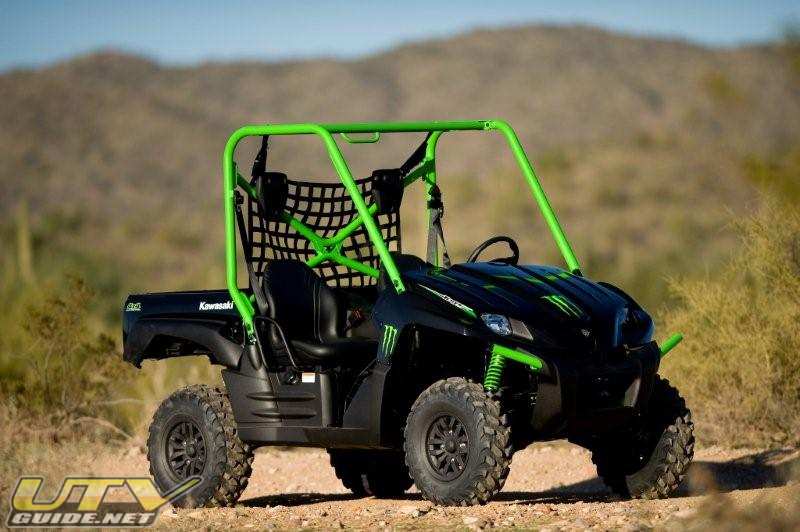
2009 Kawasaki Teryx 750 FI Sport Specifications
| Specification | 2009 Teryx 750 FI Sport |
|---|---|
| Engine | 749cc liquid-cooled 90-degree V-twin |
| Fuel system | Digital fuel injection with dual 34mm throttle bodies |
| Transmission | Automatic CVT with High, Low, Neutral and Reverse |
| Drive system | Selectable 2WD/4WD with locking front differential |
| Front suspension | Double A-arm with adjustable Kayaba reservoir shocks |
| Rear suspension | Double A-arm with adjustable Kayaba reservoir shocks |
| Wheel travel | 7.5 inches front and rear |
| Tires | 26-inch Maxxis |
| Cargo-bed capacity | 500 pounds |
| Towing capacity | 1,300 pounds |
| Fuel capacity | 7.4 gallons |
| Wheels | Cast aluminum |
| Original MSRP | $11,899 |
What the 2009 Teryx Sport Did Well
- Fuel injection improved starting and throttle consistency.
- The V-twin produced smooth, usable torque.
- Adjustable reservoir shocks improved rough-terrain control.
- Aluminum wheels reduced unsprung weight.
- Revised CVT cooling and belt protection improved durability.
- The fuel gauge made long-distance rides easier to manage.
- The cargo bed and towing capacity preserved real utility.
What Could Have Been Better
- The front suspension could still bottom in hard G-outs.
- The one-piece hood made service access unnecessarily difficult.
- The parking-brake warning was too easy to overlook.
- Overall suspension travel was limited compared with emerging sport UTVs.
- EFI improved power delivery but did not provide a dramatic increase in output.
Final Verdict
The 2009 Kawasaki Teryx 750 FI Sport was the machine the original Teryx should have been.
Fuel injection eliminated the most obvious weakness of the carbureted 2008 model, while the Sport package’s adjustable Kayaba shocks and aluminum wheels improved its performance in rough terrain. Revised CVT cooling, stronger drivetrain components, a fuel gauge and a standard tilting bed made it more durable and easier to live with.
The 2009 model was still best understood as a recreation-utility UTV rather than a pure sport machine. Its suspension limits became apparent in deep whoops and hard G-outs, but its combination of V-twin torque, trail capability, cargo capacity and durability made it an effective all-around vehicle.
More importantly, 2009 represented a key step in the evolution of the Kawasaki Teryx. It established the fuel-injected V-twin formula Kawasaki would continue refining through subsequent Teryx and Teryx4 models.
Frequently Asked Questions
Is the 2009 Kawasaki Teryx fuel injected?
Yes. Kawasaki introduced digital fuel injection across the Teryx lineup for 2009. The system used dual 34mm throttle bodies and automatically compensated for temperature and elevation changes.
What engine is in the 2009 Kawasaki Teryx 750?
It uses a 749cc liquid-cooled 90-degree V-twin engine paired with an automatic CVT.
What makes the 2009 Teryx Sport different from the standard model?
The Sport model received fully adjustable Kayaba piggyback-reservoir shocks, cast-aluminum wheels and sport-oriented colors and graphics.
How much suspension travel does the 2009 Teryx Sport have?
It provides 7.5 inches of wheel travel at the front and rear.
How much can a 2009 Kawasaki Teryx tow?
Kawasaki rated the 2009 Teryx to tow up to 1,300 pounds. Its tilting cargo bed was rated to carry 500 pounds.
Is the 2009 Kawasaki Teryx still a good used UTV?
A well-maintained example can still be a capable trail and recreation machine. Buyers should inspect the CVT, parking-brake system, air intake, wheel bearings, suspension components and cooling system carefully. Maintenance history and previous modifications matter more than mileage alone on a UTV of this age.


