


The Kawasaki MULE 4010 Trans4x4 is a traditional work-focused utility vehicle with one unusually versatile feature: its Trans Cab system converts it from a four-passenger crew machine with a short cargo bed into a two-passenger UTV with a much larger bed. The conversion requires no tools, allowing the same vehicle to move a crew in the morning and haul up to 800 pounds of material later in the day.
The 4010 is not intended to compete with fast recreational side-by-sides. Its governed 25-mph top speed, modest suspension travel and sealed drum brakes reflect a platform designed around controlled operation, durability and low-speed utility work. That makes it particularly well suited to farms, ranches, commercial properties, parks and job sites where carrying people and equipment matters more than covering rough trails quickly.
Although its basic architecture has been around for many years, Kawasaki continues to offer the MULE 4010 Trans4x4. Its longevity also gives it an important place in the history of the Kawasaki MULE: the convertible-cab concept introduced on the earlier MULE 3010 Trans4x4 eventually developed into the Trans Cab systems used throughout Kawasaki’s modern multipassenger MULE range.
What Is the Kawasaki MULE 4010 Trans4x4?
The MULE 4010 Trans4x4 is a full-size utility side-by-side powered by a 617cc liquid-cooled V-twin engine. It comes with digital fuel injection, a continuously variable transmission, high and low range, selectable two-wheel drive and four-wheel drive, a dual-mode rear differential and electric power steering.
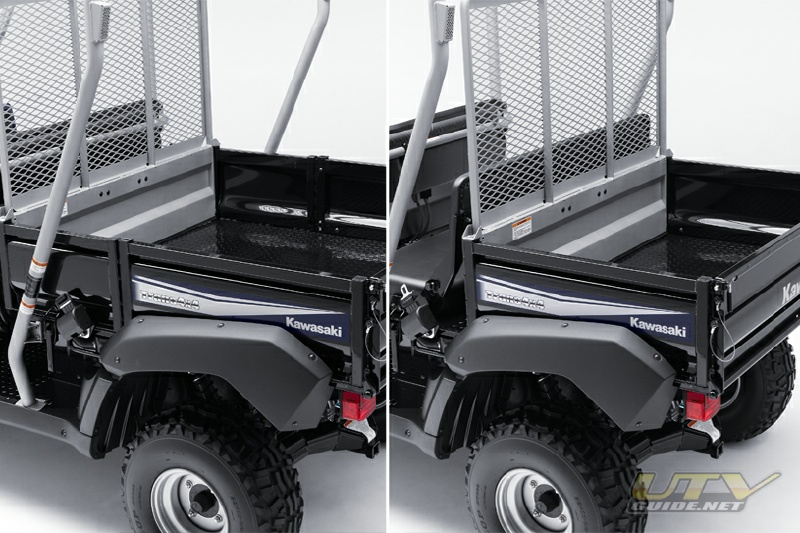
Its defining feature is the ability to change the balance between passenger room and cargo space. In four-passenger mode, the 4010 provides front and rear bench seating with a 30.3-inch-long cargo bed rated for 400 pounds. In two-passenger mode, the rear seat folds forward and the bed expands into the former rear-passenger area. The resulting 50.4-inch-long bed is rated for 800 pounds.
How the Trans Cab System Works
Converting the MULE 4010 does not require removing a separate rear-seat assembly or storing loose parts. The operator folds the rear seat and moves the cargo-bed partition forward to create the extended bed. Reversing the process restores the second row.

This flexibility is useful when a vehicle’s daily assignment changes. A property manager can carry four people to a work area, then switch to the longer bed for tools, landscaping material or debris. Hunters can use the second row to reach camp and expand the bed when additional cargo room becomes the priority.
There is a tradeoff: the MULE carries a maximum of four people, while newer full-size models such as the MULE PRO-FXT can accommodate as many as six. However, the 4010 is only 130.1 inches long and has an 85.2-inch wheelbase, making it considerably more compact than many permanent crew-cab utility UTVs.
617cc V-Twin Engine and CVT
The 4010 uses Kawasaki’s 617cc, four-stroke, liquid-cooled, overhead-valve V-twin. Digital fuel injection supports consistent starting and predictable throttle response, while the electronic control unit limits engine speed. Power reaches the wheels through a belt-type continuously variable transmission with high range, low range, neutral and reverse.
This is a low-speed work powertrain, not a performance engine. The MULE’s 25-mph governed top speed helps define its intended use around acreage, facilities and work sites. Low range is the better choice for heavier loads, steep grades and slow work, while high range handles lighter transportation duties.
The cab-frame air-intake system draws engine and converter cooling air from higher on the vehicle, where it is less exposed to dust than an intake mounted near wheel level. An air-filter restriction gauge helps the operator determine when service is required.
Cargo-Bed and Towing Capacity
The steel cargo bed is the center of the 4010’s working capability. Capacity depends on the seating configuration:
- Two-passenger mode: 50.4 x 47.7 x 11.3-inch bed, 15.7 cubic feet of volume and an 800-pound capacity
- Four-passenger mode: 30.3 x 47.7 x 11.3-inch bed, 9.4 cubic feet of volume and a 400-pound capacity
- Towing capacity: Up to 1,200 pounds when properly equipped

The tailgate uses latches on both sides, while the tilting bed makes unloading bulk material easier. Storage beneath the front hood adds a protected space for smaller supplies, and D-rings help secure items. Winch-ready mounting tabs are positioned behind the front grille for owners who need additional recovery or work capability.
Selectable 4WD and Dual-Mode Rear Differential
The MULE 4010 Trans4x4 lets the operator select two-wheel drive or four-wheel drive. Two-wheel drive is appropriate for firm, level surfaces, while four-wheel drive adds traction in mud, snow, loose soil and on steeper terrain.
The dual-mode rear differential provides another useful choice. Locking the differential makes both rear wheels drive together for maximum traction. Unlocking it allows the rear wheels to turn at different speeds, which improves maneuverability and reduces tire scuffing on lawns and other finished surfaces.

Speed-sensitive electric power steering reduces effort during low-speed maneuvering and when the vehicle is loaded. That is particularly valuable around barns, trailers, equipment yards and other confined work areas.
Suspension, Brakes and Work-Focused Ride
The chassis is built more like a traditional utility vehicle than a modern recreational UTV. Up front, MacPherson struts provide 3.9 inches of wheel travel. The rear uses a semi-independent DeDion axle with leaf springs, shocks and 2.8 inches of travel. Four sealed hydraulic drum brakes provide stopping power.
This combination prioritizes load support and simple, protected components. It is appropriate for controlled speeds on graded roads, fields and work sites, but the limited suspension travel and 7.1 inches of ground clearance are meaningful constraints on deeply rutted or rocky terrain. Drivers accustomed to modern independent-suspension UTVs should expect a firmer, more deliberate ride.

Who Is the MULE 4010 Trans4x4 For?
The MULE 4010 makes the most sense for an owner who needs a practical tool rather than a recreational machine. Its strongest use cases include:
- Farms and ranches that alternate between moving workers and hauling feed, fencing supplies or tools
- Commercial properties, campuses, parks and maintenance departments
- Landowners who want selectable 4WD without the size and cost of a larger crew UTV
- Operators who value a governed top speed and predictable low-speed behavior
- Buyers who prefer a mature, long-running platform over the latest performance features
A specialized example can be seen in the Barnwell County MULE 4010 emergency-response vehicle, which demonstrates how the platform can be adapted for duties far beyond basic cargo hauling.
It is a less natural choice for riders who regularly encounter fast, rough trails; need more than four seats; want substantial ground clearance; or expect automotive-style comfort. Those buyers should look more closely at Kawasaki’s MULE PRO family.
MULE 4010 Trans4x4 vs. MULE PRO-FXT
The MULE 4010 and MULE PRO-FXT share the same basic idea: change the vehicle between a passenger-focused configuration and a cargo-focused configuration. Their execution, size and performance are substantially different.
| Feature | MULE 4010 Trans4x4 | MULE PRO-FXT |
|---|---|---|
| Passenger capacity | 2 or 4 | 3 or 6 |
| Engine character | 617cc V-twin; low-speed utility | Larger, more powerful engine; broader work and recreation capability |
| Rear suspension | DeDion axle with leaf springs | Independent suspension |
| Maximum bed capacity | 800 lb. | Up to 1,000 lb., depending on model and configuration |
| Best fit | Compact, controlled low-speed work | Heavier work, larger crews and more demanding terrain |
The 4010’s appeal is its simpler, more compact work-first format. The PRO-FXT offers more passenger room, power, suspension capability and comfort, but it is also a larger and more complex vehicle. For a closer look at the current choices, see the 2026 Kawasaki MULE lineup.
Kawasaki MULE 4010 Trans4x4 Specifications
The following specifications reflect the current MULE 4010 Trans4x4 unless otherwise noted. Kawasaki may revise specifications, equipment, colors and pricing by model year.
| Engine | Four-stroke, liquid-cooled, OHV 90-degree V-twin |
|---|---|
| Displacement | 617cc |
| Bore x stroke | 76 x 68mm |
| Compression ratio | 10.3:1 |
| Fuel system | Digital fuel injection |
| Transmission | Continuously variable transmission with high and low range, neutral and reverse |
| Final drive | Shaft; selectable 2WD/4WD with dual-mode locking rear differential |
| Top speed | 25 mph, governed |
| Front suspension / travel | Independent MacPherson strut / 3.9 in. |
| Rear suspension / travel | Semi-independent DeDion axle with leaf springs and shocks / 2.8 in. |
| Steering | Speed-sensitive electric power-assisted rack-and-pinion |
| Brakes | Four-wheel hydraulic sealed drum brakes |
| Front tires | 23 x 11-10 |
| Rear tires | 23 x 11-10 |
| Overall length | 130.1 in. |
| Overall width | 58.5 in. |
| Overall height | 75.8 in. |
| Wheelbase | 85.2 in. |
| Ground clearance | 7.1 in. |
| Curb weight | 1,587.6 lb. |
| Fuel capacity | 6.2 gal. |
| Turning radius | 12.8 ft. |
| Seating capacity | 2 or 4 |
| Bed size, 2-passenger mode | 50.4 x 47.7 x 11.3 in.; 15.7 cu. ft. |
| Bed size, 4-passenger mode | 30.3 x 47.7 x 11.3 in.; 9.4 cu. ft. |
| Bed capacity | 800 lb. in 2-passenger mode; 400 lb. in 4-passenger mode |
| Load capacity | 1,330 lb. |
| Towing capacity | 1,200 lb. |
| Warranty | Three-year limited factory warranty |
Kawasaki MULE 4010 Trans4x4 FAQ
How many people does a Kawasaki MULE 4010 Trans4x4 seat?
It seats four people when configured with two bench seats. The Trans Cab can be converted to a two-passenger layout when more cargo-bed space is needed.
How much weight can the MULE 4010 carry in its bed?
The bed is rated for 800 pounds in two-passenger mode and 400 pounds in four-passenger mode.
How much can a Kawasaki MULE 4010 Trans4x4 tow?
Its rated towing capacity is 1,200 pounds when the vehicle is properly equipped. Always account for passengers, cargo, tongue weight, terrain and the limits stated in the owner’s manual.
How fast does the MULE 4010 Trans4x4 go?
The MULE 4010 has a governed top speed of 25 mph. It is designed for controlled utility work rather than high-speed trail riding.
Does the MULE 4010 Trans4x4 have four-wheel drive?
Yes. The operator can select two-wheel drive or four-wheel drive and can independently lock or unlock the dual-mode rear differential.
Is the Kawasaki MULE 4010 still made?
Yes. Kawasaki continues to sell the MULE 4010 Trans4x4 as part of its current utility side-by-side lineup.
What is the difference between the MULE 4010 and MULE PRO-FXT?
The 4010 is a more compact, lower-speed machine that seats two or four and uses a traditional work-focused chassis. The MULE PRO-FXT seats three or six and offers more power, independent suspension, greater comfort and higher cargo capacity.
Final Assessment
The Kawasaki MULE 4010 Trans4x4 has survived in a market filled with faster and more sophisticated UTVs because its purpose remains clear. It is a compact work vehicle that can quickly trade rear seating for a genuinely useful cargo bed.
Its 25-mph limit, short suspension travel and old-school chassis will rule it out for buyers seeking recreational performance. For farms, ranches and commercial properties that need four-wheel drive, convertible seating, 1,200-pound towing capacity and straightforward utility, however, the MULE 4010 continues to offer a combination few current UTVs directly match.


