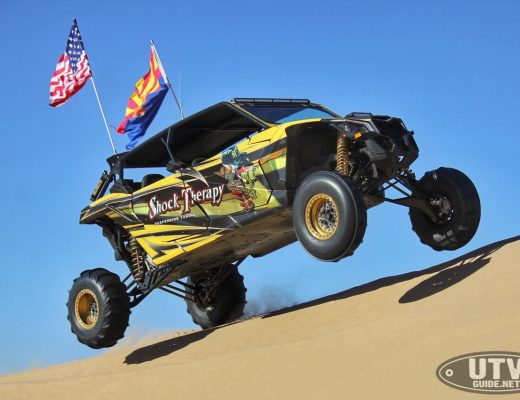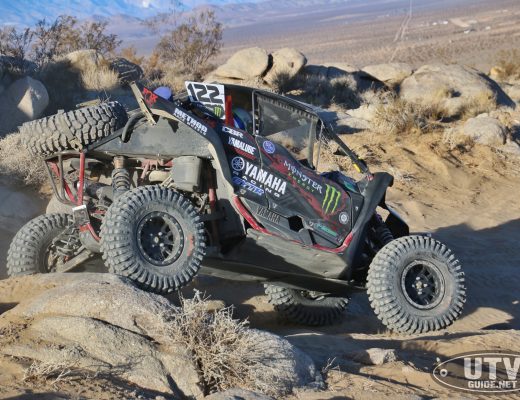
After 1,500 hard offroad miles, how is our YXZ build holding up?
By Cody Hooper
Historically, our vehicle builds happen fairly quickly. A new unit hits the showroom, we snag one up, and our incredibly talented aftermarket partners help us fine-tune the UTV to its maximum potential. We put some hard miles on the cars, but typically they are gone and replaced by the following year, when another new build is slated to begin.
We chose to do this one a little differently. This 2016 Yamaha YXZ1000R is very special to us, in part because it was sold to us by the late Art Wood before his passing. Art was a huge part of our UTV industry, and is fondly remembered by many for his friendly demeanor and constant willingness to help.
This YXZ was purchased at a time when factory loan units were not available, and over the last year and a half, has been modified into our fantasy play and chase car. It’s a go-anywhere, do-anything type build that we have put over 1,500 hard testing miles on to bring you the ultimate test- how do these high dollar builds hold up in the hands of the general public?
We kicked the build off with the help of SDR Motorsports. With only 80 miles on the odometer, Tim Berendes and his crew of talented fabricators tore the YXZ down to its bare frame, laying out a myriad of wiring and technical goodies to help us out on the trail. Here’s how it all went down.
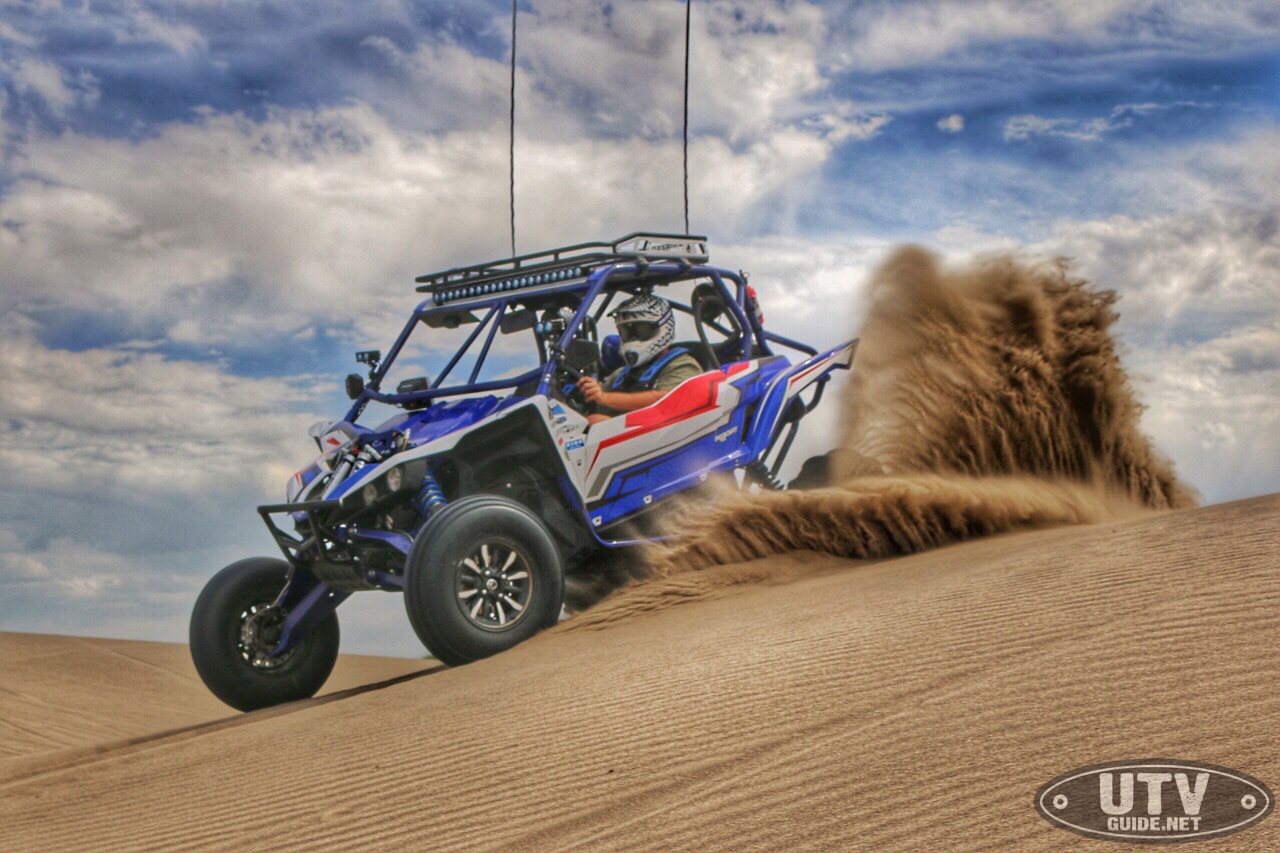
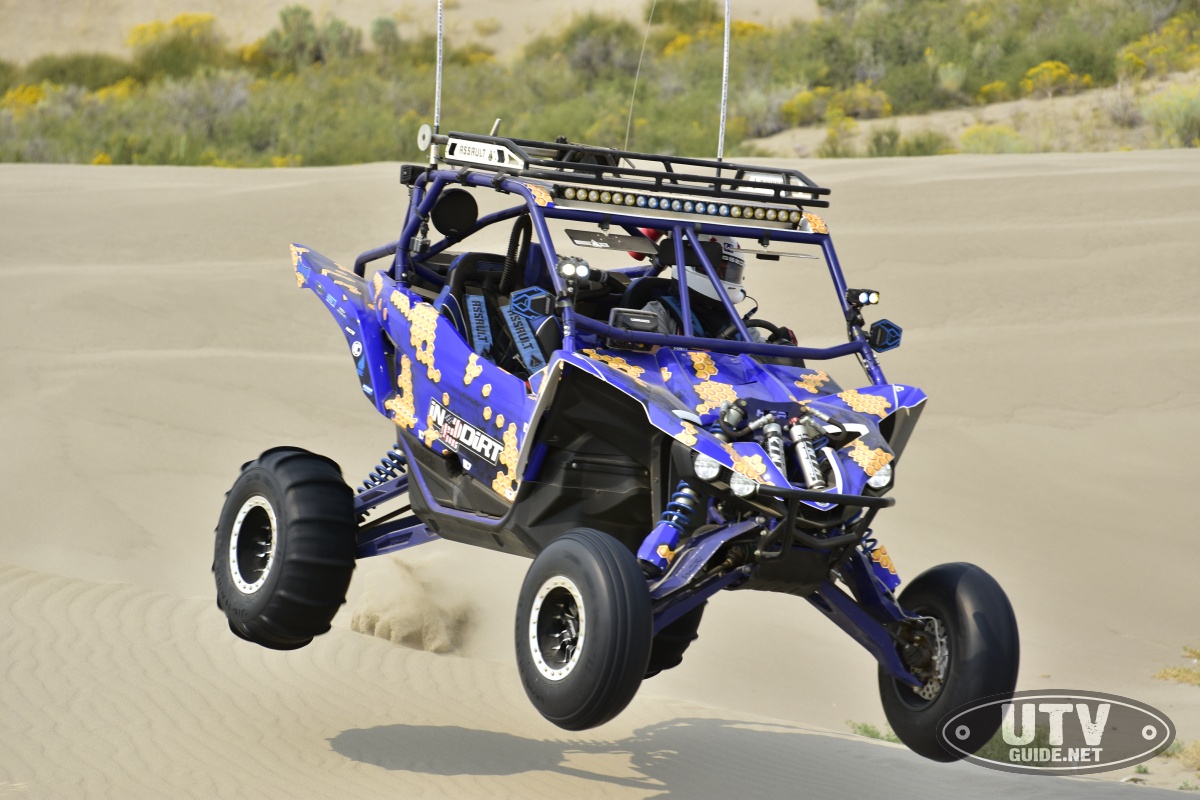
Yamaha YXZ1000R in the Dunes
HARD PARTS
SDR Motorsports of Corona, California performed the flawless cage work on the car. This was one of their very first YXZ cages, and it includes 1.75” main DOM tubing with an integrated rear bumper, a full aluminum roof with light bar pocket, and a 1.5” DOM V-shaped intrusion bar in the windshield area of the cage for strength. SDR’s cages are all welded in-house on precision jigs for the best fitment possible.
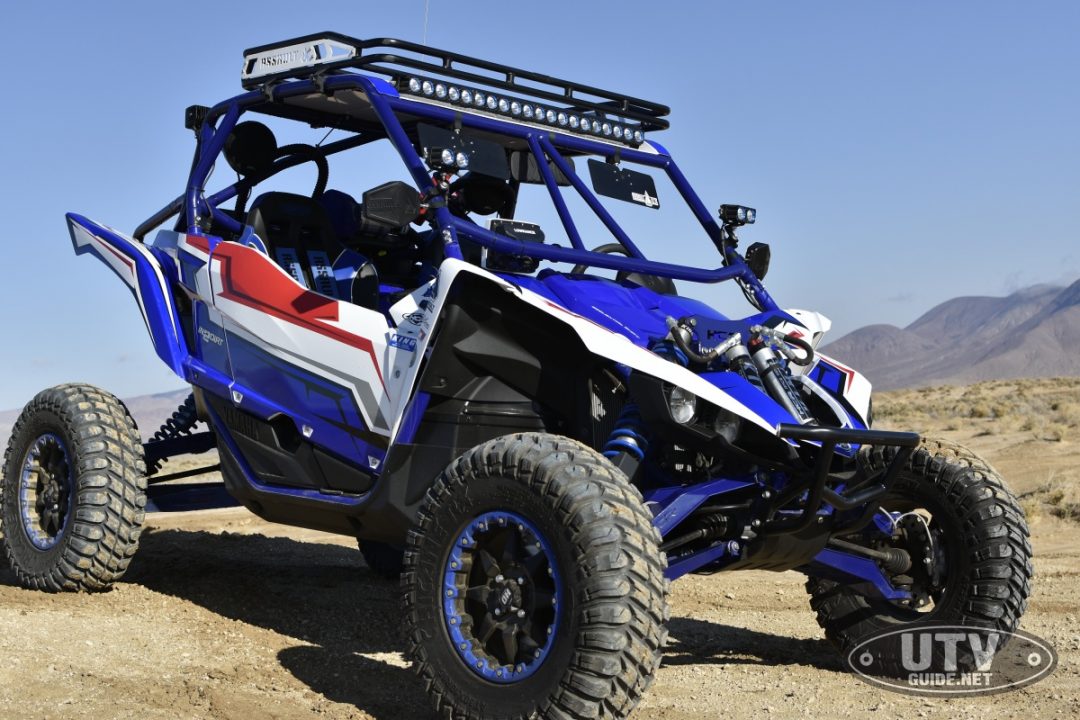
SDR Motorsports also installed HCR’s beautiful Dual-Sport long travel kit. These fully plated slot and tab honeycomb boxed arms are incredibly strong, made to withstand the abuse of hard off-road driving in any condition. We had the cage and arms powdercoated the factory Yamaha blue color for a stealth, cohesive look.
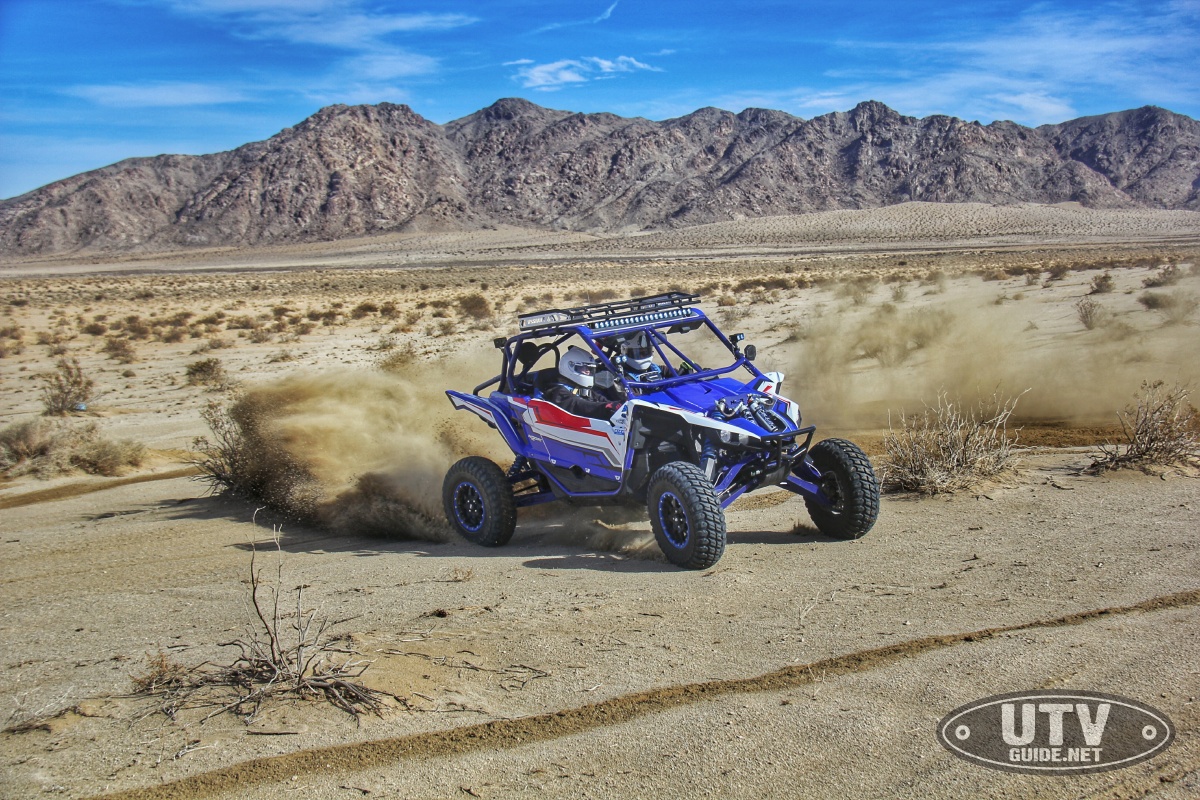
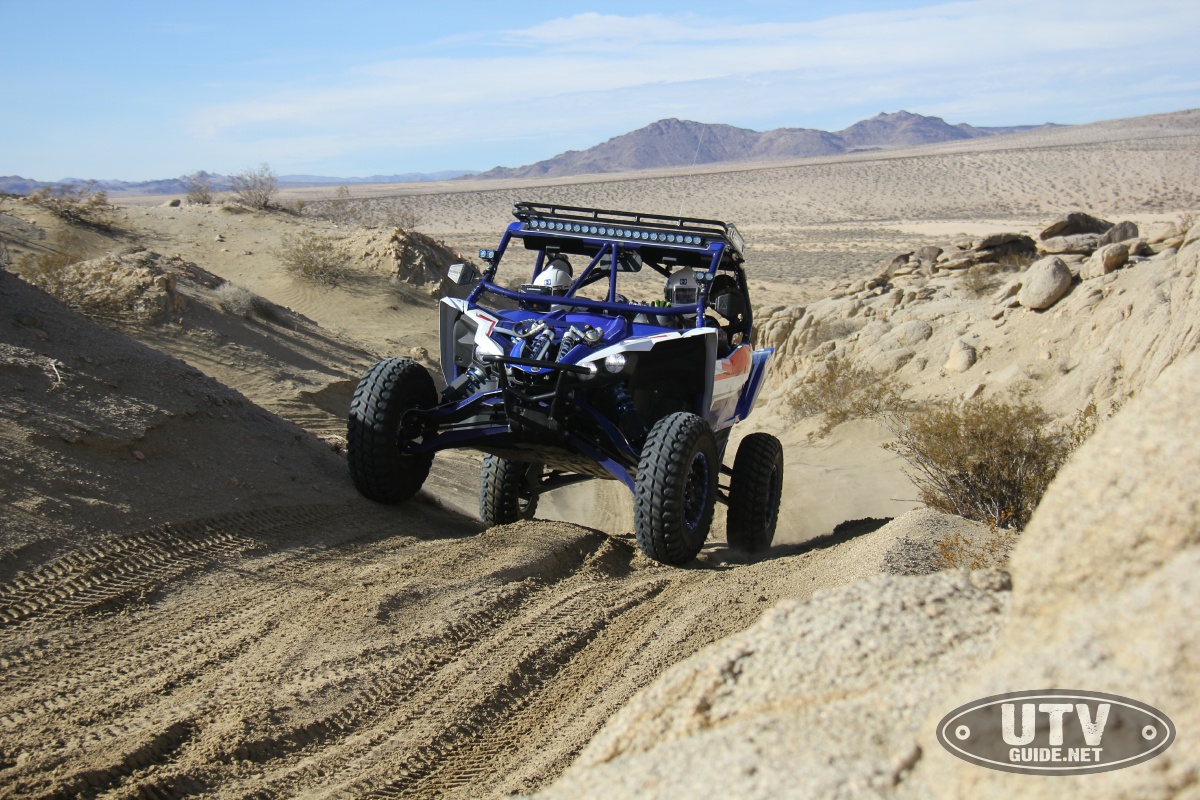
HCR’s Dual-Sport kit uses precision, computer-cut steel to form their arms, and every external weld secures a brace inside the arm. These aren’t just cheap shelled-out box arms, these are real, engineered pieces built to hold up in the long run. The gorgeous +4 kit stretches the YXZ’s width to 72 inches, adding quite a bit of stability when turning. King IBP shocks are the perfect pairing for this kit, offering an ultra-plush ride with great bottoming resistance for deep holes and hard G-outs.
The long travel kit comes with an aftermarket front shock tower to decrease the leverage angle on the shocks, correcting the front end geometry and adding a sinister look. HCR also offers a 3 month custom tuning opportunity where the customer can meet with King and have the shocks fine-tuned to their liking. How’s that for customer service?
The HCR kit comes with tie rod extenders that thread into the stock tie rod end, but new, longer axle shafts are required. We used HCR’s 300M axles with the stock CV joints, and have yet to have a failure in over 1,500 hard miles.
Once the long travel kit was bolted up, SDR began laying the wiring for all of the accessories. We stuffed a host of electronics equipment into this YXZ to make life on the trail and in the dunes more comfortable. SDR is a full vehicle build shop- they can churn out turn-key builds with any number of custom options with great attention to detail and craftsmanship.
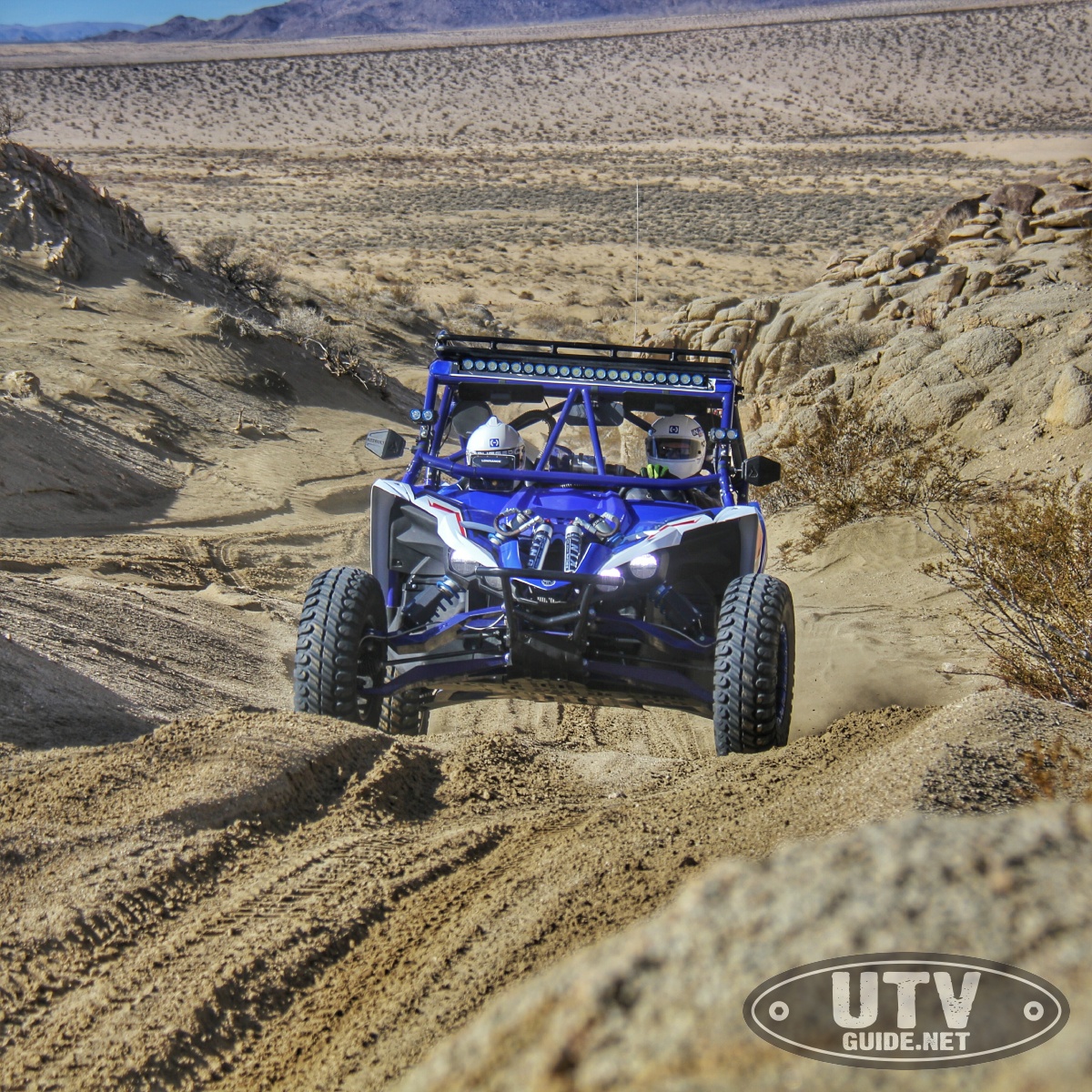
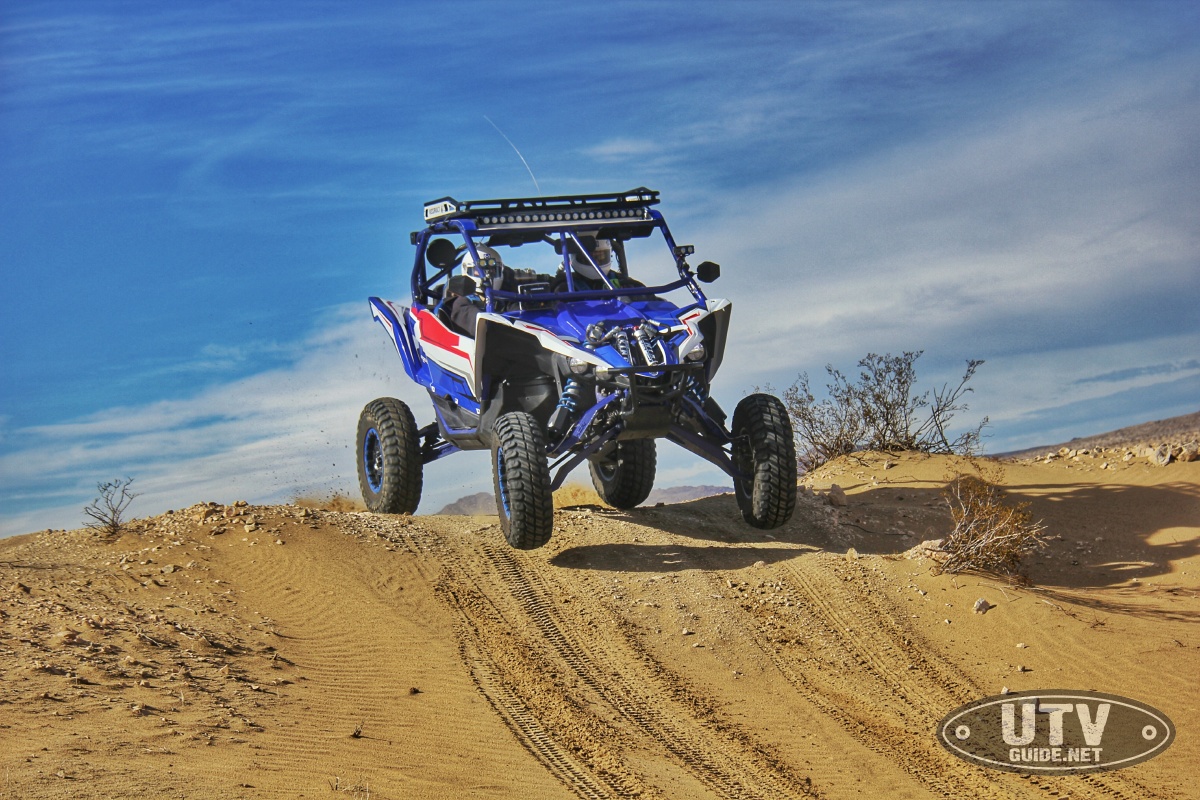
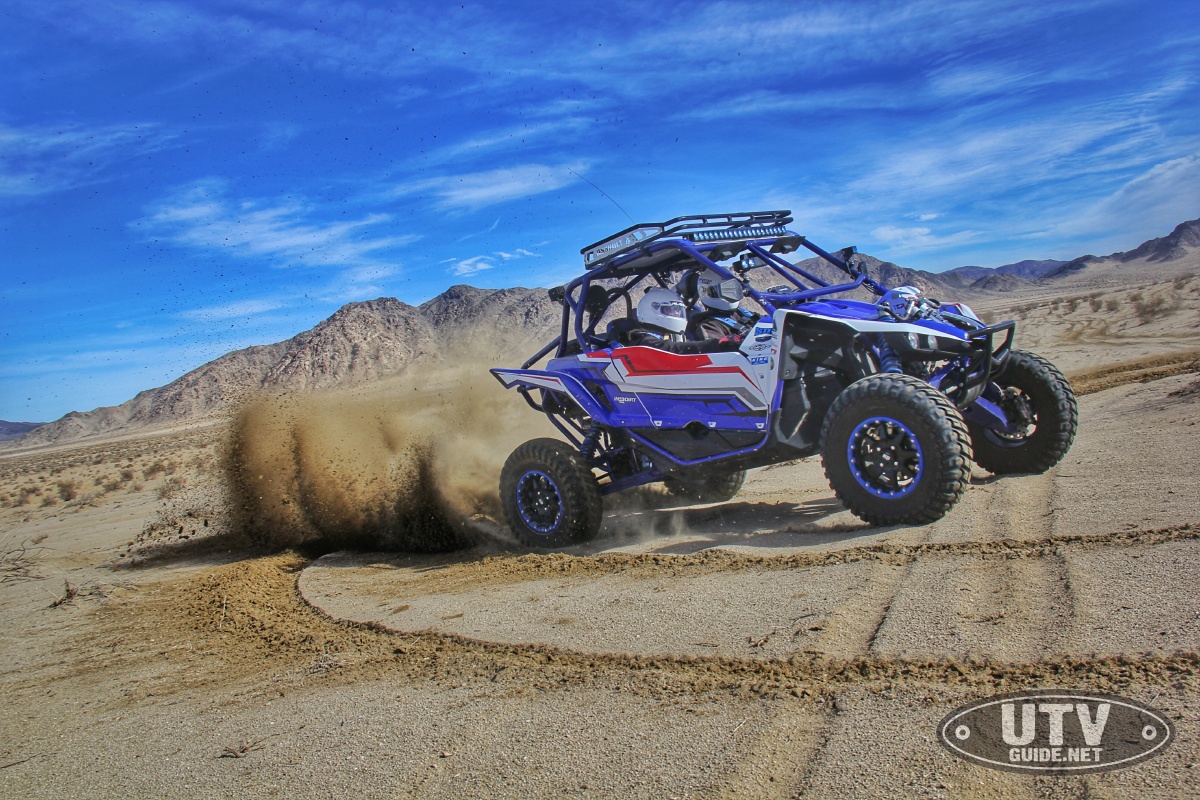
Yamaha YXZ1000R in Johnson Valley
POWER UP
SDR Motorsports handled the wiring, using a fused block for all connections and a host of custom loom work. Underneath all of the plastic, there are hundreds of feet of wiring running to all areas of the car, supporting mods like our 5 speaker SSV Works stereo system, Rugged Radios communication suite, Lowrance GPS, KC Hilites Flex LED lighting, Rugged Mac fresh air pump system, Tribal Whips 6 foot LED whips, KC Hilites interior and underbody lighting, and more.
The SSV Works stereo system that SDR installed in this car features four custom fiberglass enclosures for the 6.5” SSV speakers, with a fiberglass 10” subwoofer box that sits behind the passenger’s seat. The amplified system cranks out an incredible sound profile, and is controlled by their easy-to-use MRB2 Bluetooth sound controller. There’s no head unit- just link your phone or MP3 player up via Bluetooth or auxiliary cord, crank the sound up, and drive on. We haven’t experienced a single failure through repeated rainy days, wash cycles, and more silt than we would care to explain!
Rugged Radios really knows a thing or two about communications, and they offer a host of options for car to car and in-car coms. We run their 660+ intercom kit, which provides a crystal-clear in-car communication base between driver and passenger. The radio system adds another layer of fun to rides with friends and family. Being able to easily communicate car-to-car really eases frustration when in dust or on tight trails.
For nighttime visibility, we added a set of massive 6 foot tall Tribal Whips Aurora multicolor LED whips, which feature a remote and 125 different programmable color combinations. The Aurora whips feature an easy single-pin attachment mechanism, and are extremely bright. Being able to change the color of the whips while sitting around the camp fire is a nice touch!
Fresh air systems have spoiled us in the dusty deserts. Rather than choke on someone’s dust during a ride, it’s much easier to just close your helmet visor, plug your pumper hose into the helmet, and breathe fresh, filtered air, goggle-free. The pump itself is relatively inexpensive, starting at $250, but note that you will have to purchase a compatible pumper helmet to accept the blower hose if you don’t have one already. This system offers incredibly clean, clear air inside your helmet in even the nastiest of conditions, and is the same system run on many off-road racing teams. We have recently upgraded to Rugged’s M3 variable speed pumper system, and it works like a charm.
We hate to say it, but the YXZ1000R’s stock LED headlights are severely underpowered for any real night riding. They provide enough light to play around at slow speeds on a trail with decent visibility, but any kind of high-speed or dune riding in the dark will leave you wanting for more. We turned to long-time lighting veterans KC Hilites for a set of their incredibly robust Flex modular LED lights. We run a 40” Flex bar on the cage, with dual Flex pods on the A-pillars positioned out at 45 degrees for increased peripheral visibility.
While they aren’t cheap, the Flex lights provide an incredible amount of light. The 40” bar puts out 19,500 lumens at 250 watts, making this YXZ look like a rolling sun in the dark. The fit and finish on the KC product is incredible, all the way down to the wiring and fasteners. KC Cyclone LED light pods light the interior of the car as well as the underbody, with a patriotic red, white, and blue pattern spread under the car. We are also running a KC amber pod light as a rear chase light, since the YXZ has only one low-mounted tail light.
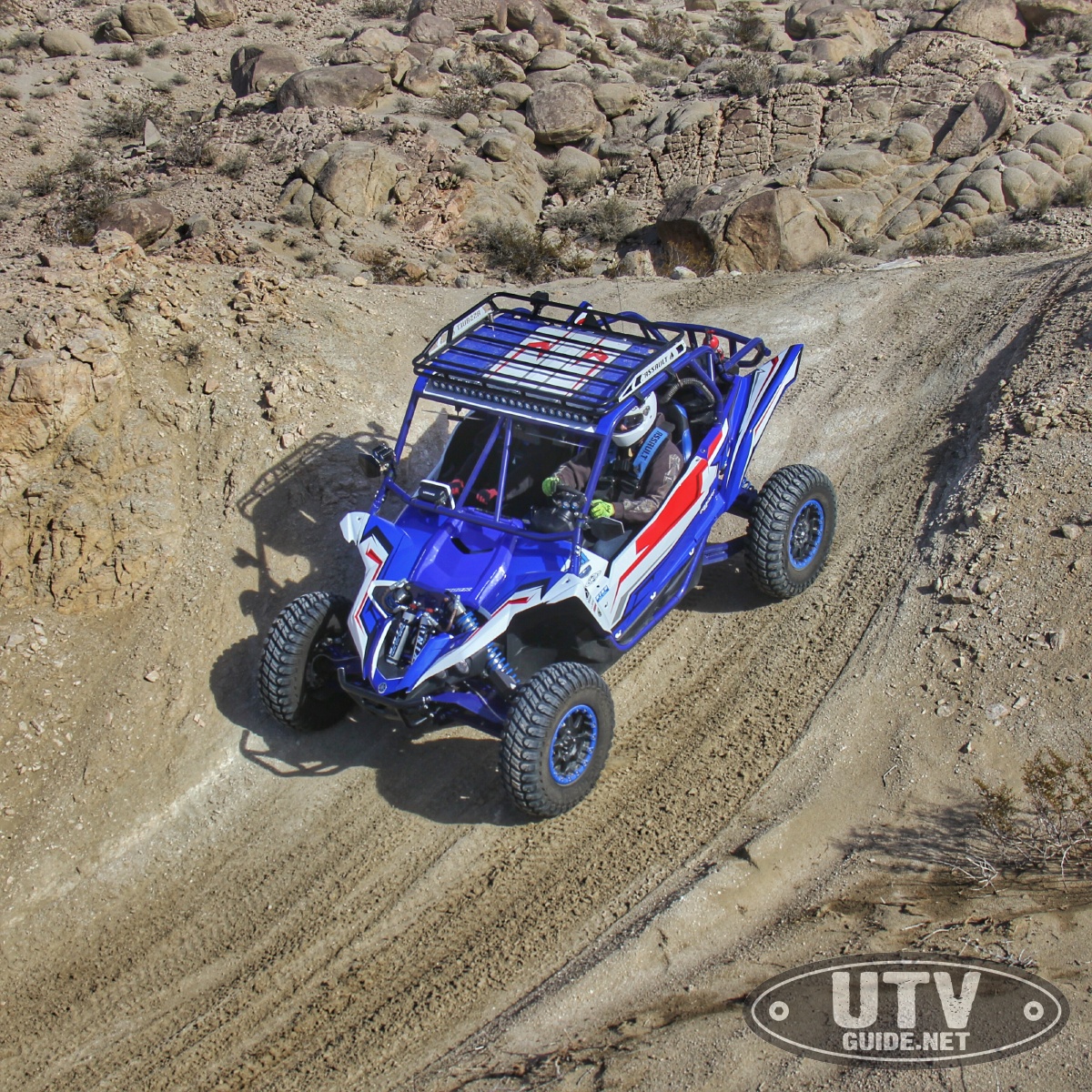
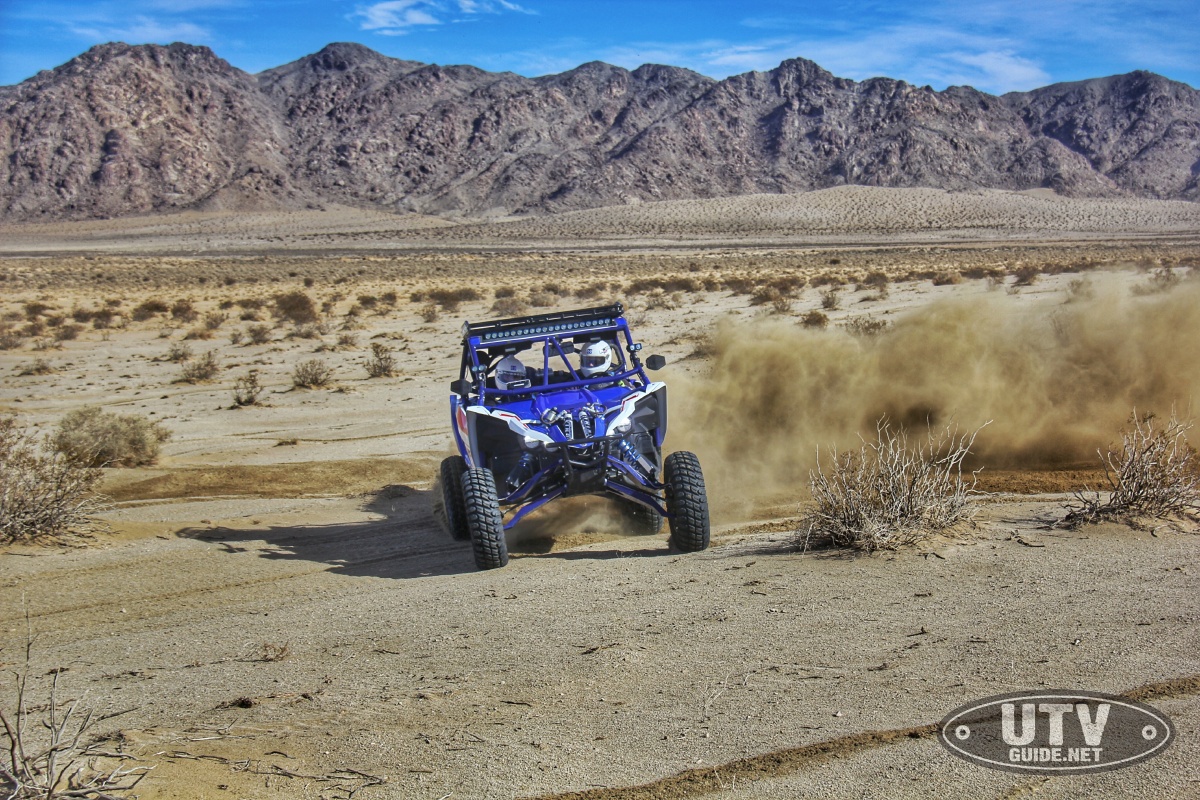
This YXZ1000R is Ready for any Terrain
ACCESSORIZE
To finish up the project, we turned to our friends at Simpson Racing Products and Assault Industries. Simpson provided a set of amazingly comfortable Vortex seats. The cutaway hip bolsters allow easy ingress and egress into the vehicle, providing a soft surface to slide over while you get in and out while still holding the occupants in place very well. The seats have held up well to hundreds of hours of use and repeated washing and sun exposure. Simpson even offers seat heaters and lumbar support, with a custom seat design feature on their website to really make the seat yours. These seats are not noticeably taller than a stock seat, so occupant fitment inside the cab does not change. We also added some custom door bags for storage, mounted on the inside of the factory Yamaha doors.
Assault Industries has released quite a few innovative inventions over the past couple of years, but our favorite has to be their clamp system. We used Assault’s 1.75” aluminum clamps to mount nearly everything on this YXZ, and there are no less than 16 of the clamps bolted to the cage in various places. It’s a simple, elegant mounting solution for a host of accessories, and with its single bolt hole and flat boss, it makes mounting custom parts a breeze.
Assault welded up a custom full-aluminum roof rack for this build, featuring colored, interchangeable side plates that are laser-cut with the Assault logo. The rack itself mounts using the same clamp as the mirrors and visor kit, and is removable via 6 allen head bolts.
Assault also provided a set of their aluminum sun visors for late-day rides, their stellar B2 Bomber series mirrors, a center mirror, aluminum short-shift lever, front bumper, fire extinguisher kit, four point harnesses, and tie rods. Small accessories like these really make the car more enjoyable to use on the trail.
We added a factory Yamaha storage box in the rear bed, and we are running GYTR’s dual battery kit. The auxiliary battery in the trunk compartment has a smart relay to ensure it stays charged but doesn’t cook when you’re running hard. Both batteries are fed by a GYTR alternator kit, ensuring that running the stereo, GPS, radios, and lighting doesn’t kill the relatively small stock electrical system. Before we installed the alternator kit, we had a few run-ins with a dead battery immediately after a hard ride at night, as the stock stator isn’t very powerful. Luckily, the YXZ has a fully manual transmission, so bump starting the car like a dirt bike is pretty easy!
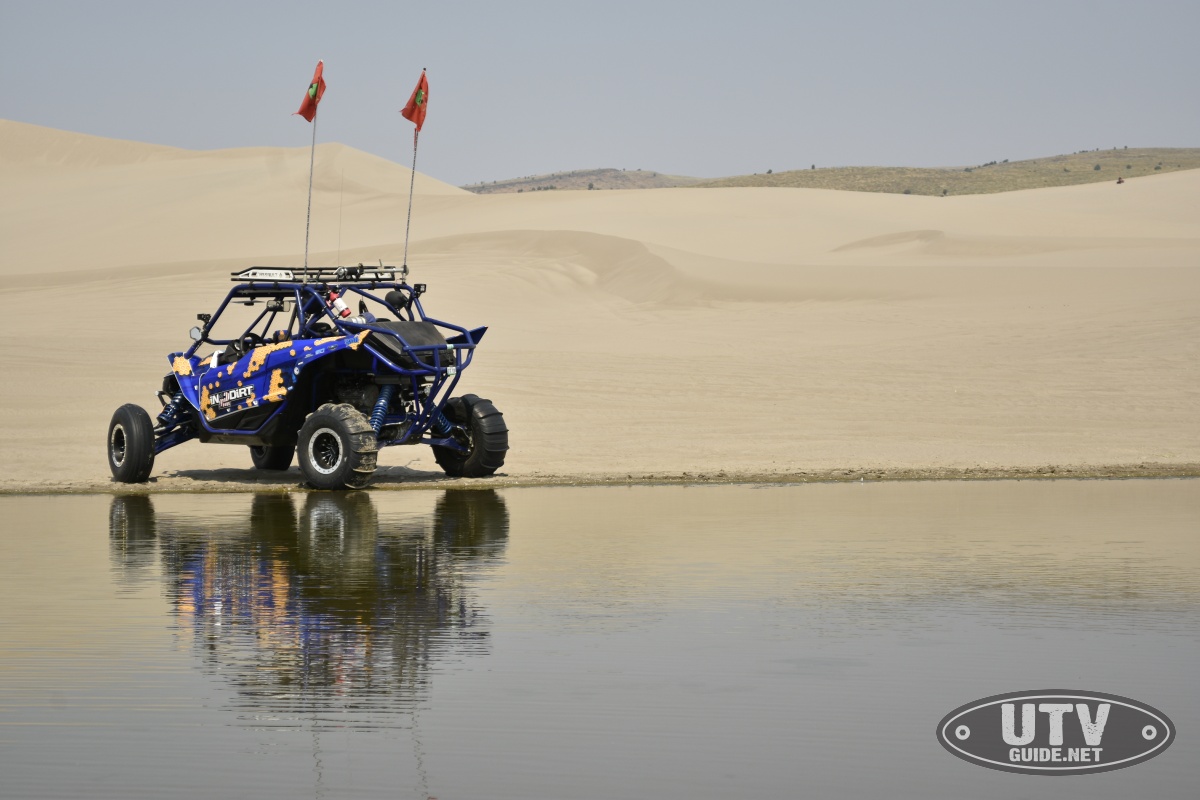
Looking Good From Any Angle
THE LOOK
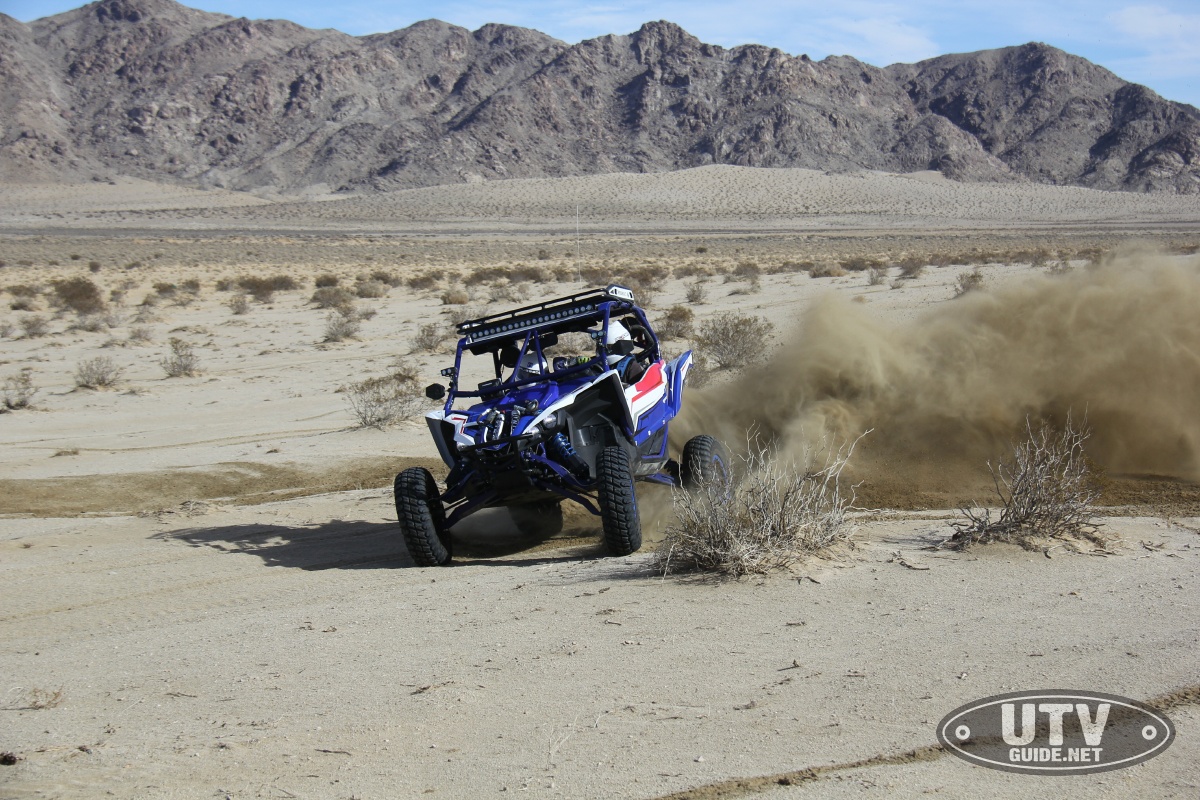
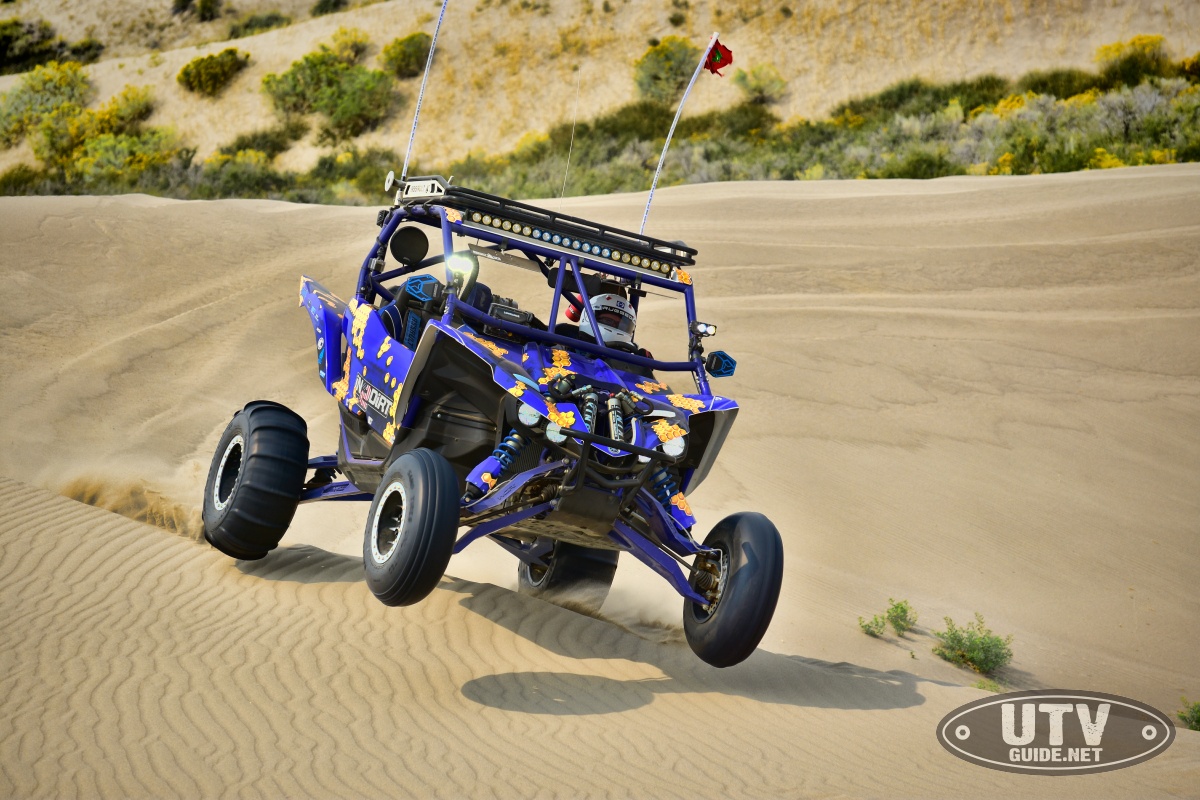
This car has gone through a few stages of graphic combinations, but all have been the handiwork of vinyl gurus Wolf Designs. Based in Arizona, Wolf knows a thing or two about how to make graphics last in harsh desert conditions, and their design and attention to detail are second to none. The first wrap featured a red, white, and blue design that highlighted the factory plastic colors very well. The second wrap featured a dark blue fade in the base, with bright yellow and orange honeycomb. Both wraps went on easily, although installation is quite time consuming. Wolf has pre-built and custom design options for their graphics kits, and offer them for nearly all sport UTVs on the market.
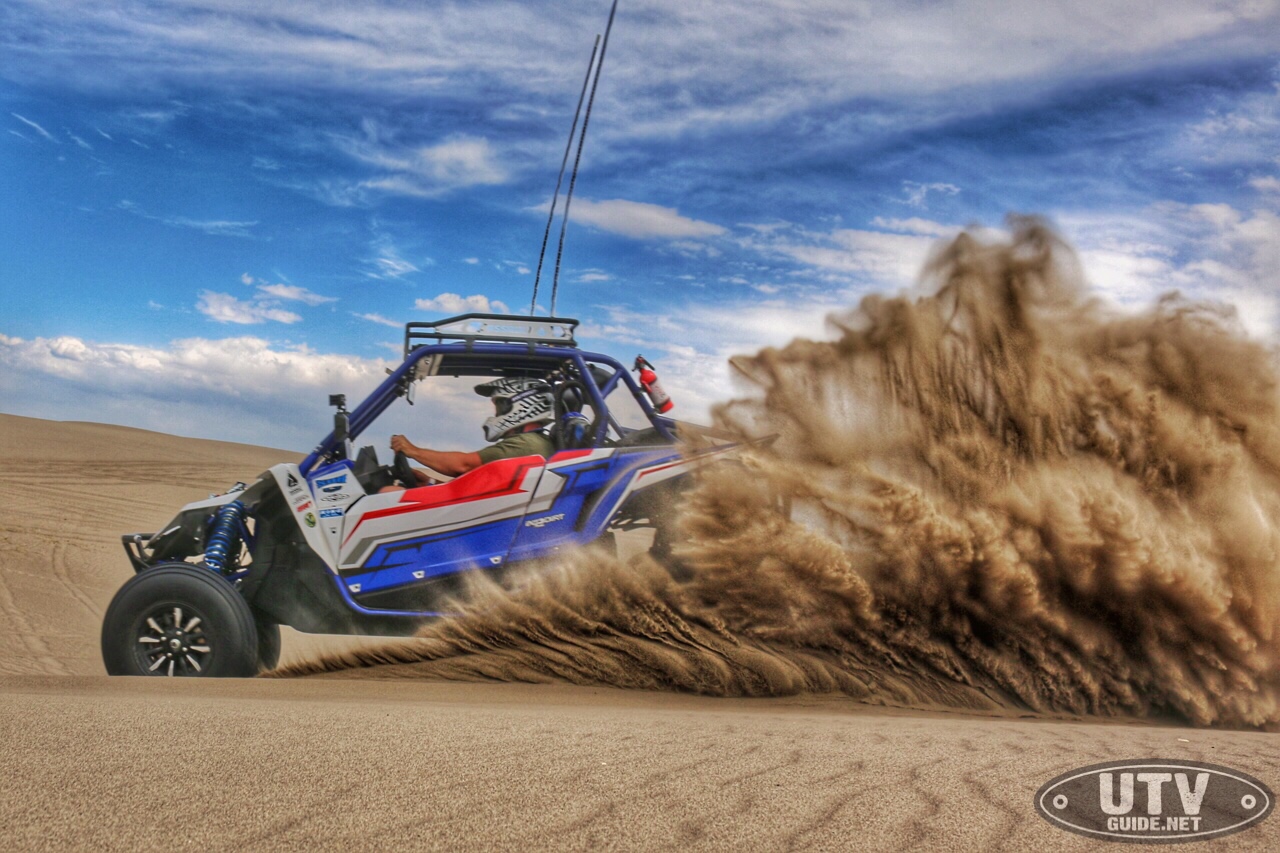
Roosting in the Dunes
PERFORMANCE
While it was clear to us that the YXZ was a pretty decent performer out of the box, we wanted a little more. A pipe and tune was the first thing we sought after, and Trinity Racing delivered. Their single-muffler stainless and aluminum full exhaust features a header that is an absolute work of art, with perfect fitment and easy installation thanks to the positioning of the YXZ’s engine in its chassis. The hardest part of the exhaust installation is getting the stock muffler out of the frame- after that, it’s a breeze.
Trinity also supplied their plug-in EFI tuner, which comes pre-set. It allows easy, basic tuning of the EFI system via a 3-button LED display. We played with the tunes quite a bit until we had it perfectly matched to our car, and it made a huge difference in power over the stock pipe. The YXZ is pretty choked up from the factory, so a simple bolt-on pipe and tuner typically adds 10-25 horsepower.
We spend a lot of time searching for unique trails, and quite a few of them are in tight, hard to reach, hilly places. The factory YXZ1000R gearing was far too tall even for the stock tires, and with the 30” STI Chicane meats we added to the build, it was like taking off in 3rd gear trying to climb. The car wasn’t hurting for power, the gearing was just far too tall. We turned to GYTR for their TAG kit, or “Torque Assist Gearing”. This Yamaha-backed accessory kit includes everything you need to internally re-gear the factory transmission. We had the work done by a local Yamaha dealership, and we upgraded the factory clutch while it was apart. The $999 kit features a 70% reduction in the first gear ratio for easy hill starts and crawling, with a 30% reduction spread across the other four gears. It really makes the YXZ come alive, bringing the gears closer together for a sportier feel and easier use of the Yamaha’s high-revving powerplant.
Those STI Chicane RX tires fit this build well, offering incredible bite in the dirt with immediate, precise steering feel. We tested a few tire setups on this car before landing on this one, and it really delivers. We have over 900 dirt miles on these tires with no failures, just a couple of plugs. We also carry a full sized spare on the roof rack, but have never had to mount it! The 8 ply carcass is strong and robust, but offers great steering feel and incredible forward traction. Sidebite is very predictable, leading to easy cornering adjustments at speed.
We spent a lot of time with HCR fine-tuning the shocks to get the best feel. We ended up with a setup that works incredibly well in the desert, on the trail, and in the dunes, with only clicker adjustments necessary to adjust for the terrain. The increased ride height really helps on rocky trails, and coupled with the 30” STI Chicane tires and the GYTR gear kit, this YXZ is a billy goat. Climbing rough, nasty hills is easy with the super-low first gear, and the YXZ’s incredibly high rev ceiling helps stretch out the gears when climbing.
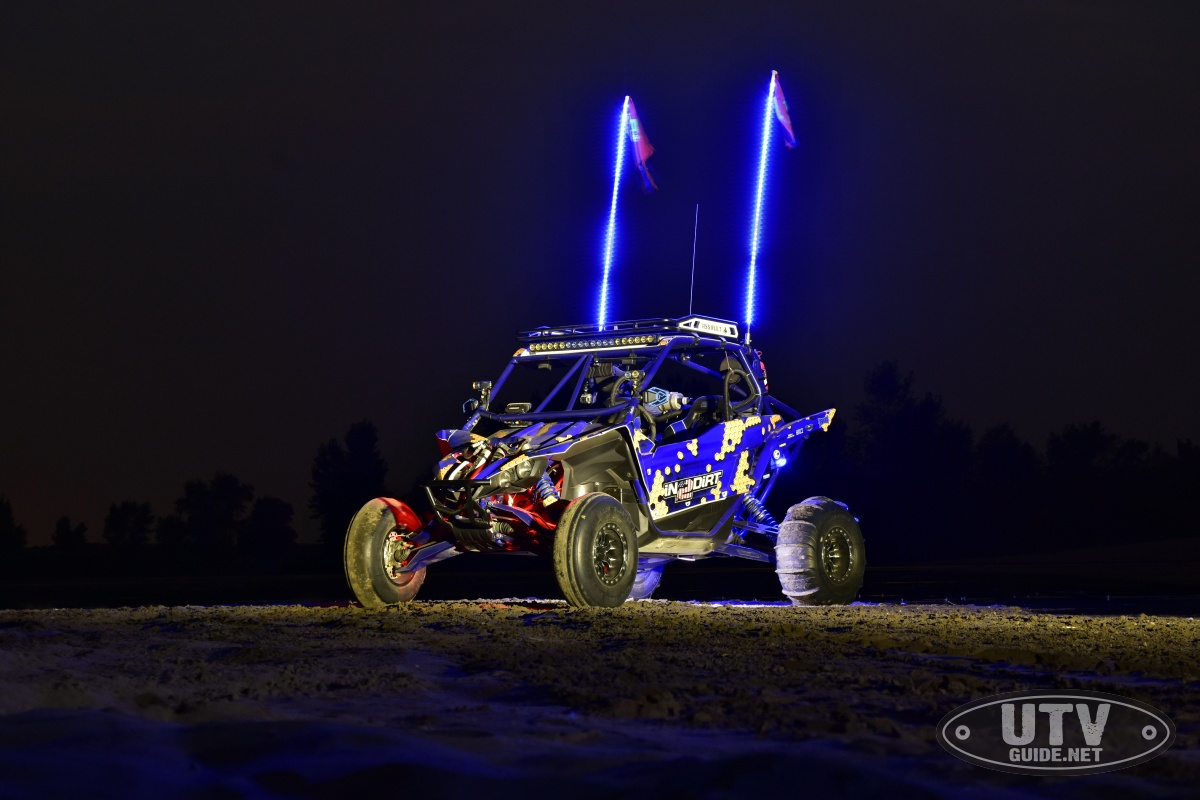
Looking Good Day or Night
RESULTS
We have driven this car in three states, nine different deserts, and in every terrain imaginable (save for mud bogs). If there’s one thing we have learned, it’s that the YXZ is an incredibly stout machine. This car has required next to zero maintenance- check to make sure everything is tight, change the oil, and keep the filters clean- it has been that easy. We have had a couple of parts failures along the way, including a factory swaybar link that was bent into a U-shape on a hard landing in the dunes. We have since upgraded the links to Assault’s much more robust heim-joint links and have yet to have another failure. We have also gone through two factory skidplates under the rear differential, and resorted to building our own out of sheet steel.
The most impressive thing about this car is by far the driving experience. It’s a very cohesive package that works together flawlessly, from the HCR suspension to the Trinity exhaust, the Rugged Radios system to the KC lights. The base work put in by SDR Motorsports to get the car set up for repeated abuse has really paid off, as it has never once let us down.
Driving the YXZ is an experience every UTV enthusiast should have. You’re not going to have the neck-snapping power of a 2017 RZR XP Turbo. You won’t have the quiet, smooth performance of the Can-Am Maverick X3’s inline triple turbocharged engine. However, what you do have is a genuine human-machine interaction that is not filtered by CVT belts, power limiters, or clever 4 wheel drive systems. It’s an old-school, visceral feeling machine that puts 100% of the vehicle’s performance capability in the driver’s hands. Miss a shift? You’re going to pay for it in speed. Forget to push the clutch in when you come to a stop? You’ll stall it. When you get it right, though, it’s the best feeling in the world. There’s nothing quite like a sequentially-shifted transmission bolted to a screaming, 11,000 RPM inline engine begging to bash against the redline. Simply put, it’s the most pure, involved driving experience we have ever experienced in a UTV. And with the help of these incredible aftermarket companies, the performance envelope has been expanded, without hampering any of the machine’s durability.
DRIVER OPINIONS
DRIVER: MARK HOOPER
AGE: 57
OCCUPATION: CONTRACTOR/IN2DIRT MEDIA PHOTOGRAPHER
EXPERIENCE LEVEL: WEEKEND WARRIOR
“I can’t believe how much fun this car is. This suspension sets you up for corners like the car is on rails. It flies perfectly flat. When the nose starts to come down, its precise balance is setting up the front end, with just the right amount of load, so that the car is ready to turn before you are. These are some of the things I love about this YXZ.
I already knew I’d love shifting a UTV. There is just something really genuine about slamming gears in an off road vehicle. Setting up into corners, do I want second or third? It’s a really fun question to ask. You can rev the car to 10k RPM and rip out of the corner and right into some two foot chop, and the car just doesn’t care. The only issue I’ve ever had with this unit is that when I first drove it (in its stock form), first gear and I didn’t have such a great relationship. She was too tall for my tastes, and I couldn’t trust her when the going got tough in an uphill stop-n-go situation. So in in the interest of saving our relationship, and my clutch, we went with the 70/30 gear reduction.
She is sooo angry now, and such a blast to drive. We would have never put any effort into this UTV had it not sucked us in from day one. I’ve been into the UTV scene with my Son since day one. We are a multi brand UTV family, so I’ve driven everything out there. But nothing gives me as much of an interactive off road experience as the Yamaha YXZ. I don’t care if it’s sand or dirt, I am hooked on this thing!”
DRIVER: CHRIS KEMP
AGE: 53
OCCUPATION: BUSINESS OWNER/DESERT RACER
EXPERIENCE LEVEL: BITD CLASS 1 CHAMPION, TROPHY TRUCK DRIVER
“I can’t believe how good these UTVs have gotten. I owned a Rhino 10 or 12 years ago, and it was great for dragging parts around between pits, but it wasn’t a sporty ride. This YXZ is sharp. The turn-in feels really good, and the car goes right where you point it every time. That [engine] is a blast! It just revs and revs. Not a whole lot going on down low in the RPM range, but when you get it up past 7,000 it moves pretty well. The suspension is super plush over the chop and still has pretty good bottoming resistance. I really didn’t expect this thing to run through the rough as well as it does! It’s just so comfortable, I could spend all day on the trail in this thing.”
PARTS LIST
- CAGE- SDR MOTORSPORTS
- INSTALL- SDR MOTORSPORTS
- SUSPENSION- HCR DUAL-SPORT LONG TRAVEL
- SHOCKS- KING 2.5” IBP (INTERNAL BYPASS)
- WHEELS- STI HD5 BEADLOCK 15”
- TIRES- STI CHICANE RX 30X10R15
- BRAKES- STOCK
- FRONT BUMPER- ASSAULT INDUSTRIES WARTHOG
- REAR BUMPER- SDR MOTORSPORTS
- DOORS- STOCK
- BODY- STOCK
- GRAPHICS- WOLF DESIGNS
- TRUNK- GYTR YAMAHA
- WHIPS- TRIBAL WHIPS
- EXHAUST- TRINITY RACING STAGE 5
- TUNING- TRINITY RACING EFI TUNER
- STEREO- SSV WORKS 5 SPEAKER AMPLIFIED KIT W/ SUBWOOFER
- COMMUNICATIONS- RUGGED RADIOS 25W RM-25R RADIO/RRP660+ INTERCOM
- FRESH AIR SYSTEM- RUGGED RADIOS M3
- SEATS- SIMPSON VORTEX
- HARNESSES- ASSAULT INDUSTRIES H-STYLE
- MIRRORS- ASSAULT INDUSTRIES BOMBER B2 AND STEALTH SERIES REAR VIEW
- FIRE EXTINGUISHER- ASSAULT INDUSTRIES QUICK RELEASE EXTINGUISHER KIT
- VISORS- ASSAULT UTV SUN VISORS
- ROOF RACK- ASSAULT INDUSTRIES CUSTOM SERIES
- SHIFTER- ASSAULT INDUSTRIES BILLET PRO SHIFTER
- TRANSMISSION- GYTR YAMAHA TAG 70/30 GEAR KIT AND UPGRADED CLUTCH
- MOTOR- STOCK
- TOP LIGHT BAR- KC HILITES FLEX 40”
- A-PILLAR LIGHTS- KC HILITES FLEX DUAL POD
- INTERIOR LIGHTING- KC HILITES CYCLONE
- UNDERBODY LIGHTING- KC HILITES CYCLONE
- REAR CHASE LIGHT- KC HILITES C3 AMBER
- ALTERNATOR KIT- GYTR YAMAHA
- AXLES- HCR W/ STOCK CV JOINTS
- GPS- LOWRANCE HDS5
CONTACTS
- SDR MOTORSPORTS- (800) 277-2280,WWW.SDRMOTORSPORTS.COM
- HCR RACING- (888) 928-7223, WWW.HCRRACING.COM
- STI TIRE AND WHEEL- WWW.STIPOWERSPORTS.COM
- ASSAULT INDUSTRIES- (714) 799-6711, WWW.ASSAULTIND.COM
- WOLF DESIGNS- (480) 888-0202, WWW.UTVWRAP.COM
- SSV WORKS- (818) 991-1778, WWW.SSVWORKS.COM
- TRINITY RACING- (714) 988-0339, WWW.TRINITYRACING.COM
- SIMPSON- (800) 654-7223, WWW.SIMPSONRACEPRODUCTS.COM
- KC HILITES- (888) 689-5955, WWW.KCHILITES.COM
- RUGGED RADIOS- (888) 541-7223, WWW.RUGGEDRADIOS.COM
- TRIBAL WHIPS- (702) 943-0784, WWW.TRIBALWHIPS.COM