


Editor’s note: This trip report documents our family visit to the Coos Bay section of the Oregon Dunes in June 2011. Routes, access points, campground information and regulations may have changed since this trip. Review current requirements before visiting.
In June 2011, our family traveled north to Oregon for several days of riding in the Coos Bay dunes. We stayed at the Oregon Dunes KOA in North Bend and entered the dunes through the Hauser access area.
Our vehicles for the trip were two of the most significant sport and recreational UTVs of the period: a first-generation 2011 Polaris RZR XP 900 and a 2011 Can-Am Commander 1000 XT.
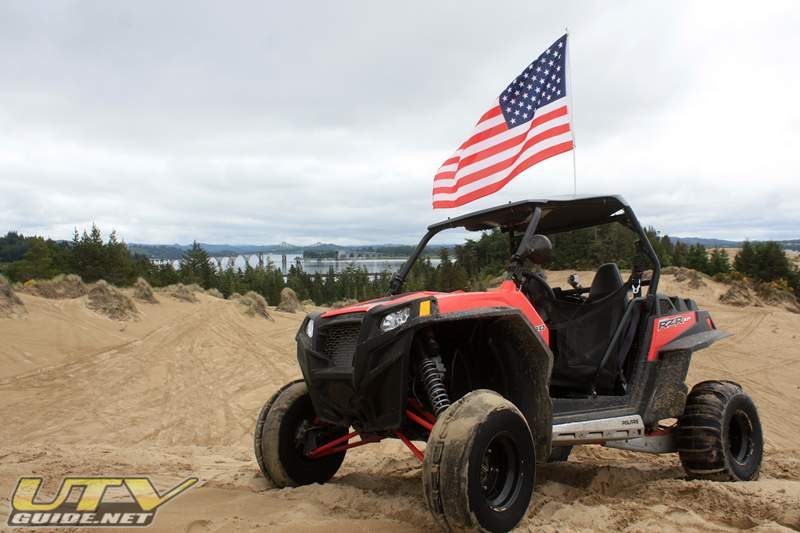
Exploring the Coos Bay Dunes
From Hauser, we made several trips through the dunes and out to the beach. One day we traveled north toward the Spinreel area before returning through the dunes. On another ride, we headed south toward Horsfall and returned through Bull Run.
The Coos Bay area offers a distinctive mix of open sand, beach access, forested sections and narrow trails through the vegetation. That variety makes it an especially memorable place to ride, but—as we discovered later in the trip—the tighter wooded routes can present challenges that are not obvious from the entrance.

For a more detailed look at the riding area, landmarks and connections between its different sections, see our virtual tour of the Coos Bay sand dunes.
Our 2011 Oregon Dunes UTVs
The trip gave us an opportunity to spend several days with two very different machines. The RZR XP 900 represented a major step forward in pure sport UTV performance, while the Commander 1000 XT combined strong engine performance with more utility, storage and a factory-installed winch.
Both vehicles handled the open dunes and longer routes well. The trip also gave us time to evaluate a new sand-tire combination and upgraded FOX shocks on the RZR XP 900.
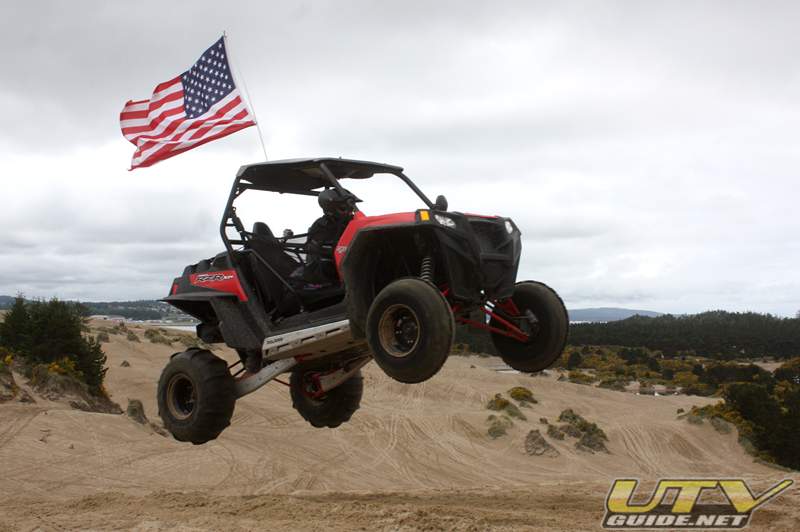

Testing Sand Tires on the RZR XP 900
For this trip, the RZR XP 900 was equipped with a Fullerton Sand Sports tire package. It used narrow razor-style front tires for steering and stagger-cut Sand Tires Unlimited Sand Blasters at the rear.
The combination worked extremely well on the RZR XP. The front tires provided enough directional control while the rear paddles delivered strong forward traction without requiring four-wheel drive throughout the dunes. We could run virtually everywhere in two-wheel drive.

FOX 2.0 RC2 Shock Upgrade
We also replaced the RZR XP 900’s original shocks with FOX 2.0 RC2 shocks. The front shocks provided high- and low-speed compression adjustment along with rebound adjustment. At the rear, dual-rate coil springs were paired with RC2 adjusters and position-sensitive damping.
The increased adjustability was useful in the varied Coos Bay terrain, but the most noticeable improvement came through the whoops. The upgraded suspension gave the RZR XP better control and a more composed ride when the sand became rough.

Recovering a RZR From a Steep Sand Trail
The most memorable part of the trip was not something we had planned. While exploring one of the tighter forested trails, a Polaris RZR became stuck on a steep slope covered in loose sand.
Some trails through the vegetation looked passable at first but quickly became too narrow or steep for a UTV. Once committed, there was little room to turn around, and the loose sand made it difficult to reverse back up the slope.


We positioned our Can-Am Commander 1000 XT where its factory winch could assist with the recovery. The Commander also had to be anchored so it would not slide toward the RZR when tension was applied.

Using the Commander’s winch and several tow straps gave us the reach and mechanical advantage needed to move the RZR. Even with that equipment, the recovery required plenty of digging and several people pushing.


In the end, we recovered everyone without damage or injury. The experience reinforced the value of carrying a winch, properly rated recovery straps, shackles and digging tools—even when riding primarily in sand.
What We Learned at the Oregon Dunes
The primary lesson from this trip was to be cautious when entering tight trails through the Oregon Dunes vegetation. A route that appears manageable from one end can become much steeper, narrower or softer farther ahead.
- Stop and inspect an unfamiliar trail before committing the entire group.
- Leave enough distance between vehicles to allow room for recovery.
- Carry recovery equipment even when riding open dunes.
- Identify secure anchor points before connecting a winch or tow strap.
- Keep bystanders clear of tensioned winch lines and recovery straps.
- Do not rely on another vehicle being able to drive directly to the stuck UTV.
Despite the difficult recovery, this was an excellent family trip and an important chapter in our long-term experience with the RZR XP 900 and Commander 1000 XT. The combination of open dunes, forested routes and access to the Pacific Ocean made Coos Bay unlike any other riding destination we had visited.
More Oregon Dunes Coverage
- A Virtual Tour of Oregon’s Coos Bay Sand Dunes
- Oregon Dunes OHV Access Battle Intensifies
- DuneFest 2014 Trip Report
- 2011 Polaris RZR XP 900 Long-Term Review
- Can-Am Commander 1000 XT Long-Term Review
Explore more firsthand adventures in the UTV Guide Trip Reports archive.


