


By Jon Crowley, UTVGuide.net
My name is Jon, and I have a King of the Hammers addiction.
Since the first UTV race in 2009, I had either driven or served as co-driver every year. King of the Hammers had become a love-hate relationship: I loved building a UTV capable of surviving Johnson Valley, but the preparation, long hours and pressure always made me question why I kept returning.
Every year, I said it would be my last. Then the idea of building something better pulled me back in.
For the 2015 King of the Hammers UTV race, the challenge was different. Instead of starting with the faster and more established Polaris RZR XP 1000, I decided to race a new 60-inch Polaris RZR S 900. It was down on horsepower, suspension travel and wheelbase, but I believed its compact size and rear A-arm suspension could make it a capable rock-crawling race car.

Leaving the starting line in the Polaris RZR S 900.
Thanks to Polaris RZR and HCR Racing for sponsoring the 2015 UTV race.
Returning to King of the Hammers
My decision to race again was shaped by what had happened during the previous two years.
A Second-Place Finish in 2013
In 2013, King of the Hammers organizer Dave Cole raised the difficulty considerably. The course was no longer a quick desert race with a few rock trails mixed in. It had become a true King of the Hammers course with big whoops, punishing desert terrain and difficult rock canyons.
I teamed up with Jagged X for pit support, with Blake Van de Loo riding as my co-driver. We finished second, only 16 seconds behind the winner and just minutes before the official race cutoff.
Simply finishing that course was a major accomplishment. Standing on the podium made it even better.
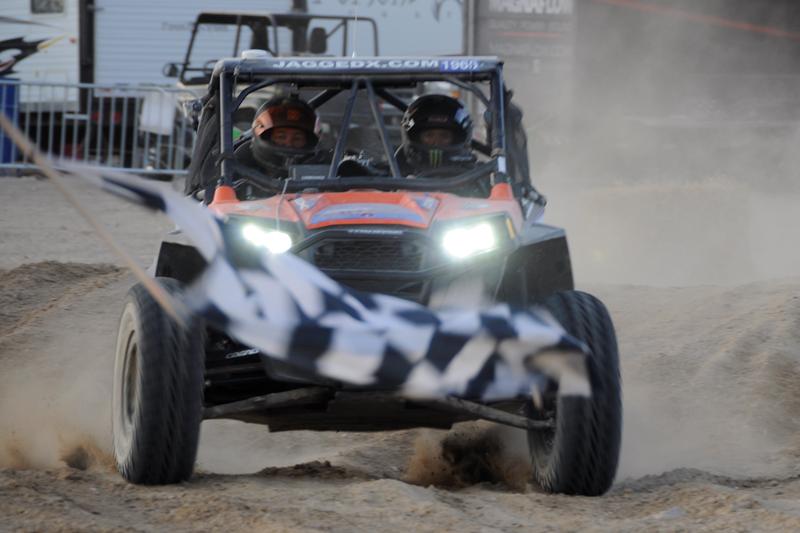
Racing at King of the Hammers in 2013.
Co-Driving in 2014
For the 2014 race, I joined Blake as his co-driver. He had done the same for me the previous year, and returning the favor seemed right.
I still built a Polaris RZR XP 1000 that served as a backup and pre-run vehicle, but the preparation was less stressful than managing my own race effort. Blake and I encountered plenty of adversity during the race but recovered to finish fifth.
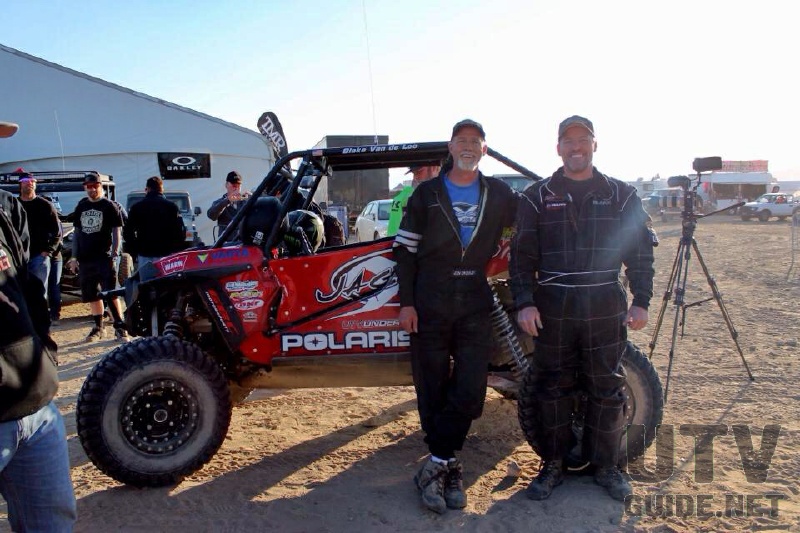
Finishing the 2014 King of the Hammers UTV race.
Afterward, I did not seriously consider racing again. Competing without the support of Jagged X would have required a commitment I was not prepared to make, and I hoped lowering my expectations might also lower my stress.
Then I drove the new Polaris RZR S 900.
Why Race a Polaris RZR S 900?
I first drove the Polaris RZR S 900 at its media introduction in September 2014. Its rear A-arm suspension design immediately made me think it could work well in the rocks.
Compared with the RZR XP 1000, however, the RZR S 900 had more than 30 fewer horsepower, an 11-inch-shorter wheelbase and approximately four to five inches less suspension travel. Those differences would be significant in the fast, rough desert sections at King of the Hammers.
That was also part of the appeal. Nobody expected the RZR S 900 to beat a field filled with RZR XP 1000 race cars. If we could get the smaller, less powerful machine across the finish line, it would be a genuine accomplishment.
I asked Bill Schueler at Jagged X whether the team could support two race cars at KOH. He said they were up to the task.
Convincing Polaris took more effort. The obvious question was why I would choose the RZR S 900 when the RZR XP 1000 was better suited to a race combining high-speed desert terrain with extreme rock crawling. I explained the value of showing what the new 60-inch machine could do, and Polaris eventually agreed.
It was game on.
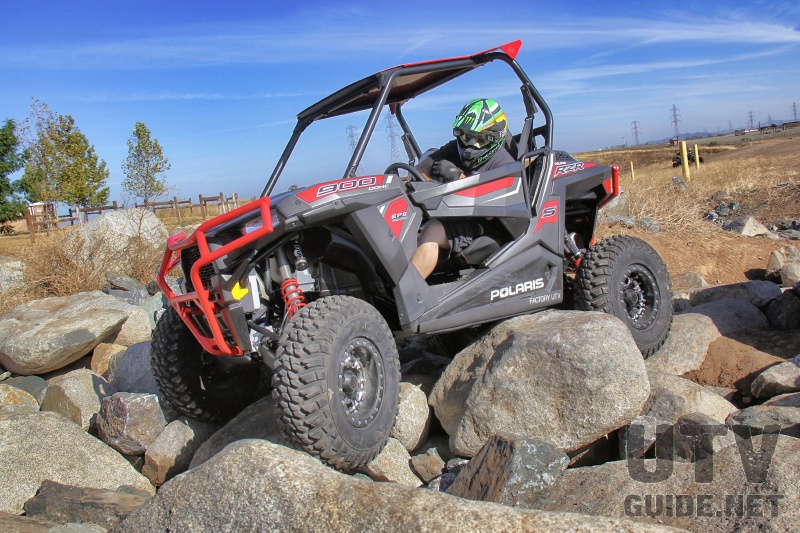
Testing the new RZR S 900 in the rocks following the media introduction.
Building the RZR S 900 for King of the Hammers
Choosing a newly released UTV created complications. The aftermarket had not yet had much time to develop, test and manufacture race parts for the RZR S 900.
Spare parts were another concern. Jagged X carried an extensive inventory for the RZR XP 1000, but the RZR S 900 used different components, including its clutch, brake calipers, A-arms and axles.
My goal was to keep the build as simple and reliable as possible.
Safety and Chassis Preparation
IMG Motorsports fabricated a lightweight six-point roll cage and bumpers. The RZR was also equipped with the required safety equipment, including suspension seats, five-point harnesses and fire extinguishers.
Additional chassis protection included a Factory UTV UHMW skid plate and rock sliders. HCR Racing stock-geometry A-arms added strength and improved ground clearance without changing the basic suspension layout.
Tires, Wheels and Suspension
We installed 30-inch GMZ Kahuna tires with Tire Blocks run-flat inserts on HiPer Fusion beadlock wheels. FOX 2.5 Podium RC2 shocks replaced the stock dampers and were tuned to help the RZR survive the rough desert sections.
The RZR S 900 still had less suspension travel than the XP 1000, but the larger FOX shocks gave us a better chance of maintaining control through the relentless Johnson Valley whoops.
Power and Drivetrain
Performance modifications were intentionally limited. A Muzzys Performance dual exhaust and DigiTune system were paired with a Hunterworks clutch kit.
We would have to be satisfied with a top speed of a little more than 60 mph. The goal was not to build the fastest UTV in the field. It was to build one that could finish.
Communication and Navigation
Inside the car, Rugged Radios supplied the radio, intercom and MAC helmet-air system. We also installed a Bluetooth wireless communication system that allowed me to speak with my co-driver while he was outside the car spotting or handling the winch.
That hands-free communication would become one of the most useful pieces of equipment on the car. Hand signals and yelling are poor substitutes for clear communication when a UTV is balanced on a rock obstacle.
Other equipment included a GPS, Polaris 4,500-pound winch, Pro Armor doors and steering wheel, Axia Alloys mirrors and fire-extinguisher mounts, a UTV Inc. horn kit and an Autotrend EFI fuse and relay panel.
Selecting a Co-Driver
Tommy Scranton joined me as co-driver. Tommy raced a RZR in several short-course series and worked as a fabricator at IMG Motorsports, so he knew how to work on the car.
He was not an experienced rock crawler, but he was young, light and mechanically capable. We made one two-day trip to Johnson Valley to pre-run several trails, but otherwise had little experience wheeling together before race week.
A Race Within the Race
At some point, simply finishing stopped sounding challenging enough, so I made two $100 side bets.
The first was with Dean Bulloch of D&P Performance. Dean was racing an Arctic Cat Wildcat Sport, another new 60-inch UTV for 2015. It gave us a race within the race: Polaris versus Arctic Cat and Crowley versus Bulloch.
The second bet was against BC Vaught, who was racing a RZR XP 1000. I figured that would be easy money because I was not convinced he would even show up.
That assumption would come back to haunt me.
The 127-Mile 2015 KOH UTV Course
The course was released the Thursday before the race. It was longer than the previous year, but at first glance the rock sections did not appear dramatically more difficult.
I was wrong.
The approximately 127-mile course included:
- Crowbar
- Aftershock
- Highway 19/20
- Fissure Mountain
- Sledgehammer
- Jackhammer
- Chocolate Thunder
- Wrecking Ball
- Long sections of rough desert and deep whoops
Jackhammer was the biggest addition. Its gatekeeper obstacle was difficult enough that many full-size Ultra4 cars needed to winch. A UTV could expect to winch at least two or three times.
The course also sent us through miles of ugly whoops twice.
We pre-ran the opening 44 miles, including Crowbar, the sand hill and the return to the main pit. Crowbar was not especially difficult during the pre-run, but it contained narrow choke points with few alternate lines. Any disabled or inexperienced competitor could create a major traffic jam.
Because our RZR was not particularly fast in the desert, getting trapped behind traffic at the first rock section was a serious concern.
Starting the 2015 King of the Hammers UTV Race
We drew an excellent starting position in the fourth row. Cars started two at a time at 30-second intervals.
The RZR S 900 had a tall low range and could reach approximately 40 mph. During pre-running, we determined that we could start in low and remain there through the first few miles before shifting into high near the saddle leading toward Melville Dry Lake.
We beat the XP 1000 beside us off the starting line, but it moved ahead after I backed off before the final jump. I did not want to nose-dive and destroy the car in the first mile.
I had already warned Tommy that faster XP 1000s would pass us in the desert. Our job was to remain patient and get to the rocks.
Traffic at Crowbar
Approximately a dozen cars passed us before Crowbar. We also passed two cars sidelined with mechanical problems, putting us somewhere near 18th when we reached the first rock section.
As expected, we found a traffic jam. Approximately 10 UTVs were waiting to get through the canyon’s most difficult section.
This demonstrated why desert speed still mattered in a rock race. The leading drivers—including Mitch Guthrie, Branden Sims, Miller and Duckworth—reached the rocks before the traffic developed. Anyone hoping to win needed to arrive at that first bottleneck near the front.
We probably lost 15 to 20 minutes more than the leaders in Crowbar. Because I had not entered the race expecting to win, I was relieved the delay was not worse.
At our return to Pit 1 near race mile 31, we stopped at the Jagged X pit for a quick visual inspection. Brandon Schueler and the crew found no problems, and we were moving again in roughly 30 seconds.

Racing near mile 35 during the opening lap.
Completing the First Lap
The course continued across an old MDR race route filled with whoops and tight, technical desert terrain. At race mile 41, we chose the alternate route around the sand hill to reduce the chance of getting stuck or damaging the car.
We reached the race-mile-44 pit in approximately 12th place. Our first lap was 27 minutes slower than Guthrie and Sims.
After taking fuel, we began the second lap and the most difficult portion of the race. Bulloch remained a few minutes ahead of us, while BC Vaught had fallen behind with a flat tire.
Stopping to Help Burt Jenner
About 20 miles of desert separated us from Aftershock. In the wash before the rocks, we found an overturned RZR XP 1000. The driver and co-driver were outside the car with their winch line extended, but there was nothing nearby that could serve as an anchor.
I pulled over and told them to connect the winch to our RZR so we could help roll them upright.
The driver was Burt Jenner, who had taken himself out of the 2013 race after rear-ending my RZR XP 900. Burt and I had talked since then, and everything between us was fine. He was appreciative that we stopped, and I hoped the good deed might earn us a little karma.
You can read the full story in our 2013 King of the Hammers UTV race report.
Making Passes in Aftershock and Highway 19/20
We encountered several competitors in Aftershock and passed at least one or two before reaching the top.

Traffic in Aftershock during the second lap.
Highway 19/20 was longer and more difficult. I had broken a front axle at the bottom of the trail in 2013, so I knew how quickly it could end a race.
Unlike some of the narrower canyons, Highway 19/20 offered alternate lines and opportunities to pass. Tommy did an excellent job spotting. We gained another two or three positions, including a pass on teammate Blake Van de Loo, who was trying to continue with two broken front axles.
I asked whether he needed our help, but he declined.
We used the winch once on a steep bypass covered in loose rocks. At the top, I called Bill Schueler and considered stopping at the pit for an inspection. Bill wisely advised us to continue unless we knew something was wrong.
Skipping the stop probably gained several more positions and helped us reach Jackhammer ahead of additional traffic.
Descending Sledgehammer
We crossed Fissure Mountain and descended Sledgehammer without a problem. At the bottom, we turned toward Jackhammer—a trail that had never previously been included in the KOH UTV race.
Everyone knew it would require multiple winch pulls.

Chasing BC Vaught after he passed us at the bottom of Jackhammer.
Trouble on Jackhammer
A good-sized crowd had gathered at the bottom of Jackhammer, and approximately five UTVs were already backed up ahead of us.
I stopped briefly to reconnect my helmet cable. While we were sitting still, BC Vaught drove past us. I had not realized he had caught up, and I was shocked to see him back in front after his earlier flat tire.

A traffic jam developed at the Jackhammer gatekeeper.
John Duckworth was sidelined with a transmission problem. Dean Bulloch was two cars ahead, with Sportsman racer Cody Currie in front of him.
When our turn came, the gatekeeper required a heavy winch pull. That was when the winch began popping into free-spool and sending the RZR backward.
We made several attempts before clearing the gatekeeper, only to have more trouble on the next obstacle. Cars were stacking up behind us, and I began to think our race might be over. We still had more mandatory winch points on Jackhammer, followed by Wrecking Ball.
Without a functioning winch, we were not going to finish.

Trying an aggressive line after the winch began popping into free-spool.

Jackhammer created one of the toughest challenges of the 2015 UTV race.
We eventually traced the problem to the cable-operated free-spool control mounted in the dashboard. Pulling on the control had partially separated the dashboard from its mounts. That movement shortened the effective cable travel by approximately an inch, preventing the winch from fully engaging.
We cut off the cable connector and returned to operating the winch manually. It worked, but the diagnosis had cost us considerable time and delayed every racer behind us.

Continuing up Jackhammer after correcting the winch problem.
Near the top, BC Vaught broke an axle and we passed him. We finally escaped Jackhammer, but the lost time had allowed Bulloch to build a lead of approximately 20 to 30 minutes.
Chocolate Thunder and Wrecking Ball
By the time we reached Chocolate Thunder, Mitch Guthrie had already finished the race.
We made relatively quick work of Chocolate Thunder, using the winch at its most difficult obstacle rather than taking an unnecessary risk.

Climbing Chocolate Thunder during the 2015 UTV race.
Wrecking Ball started well. We moved quickly through the lower trail and winched the waterfall without a problem. Above the waterfall, I put the RZR in a difficult position where the drivetrain began to bind.
I did not want to break an axle or another component after making it that far, but the recovery required a combination of throttle and winching. I smoked the drive belt badly enough to fill the cab with smoke.
We continued toward Pit 2A, hoping the damaged belt would survive.
Racing the Clock
At Pit 2A, the Jagged X crew fueled the RZR and repaired a problem with the driver-side door latch. We discussed changing the drive belt but decided against it because we were running out of time.
It was a gamble, but the belt was still moving the car.
We increased our pace through the desert, skipped Pit 1 and continued around Fry Mountains before returning to Crowbar. After passing Pit 1 again, we chose the shortest route at the sand hill.
The RZR S 900 charged up the hill without a problem. Unfortunately, our calculations showed that we could not reach Hammertown by the original 4 p.m. cutoff.
Third Place in the Pro UTV Class
We crossed the finish line at 4:07 p.m. after spending 8 hours, 5 minutes and 30 seconds on the course.

Crossing the finish line after more than eight hours on course.
After telling the story of our race onstage and thanking our sponsors, we went looking for Dean Bulloch. He had beaten us to the finish by 16 minutes and 45 seconds, winning our 60-inch UTV side bet.
I initially thought Guthrie and Sims had finished first and second. We later learned that Sims had broken, moving us into third place in the Pro UTV class.
Race officials ultimately allowed competitors until 5 p.m. to finish. Chad Hughes crossed the line in a RZR XP 1000 with 16 minutes remaining, while Cody Currie completed the course in the Sportsman class.
Only five of the more than 50 starters finished the race.

All smiles after completing one of the toughest UTV races we had attempted.
Mitch Guthrie earned his sixth King of the Hammers UTV victory. Dean Bulloch stayed ahead of us despite being within a few positions several times during the race. Both drove outstanding races.

Congratulating Dean Bulloch at the finish.
What the RZR S 900 Proved at KOH
Looking back, I remain proud of what we accomplished with the Polaris RZR S 900.
The faster cars beat us in the desert, but the compact RZR performed exceptionally well in the rocks. Despite seven available pit stops, we stopped only three times: twice for fuel and once for a quick inspection.
Completing a 127-mile King of the Hammers course with so few stops was a significant achievement for a new platform.
The experience reinforced several important lessons:
- A carefully prepared UTV does not need to be the fastest vehicle in the desert to finish KOH.
- Reaching the first rock section near the front can prevent major delays caused by traffic.
- Reliable winching equipment is essential on trails such as Jackhammer and Wrecking Ball.
- Wireless communication between the driver and co-driver makes spotting and winching safer and more efficient.
- Smart driving and avoiding unnecessary pit stops can offset some of a vehicle’s performance disadvantage.
The RZR S 900 entered the race with less horsepower, a shorter wheelbase and less suspension travel than the leading RZR XP 1000s. It still completed a course that eliminated the overwhelming majority of the field and earned third place in the Pro UTV class.
For more context on how the race evolved from its 2009 beginnings into one of the hardest UTV competitions in the country, read the history of the King of the Hammers UTV race.
Thanks to the Team
Thanks to Polaris for giving us the opportunity to demonstrate the capabilities of the RZR S 900 and to Jagged X for providing professional pit support once again.
Thanks also to Tommy Scranton for believing in the plan and quickly learning the demands of rock-crawling competition; Paul Hart for helping prepare the car; and Dave Lommori for keeping the team fed on the lakebed.
Most importantly, thanks to all the sponsors and companies whose components helped us reach the finish line.
2015 King of the Hammers RZR S 900 Build Partners
- Polaris RZR: RZR S 900 and race support
- IMG Motorsports: Six-point cage and bumpers
- HCR Racing: Stock-geometry A-arms
- FOX: 2.5-inch Podium RC2 shocks
- HiPer Racing Wheels: Fusion beadlock wheels
- GMZ Race Products: Kahuna tires
- Tire Blocks: Run-flat system
- Factory UTV: UHMW skid plate and rock sliders
- Pro Armor: Seats, harnesses, doors and steering wheel
- Rugged Radios: Radio, intercom, wireless communication and helmet-air system
- Muzzys Performance: Dual exhaust and DigiTune
- Hunterworks: Clutch kit
- Autotrend EFI: Fuse and relay panel
- Axia Alloys: Fire-extinguisher mounts and panoramic mirrors
- Diamond Wrap Factory: Vehicle graphics
- Vision X: LED rock lights
More 2015 King of the Hammers Coverage
- Polaris RZR S 900 overview
- Polaris RZR S 900 review
- Polaris RZR S 900 King of the Hammers build
- 2015 King of the Hammers pre-run
Previous King of the Hammers UTV Race Reports
- 2014 King of the Hammers UTV race
- 2013 King of the Hammers UTV race
- 2012 King of the Hammers UTV race
- 2011 King of the Hammers UTV race
- 2010 King of the Hammers UTV race
- 2009 King of the Hammers UTV race
Photos by Paul Hart, UTVGuide.net, Woody Swearingen – UTVWeekly.com, Troy Merrifield – UTV Off-Road Magazine.
Polaris RZR became the official side-by-side sponsor of the 2015 King of the Hammers and added a new RZR XP 1000 EPS to the Pro UTV purse. The sponsorship was particularly important after concerns that the UTV race might not return following the 2014 event.


