

By Jon Crowley
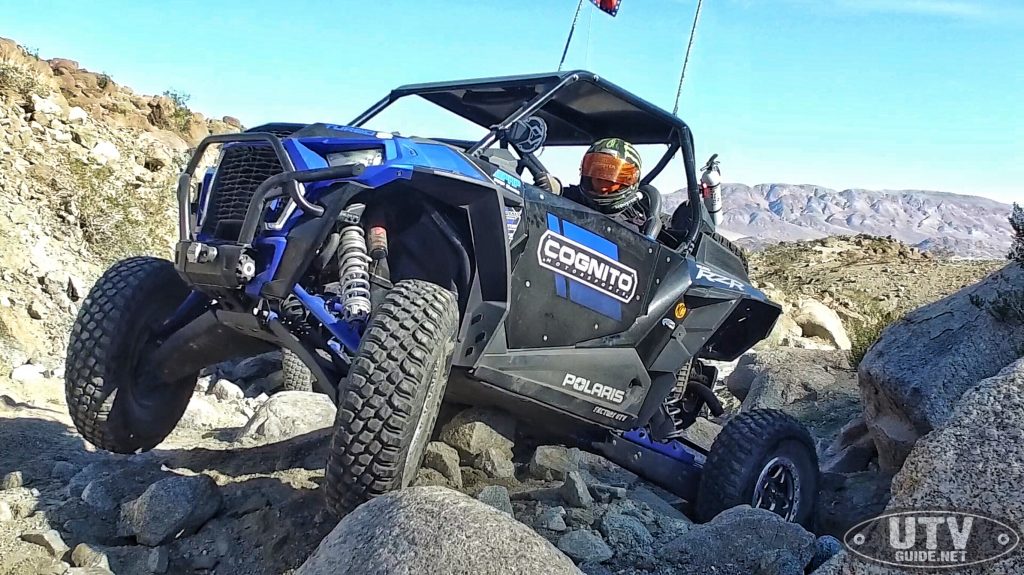
Our Polaris RZR XP Turbo S had spent nine months in the dunes, desert and rocks when I decided its tall low range needed attention. The Turbo S worked well at speed, as we found in our first ride review, but its gearing made precise rock crawling harder than it needed to be. Our Turbo S rock crawling review explains the problem. I wanted a lower crawl speed and better belt control without giving up the high-range speed we use in the Southwest.

Why lower the RZR XP Turbo S transmission gears?
The 2016 RZR XP Turbo transmission used 12.46:1 high and 22.74:1 low ratios. The 2017 and newer two-seat RZR XP Turbo gearing changed to 11.58:1 high and 20.25:1 low, a taller setup carried into the XP Turbo S. On our 32-inch tires, low range could run to roughly 45 mph. That left the engine and clutch working harder than I liked when easing through technical obstacles.
My reference was the RZR XP 1000 Trails & Rocks Edition, with its 11.79:1 high and 29.02:1 low gearing. We raced a 2017 RZR XP 1000 EPS Gold Matte Metallic Limited Edition at the 2017 King of the Hammers UTV race and finished third. With 32-inch tires, that setup ran about 30 mph in low and reached 77 mph in high during the race. The original photo below shows the related 2018 Trails & Rocks Edition; it is not the 2017 race vehicle.

The gear combination we chose
I aimed to keep high-range capability above 75 mph while lowering the Turbo S’s low range as much as practical. The selected combination was 13.00:1 high and 27.61:1 low. With our 32-inch tires, the calculated speeds were about 82 mph in high and 38 mph in low. A lower crawl setup could have put low range nearer 30 mph, but would have reduced the projected high-range speed to about 73 mph. Those are estimates based on the gear and tire combination, not measured top speeds.
We used a 27/46 Stage 2 gear set from a four-seat RZR XP Turbo and a 25/67 low gear set from a 2018 RANGER 1000. The four Polaris part numbers recorded for our swap are:
- 3235380 — 27-tooth reverse gear/shaft
- 3235381 — 46-tooth Stage 2 gear
- 3236132 — 25-tooth low gear
- 3235232 — 67-tooth low gear
These numbers document our 2018-era build; verify compatibility for your exact transmission and model year before ordering. Alpine UTV in Placerville, California handled the work. The transmission had to come out of the RZR and the case had to be split.
Transmission gear swap photo gallery


Testing the lower gears in Johnson Valley
After the swap, we took the RZR XP Turbo S to Johnson Valley, California, home of King of the Hammers. Even loading it onto our Alpine Designs truck rack felt easier with the lower gearing.
View our Polaris RZR XP Turbo S Johnson Valley trip on Instagram
Over two days we ran Boulderdash, Upper Big Johnson, Claw Hammer, Chocolate Thunder, Jack North, Sledge Hammer, Resolution and Spooners. I drove the first day; my friend Reid Nordin from Walker Evans Racing drove the second. We both noticed better slow-speed control and much less belt slipping. Low range still ran past 30 mph, which was plenty for our use.
We did not conduct a measured top-speed test in high range. I saw 75 mph with room to go, so the new gearing met my practical goal. The high-range gear combination also matches the four-seat XP Turbo setup. Our observations suggest less clutch slip in this kind of crawling; we did not run a controlled belt-life test.
For our mix of rock trails and faster Southwest riding, this was the right compromise. The lower low range made the machine easier to place on obstacles while preserving the high-range performance we wanted.

Our RZR XP Turbo S build
- Cognito Motorsports cage, doors, tire carrier and front shock upgrades
- Walker Evans Racing forged beadlock wheels and 32-inch BFGoodrich KR2 tires
- Factory UTV UHMW skid plates, rock sliders and arm guards
- Rugged Radios intercom, radio and MAC3.2 helmet air system
- PRP seats and harnesses; Switch Pros power panel
- Factor 55 FlatLink; Polaris front bumper and winch
- Zollinger Race Products radius links and plate
- SSV Works/Kicker four-speaker audio system with RIDE COMMAND integration
- Assault Industries side mirrors, fire extinguisher and mount
- Sick Stick LED whips; Alpine UTV transmission gear swap

For more on this machine, read our rock crawling review, first ride review and original XP Turbo S model overview.


