


The Polaris RZR S 800 helped establish the formula for the modern sport side-by-side. Introduced for the 2009 model year, it took the compact original RZR 800 and added a wider stance, substantially more suspension travel, premium FOX shocks and a higher-output engine.
While the original RZR measured 50 inches wide for access to width-restricted trails, the RZR S grew to 60.5 inches and targeted riders who wanted better stability and suspension performance in the desert, dunes and rough recreational terrain.
This was an important step in the evolution covered in our complete history of the Polaris RZR. It demonstrated that customers were ready to buy a wider, long-travel sport UTV directly from the factory instead of building one entirely through the aftermarket.

Why the Polaris RZR S 800 Mattered
When Polaris introduced the original RZR 800 for the 2008 model year, owners quickly began modifying it with wider A-arms, long-travel suspension, upgraded shocks and larger tires. The RZR S brought much of that proven aftermarket formula to the showroom floor.
Its 60.5-inch stance and 12 inches of front and rear wheel travel provided a meaningful improvement over the standard RZR’s 50-inch width and 9 inches of suspension travel. Reservoir-equipped FOX Podium shocks, chromoly upper front A-arms and 26-inch Maxxis Bighorn tires completed a package that looked and performed more like a modified sport UTV.
The tradeoff was trail access. The RZR S was too wide for many designated 50-inch trails, but it was significantly more stable when carving dunes, sliding through corners or crossing rough terrain at speed. That made the two models complementary rather than interchangeable.
2009 Polaris RZR 800 vs. RZR S 800
| Specification | 2009 RZR 800 | 2009 RZR S 800 |
|---|---|---|
| Engine | 760cc twin-cylinder EFI | 760cc H.O. twin-cylinder EFI |
| Claimed output | Not stated | 55 horsepower |
| Claimed top speed | 55 mph | 63 mph |
| Overall width | 50 inches | 60.5 inches |
| Front suspension travel | 9 inches | 12 inches |
| Rear suspension travel | 9 inches | 12 inches |
| Ground clearance | 10 inches | 12.5 inches |
| Shocks | Standard equipment | FOX Podium reservoir shocks |
| Tires | 25-inch | 26-inch Maxxis Bighorn |
| Primary purpose | Width-restricted trails | Higher-performance recreational riding |
2009 Polaris RZR S 800 Introduction
The original RZR S used a liquid-cooled 760cc parallel-twin engine with electronic fuel injection. High-output pistons and cams helped it produce a claimed 55 horsepower and reach a claimed top speed of 63 mph.
The defining feature, however, was its suspension. Longer arms increased the overall width to 60.5 inches, while wheel travel grew to 12 inches at both ends. Adjustable FOX Podium shocks with piggyback reservoirs provided better damping and heat management than the standard RZR suspension.
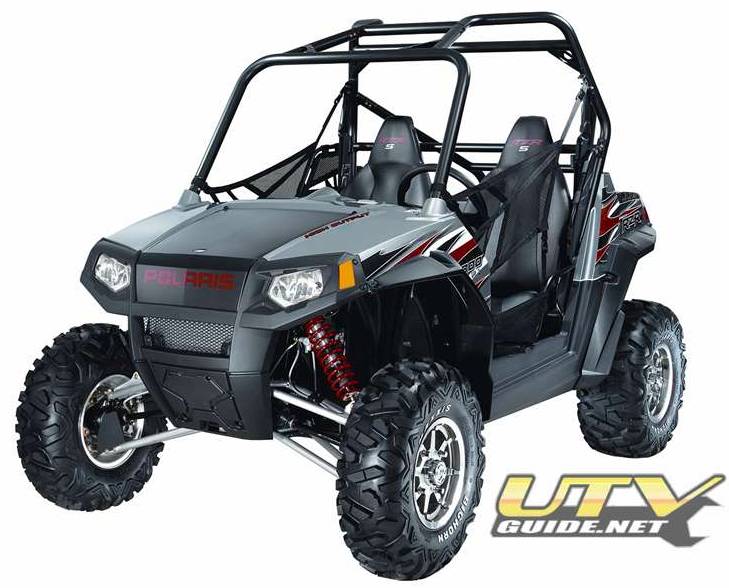
The first RZR S combined factory long-travel suspension, FOX reservoir shocks and 26-inch Maxxis Bighorn tires.
Polaris also equipped the RZR S with chromoly upper front A-arms, a rear sway bar and no front sway bar. Eliminating the front bar allowed the independent front suspension to work more freely over uneven terrain, while the rear bar helped manage body roll.
Turbo Silver bodywork, race-inspired graphics, extended rear cage supports, fender flares and eight-spoke aluminum wheels gave the RZR S a more aggressive appearance than the original 50-inch RZR.
Additional Changes for 2009
The RZR S arrived with several updates that addressed concerns found on the first-generation 2008 RZR. A heel pocket was added to the floor to help provide more controlled pedal operation at lower speeds. Polaris also revised the transmission shifting, strengthened the shoulder bolster, reduced exhaust noise and added covered storage under the seats.
The air-intake system received several important changes. The throttle body incorporated a lip intended to help retain the intake boot, the connecting boot gained bellows to accommodate movement and the air-filter element was enlarged.
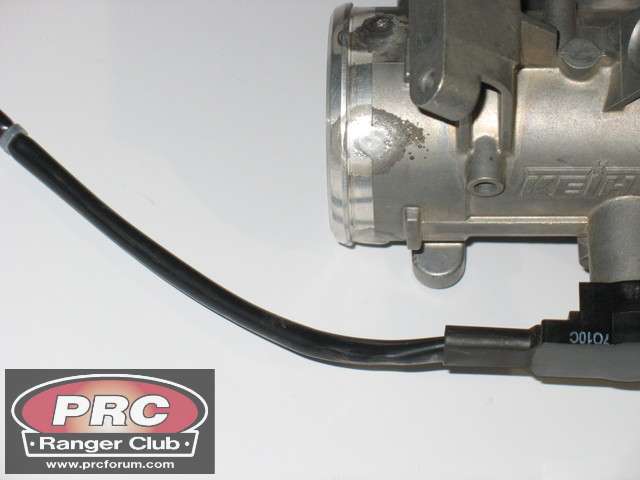
The revised intake connection included a throttle-body lip and a more flexible boot. Intake photographs were originally provided courtesy of Neal Hanger and the PRC forum.
Other detail changes included a stronger upper rear shock mount, additional frame gusseting, an elevated rectifier location for improved cooling and additional tie-down points in the cargo bed.
Driving the Original RZR S
We drove the first RZR S in the dunes at Gordons Well in California’s Imperial Sand Dunes Recreation Area. The wider stance made it considerably more stable than the standard RZR when carving bowls, sliding through corners and crossing whooped-out terrain.
The stock machine climbed both Test Hill and the hill at Patton Valley without paddle tires or reduced tire pressure. We also recorded 51 mph by GPS in the dunes. That was a respectable real-world speed in soft sand, even though it was below the manufacturer’s 63-mph top-speed claim.
Read our complete 2009 Polaris RZR S 800 dune review for the original driving impressions, performance observations and detailed photographs.
Polaris RZR S 800 Model-Year Updates: 2010–2013
2010 RZR S 800
The basic RZR S formula continued into 2010 without major mechanical changes. The most important update was a ROPS-certified cab frame. Polaris offered the model in Pearl White with a black rally stripe and produced an Orange Madness Limited Edition.
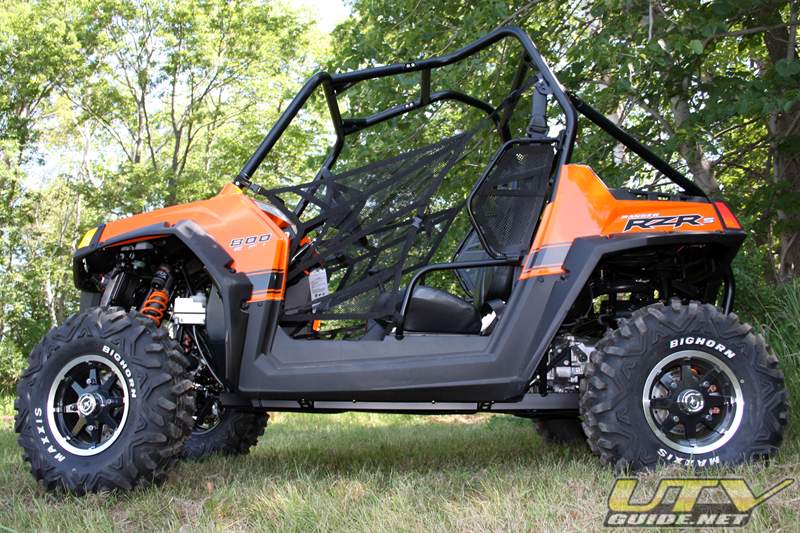
2010 Polaris RZR S 800 Orange Madness Limited Edition.
Polaris also expanded the RZR family for 2010 with the RZR 4 Robby Gordon Edition. That four-seat machine used the wider RZR S concept as the foundation for a longer-wheelbase sport UTV.
2011 RZR S 800
For 2011, the RZR S received ITP 900 XCT tires intended for aggressive cross-country trail riding. Polaris also replaced the previous FOX suspension on applicable models with Sachs shocks featuring a 2-inch body for greater oil capacity, improved cooling and better resistance to damping fade.
The standard Indy Red RZR S carried a listed price of $12,499. Gloss Black/Carbon Fiber and Gloss Black/Orange Madness Limited Editions were listed at $13,999.

The 2011 RZR S introduced ITP 900 XCT tires and larger-bore Sachs shocks.
2012 RZR S 800
The RZR S 800 continued for 2012 as the established middle ground between the narrow RZR 800 and the faster, more powerful RZR XP 900. By this point, the original RZR S formula was no longer the most extreme machine in the lineup, but its manageable size and naturally aspirated 800-class engine remained attractive to recreational riders.
2013 RZR S 800 Limited Editions
Polaris offered several distinctive RZR S 800 packages for 2013. These editions primarily combined premium suspension, wheels, body colors, graphics and interior trim with the established RZR S platform.
RZR S 800 EPS Sunset Red
The Sunset Red edition was offered in selected southern states with a listed price of $15,999. Equipment included electronic power steering, FOX Podium X shocks, Maxxis Bighorn tires on black Crusher aluminum wheels, low-profile doors, a front bumper and under-hood dry storage.

2013 Polaris RZR S 800 EPS Sunset Red edition.
RZR S 800 Blue Fire/Orange Limited Edition
The Blue Fire/Orange Limited Edition featured FOX Podium X shocks, 12-inch black Crusher aluminum wheels, painted body panels, color-matched suspension springs, custom graphics and two-tone seats.

RZR S 800 Orange/White Limited Edition
The Orange/White Limited Edition combined White Lightning body panels with an Orange Madness hood, cab frame and control arms. It also included FOX Podium X shocks, black Crusher wheels, custom graphics and three-color seats.

Original 2009 Polaris RZR S 800 Specifications
| Specification | 2009 Polaris RZR S 800 |
|---|---|
| Engine | 760cc liquid-cooled, twin-cylinder, four-stroke |
| Fuel system | Electronic fuel injection |
| Claimed horsepower | 55 hp |
| Claimed top speed | 63 mph |
| Drive system | Selectable 2WD/On-Demand AWD |
| Transmission | Automatic PVT with Park, Reverse, Neutral, Low and High |
| Front suspension | Dual A-arm with FOX Podium reservoir shocks |
| Rear suspension | Independent suspension with FOX Podium reservoir shocks and sway bar |
| Front wheel travel | 12 inches |
| Rear wheel travel | 12 inches |
| Ground clearance | 12.5 inches |
| Overall length | 102 inches |
| Overall width | 60.5 inches |
| Overall height | 70.5 inches |
| Wheelbase | 77 inches |
| Dry weight | Approximately 1,000 pounds |
| Fuel capacity | 7.25 gallons |
| Front tires | 26 x 9-12 Maxxis Bighorn |
| Rear tires | 26 x 12-12 Maxxis Bighorn |
| Wheels | 12-inch eight-spoke aluminum |
| Cargo-box capacity | 300 pounds |
| Towing capacity | 1,500 pounds |
| Receiver | 1.25 inches |
| Wheel-bolt pattern | 4/156 |
| Original starting MSRP | $13,999 |
Specifications apply to the original 2009 RZR S 800. Equipment, tires, shocks, colors and pricing varied by model year and edition.
Polaris RZR S 800 Legacy
The RZR S 800 was not simply a wider version of the original RZR. It showed that a factory-built side-by-side could offer the stance, wheel travel, shocks and aggressive handling previously associated with modified machines.
Later RZR models would become wider, faster and substantially more powerful, but the RZR S established the basic recipe: start with a compact sport platform, widen the suspension, add quality shocks and tune the machine for riders who value performance more than access to 50-inch trails.
That makes the original RZR S an important link between the trail-focused 2008 RZR 800 and later machines such as the RZR XP 900. Explore the complete model timeline in our Polaris RZR history guide.
Frequently Asked Questions
What year did the Polaris RZR S 800 come out?
The Polaris RZR S 800 was introduced for the 2009 model year. It followed the original 50-inch RZR 800, which debuted for 2008.
How wide is a Polaris RZR S 800?
The original RZR S 800 measured 60.5 inches wide. That made it approximately 10.5 inches wider than the standard 50-inch RZR 800.
How much horsepower does a Polaris RZR S 800 have?
Polaris rated the original 760cc high-output twin-cylinder engine at 55 horsepower.
How much suspension travel does the RZR S 800 have?
The original RZR S 800 provided 12 inches of front and rear suspension travel, compared with 9 inches on the standard RZR 800.
Will a RZR S 800 fit on a 50-inch trail?
No. At 60.5 inches wide, the RZR S 800 is too wide for designated 50-inch trail systems. The standard RZR 800 was designed for that type of width-restricted access.
What was the difference between the RZR 800 and RZR S 800?
The RZR S was wider and used a higher-output engine, longer suspension arms, 12 inches of wheel travel, reservoir shocks, larger tires and more ground clearance. The standard RZR 800 was narrower and better suited to width-restricted trails.


