


The 2009 Polaris RZR 170 brought the appearance and basic driving experience of Polaris’ rapidly growing sport side-by-side lineup to younger drivers. With two seats, a 169cc four-stroke engine, automatic transmission and parent-adjustable speed limiter, it gave families a smaller way to introduce appropriately sized riders to recreational off-road driving.
More than a youth vehicle wearing RZR-inspired bodywork, the RZR 170 provided a steering wheel, foot pedals, bucket seats, three-point seat belts and protective cab frame. Its introduction also marked an important early step in the history of the Polaris RZR: only one model year after launching the original adult-size RZR 800, Polaris was already turning RZR into a broader family of vehicles.

Polaris Introduces the Youth RZR 170
Polaris introduced the youth RANGER RZR 170 for drivers and passengers ages 12 and older. Its styling closely followed the original Polaris RZR 800, but the youth model measured only 47 inches wide, 85 inches long and 55 inches tall.
The compact dimensions made the RZR 170 easier to transport and more approachable for appropriately sized young drivers. An adjustable driver’s seat accommodated different rider sizes, while an adjustable passenger grab handle helped the passenger maintain a secure position.
Power came from a 169cc, four-stroke, forced-air-cooled engine. Electric starting and a fully automatic continuously variable transmission simplified operation. The transmission provided forward, neutral and reverse, eliminating the need for a manual clutch or gear changes.
Unlike the four-wheel-drive adult RZR, the youth RZR 170 used a simpler two-wheel-drive chain-driven layout. It was built for supervised recreational riding rather than difficult terrain or adult-level performance.
How Much Smaller Was the RZR 170?
These period photos show the RZR 170 beside a modified full-size RZR. Although both machines shared recognizable styling, the youth model had a much shorter, narrower and lower chassis.

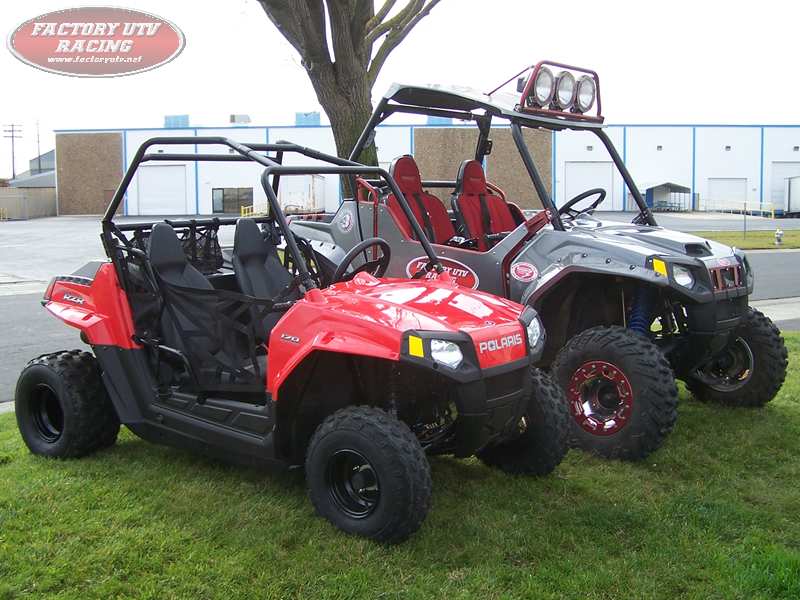
RZR 170 Safety and Parental Controls
Polaris equipped the RZR 170 with features intended to help parents control and supervise the learning process. These did not make the machine risk-free, but they gave families several useful tools for introducing a young driver to vehicle operation.
- Parent-adjustable speed limiter
- Removable ignition key
- Electronic throttle safety control
- Full protective cab frame
- Side nets
- Bucket seats with three-point seat belts
- Adjustable passenger grab handle
- Color-coded foot controls
- Hydraulic front and rear disc brakes
- Manual parking brake
- Daytime running lights
- Taillight and brake light
- High-visibility safety whip flag
At introduction, Polaris also included two DOT-approved helmets and a safety video with the RZR 170. The minimum recommended age was 12, but age alone did not determine whether a rider fit the vehicle. The driver needed to sit securely and comfortably reach the steering wheel, brake and accelerator. A passenger needed to grasp the handhold and keep both feet planted firmly on the floor.

Engine and Drivetrain
The 169cc engine was designed around manageable recreational performance rather than the acceleration of a full-size sport UTV. Forced-air cooling kept the design relatively simple, and the electric starter made operation straightforward.
The CVT transferred power through a chain to the rear axle. This arrangement required owners to inspect, lubricate and adjust the drive chain as specified in the owner’s manual. The exposed underbody and chain-drive components also made proper terrain selection important.

Suspension, Brakes and Ground Clearance
The standard RZR 170 provided 5 inches of front and rear suspension travel. The rear used a swingarm arrangement with two preload-adjustable shocks, while hydraulic disc brakes were fitted at both ends.
Ground clearance was limited compared with a full-size RZR. One of our early observations was the lack of substantial underbody protection, particularly around components that could be exposed to rocks and uneven terrain.


2009 Polaris RZR 170 Specifications
The following specifications describe the original 2009 Polaris RZR 170. Equipment and specifications changed during the model’s production, so owners should confirm parts and service information using the model year and VIN of a specific vehicle.
| Category | 2009 Polaris RZR 170 |
|---|---|
| Engine | 169cc four-stroke, two-valve single-cylinder |
| Cooling | Forced air and fan |
| Fuel system | 22mm carburetor |
| Starting | Electric |
| Transmission | Automatic CVT with forward, neutral and reverse |
| Final drive | Chain drive |
| Drive system | Two-wheel drive |
| Front suspension travel | 5 inches |
| Rear suspension | Swingarm with dual preload-adjustable shocks |
| Rear suspension travel | 5 inches |
| Front brakes | Hydraulic disc |
| Rear brakes | Hydraulic disc |
| Parking brake | Manual lever |
| Wheelbase | 65 inches |
| Length | 85 inches |
| Width | 47 inches |
| Height | 55 inches |
| Estimated dry weight | 500 pounds |
| Fuel capacity | 2.5 gallons |
| Minimum recommended age | 12 years old |
The RZR 170 Did Not Have a Cargo Bed
Although its bodywork resembled the original RZR, the RZR 170 did not have a functional rear cargo bed. The area behind the seats was primarily occupied by the engine and drivetrain, with only a small storage basket available for light items.

2011 Polaris RZR 170 Big Wheel Kit
Polaris later offered a Big Wheel Kit for the RZR 170. The package added aluminum wheels, larger tires, revised drive and driven sprockets, an O-ring chain, skid plate and the required warning decals.
Ground clearance increased to 7.5 inches with the kit installed. The sprocket changes were important because simply fitting taller tires would have altered the vehicle’s effective gearing and placed additional load on the drivetrain.

2009 Passion Pink Limited Edition
Polaris also offered a Passion Pink Limited Edition RZR 170 for 2009. The special color showed how quickly Polaris began treating its youth model as part of the broader RZR product family rather than as a one-time experiment.

The RZR 170 Aftermarket Takes Off
Just as aftermarket companies had responded to the full-size RZR, fabricators quickly began developing parts for the RZR 170. Custom cages, roofs, doors, bumpers, harness bars, skid plates and long-travel suspension systems transformed some of the small youth vehicles into elaborate custom builds.
Jagged X was among the companies to customize the RZR 170 with a replacement cage, bumpers, nerf bars and custom paint.

Lone Star Racing developed suspension and chassis components that significantly changed the RZR 170’s stance. Other companies, including DragonFire Racing and Racer Tech, also entered the growing youth UTV aftermarket.


Why the Original RZR 170 Matters
The RZR 170 was not designed to duplicate the performance of an adult sport side-by-side. Its importance came from translating the RZR concept into a smaller two-seat vehicle with parental controls and youth-oriented operation.
When the original 2008 Polaris RZR 800 arrived, RZR was still a single model. The subsequent arrival of the wider RZR S 800, four-seat RZR 4 800 and youth RZR 170 demonstrated how quickly Polaris recognized the potential to expand the platform into distinct categories.
The RZR 170 ultimately established the foundation for the company’s later youth side-by-side models. It remains a notable part of RZR history because it helped turn one successful sport UTV into a nameplate capable of serving several types and ages of recreational riders.
Polaris RZR 170 FAQ
What year did the Polaris RZR 170 come out?
Polaris introduced the RZR 170 for the 2009 model year. Availability began in early 2009.
What engine was used in the original RZR 170?
The original RZR 170 used a 169cc, four-stroke, forced-air-cooled single-cylinder engine with electric starting.
Was the Polaris RZR 170 four-wheel drive?
No. The RZR 170 was a two-wheel-drive youth side-by-side with a chain-driven rear axle.
Did the RZR 170 have reverse?
Yes. Its automatic CVT included forward, neutral and reverse.
How wide was the 2009 RZR 170?
The original model was 47 inches wide. It measured 85 inches long, 55 inches tall and had a 65-inch wheelbase.
What was the minimum age for the RZR 170?
Polaris recommended the RZR 170 for drivers and passengers ages 12 and older. Both occupants also needed to properly fit the vehicle and comfortably reach the required controls or handholds.
Did the RZR 170 have a speed limiter?
Yes. A parent-adjustable speed limiter allowed an adult to restrict maximum performance while a young driver developed experience.
RZR 170 Safety Reminder
The Polaris RZR 170 is an off-road vehicle and is not intended for operation on public roads or paved surfaces. The driver and passenger must meet the manufacturer’s age and fit requirements. Occupants should always use the seat belts and side nets and wear properly fitted helmets, eye protection and protective clothing.
Never carry more than one passenger. Avoid excessive speed, sharp turns and terrain beyond the driver’s ability. Follow the warnings, maintenance requirements and operating instructions in the owner’s manual and on-product safety labels. Owners of used machines should confirm that the vehicle has not been modified in a way that compromises its restraints, protective structure, controls or speed-limiting system.
Continue exploring the milestones, models and engineering changes that shaped the lineup in our complete Polaris RZR history.


