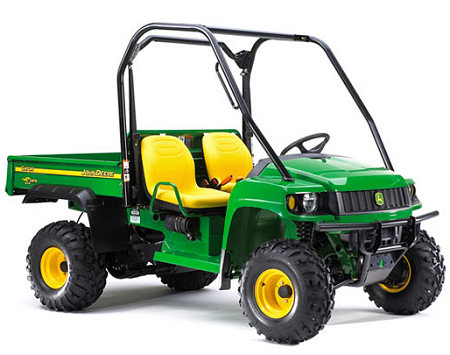
| John Deere Gator XUV 850D 4×4
Features and Benefits:
| Choice of Colors |
- The 850D 4×4 is available in 2 color schemes: John Deere Green & Yellow or Olive & Black
|
| Reliable/Durable |
- 854 cc (24.6 hp) liquid cooled, 3-cylinder , 4-cycle Yanmar diesel engine has more horsepower for incredible performance in any terrain; best-in-class diesel unit is the most powerful, fastest accelerating, and fastest top speed diesel in its class
- 30 mph top speed (17 mph in low range) allows you to be more efficient, herd livestock, or cover a field faster
- Increased acceleration for improved performance
- Advanced clutching with a tighter belt provides increased acceleration, smoother at low speeds, and efficient engine braking to assist descending down hills
- Standard Occupant Protection System (OPS) with a passenger-side hand-hold and 3-point seat belts is SAE and OSHA ROPS-certified, providing rugged “off-road” looks and protection
- Two-range CVT transmission for superior low-speed pulling and towing ability
- Long lasting front and rear hydraulic service brakes with mechanical rear park brake provide an automotive-style brake system with a dual circuit for the greatest reliability and a smoother-feeling engagement
- Hydroformed frame for unmatched strength and durability
- Engineered plastic (JDLOY) can be painted and provides improved scratch and marring resistance/recoverability
- Standard bumper protects the vehicle
|
|
| Stable |
- Independent Rear Suspension (IRS) provides excellent ride quality and superior terrain capability
- 7-inch suspension travel soaks up bumps and terrain while maintaining traction through any condition
- 11-inch ground clearance for greater access over obstacles on the trail and superior terrain capability
- Larger styled wheels (12 inches) and tires (25 inches) for greater ground clearance and sporty good looks
|
|
| Go Anywhere Capability |
- On-demand, “true” 4-wheel drive gives you total control; select a completely turf friendly mode of operation, or press the switch and get on-demand 4-wheel drive for climbing the toughest trails
- Rear traction assist locks the rear drive wheels together to push through tough spots
- Improved steering further reduces steering effort for assured predictability
- Choice of Aggressive Tread Tires (AT489) or All-Purpose (All Trail II) Tread Tires
- Optional automotive-style, deluxe glass cab and other weather protection accessories for the OPS are available to keep you going in almost any weather condition
- Utility vehicles are intended for off-road use only
|
|
| Easy To Use |
- Standard integrated 2-inch rear receiver hitch
- Attractive styling with integrated features such as cup holders, 12-volt outlet, glove box, storage compartment, and fuel gauge
|
John Deere Gator 850D XUV 4×4 Specifications:
| Engine and Electrical |
 |
| |
Make |
Yanmar 3TNV70 |
|
|
| |
Type |
4-cycle diesel |
|
|
| |
Cylinders |
3 |
|
|
| |
Valving |
OHV |
|
|
| |
Horsepower* |
24.6 (18.3 kw)* |
|
|
| |
Displacement |
854 cc |
|
|
| |
Maximum torque, ft.-lb. (Nm) |
36.9 (50) @ 2400 rpm |
|
|
| |
Iginition type |
Compression ignition |
|
|
| |
Lubrication |
Full pressure |
|
|
| |
Oil filter |
Screw on filter |
|
|
| |
RPM, idle (no load) |
1050 +/- 25 |
|
|
| |
RPM, fast (no load) |
3700 +/- 25 |
|
|
| |
Cooling system |
Liquid |
|
|
| |
Air cleaner |
Dry, replaceable single element with remote intake |
|
|
| |
Muffler |
— |
|
|
| |
Battery |
480CCA |
|
|
| |
Alternator |
40 amp @ 3200 rpm regulated, 540 watts |
|
|
| |
Headlights |
Two 37.5 watt halogen |
|
|
| Fuel System |
|
| |
Capacity, U.S. gal. (L) |
5.3 (20.1) |
|
|
| |
Consumption (half load at avg. speed), U.S. gal./hr. (L/h) |
0.5 (1.89) |
|
|
| |
Fuel pump type |
Electric |
|
|
| 4WD |
|
| |
System Type |
On-demand true four-wheel drive system |
|
|
| |
Front Differential (Engagement) |
Auto-locking (On/off rocker switch) |
|
|
| |
Rear Differential (Engagement) |
Positive locking, mechanically actuated (hand-operated) |
|
|
| Transmission |
|
| |
Type |
Continuously Variable Transmission (CVT) |
|
|
| |
Drive belt |
Spun top cog, 31 mm wide |
|
|
| |
Ground speed, mph (km/h) |
0-30 (0-48) Hi Forward, 0-15 (0-24) Lo Forward, 0-17 (0-27) Reverse |
|
|
| |
Transaxle |
Two speed, oil bath |
|
|
| |
Gear Selection |
Forward (hi-lo), Netural, Reverse |
|
|
| |
Overall Reduction Ratio: |
— |
|
|
| |
|
Low |
86.8488:1 |
|
|
| |
|
High |
86.8488:1 |
|
|
| |
|
Reverse |
75.9333:1 |
|
|
| |
Brakes |
Front/rear hydraulic disk |
|
|
| |
Park brake |
Driveline mechanical disk, hand operated |
|
|
| |
Bearings |
Sealed, double-row ball |
|
|
| |
Axle |
27 mm dia., forged CV-shaft with Double Offset Joint |
|
|
| Suspension and Steering |
|
| |
Suspension, front |
Independent with McPherson Strut |
|
|
| |
Front Susp. Travel (total), in. (mm) |
5.15 (131) |
|
|
| |
Suspension, rear |
Independent with coil over shock |
|
|
| |
Rear Susp. Travel (total), in. (mm) |
7 (170 mm) |
|
|
| |
Steering |
Rack and Pinion |
|
|
| |
Turning radius, ft. (m) |
12.4 (3.8) |
|
|
| Hitch |
|
| |
Front |
Optional 2-in receiver |
|
|
| |
Rear |
Standard 2-in receiver |
|
|
| Occupant Protective System (OPS) |
|
| |
Tubular overhead structure |
1.75 in (44.4 mm) steel tube |
|
|
| |
Passenger grab handles |
Front OPS post, front dash and on both sides of seat |
|
|
| |
Seat belts |
3-point |
|
|
| |
Certification |
SAE J2194 and OSHA ROPS |
|
|
| Ground Pressure (max): |
|
| |
With 200-lb. Operator Only, psi (kg/cm2) |
14 (0.98) |
|
|
| |
Fully Loaded Vehicle, psi (kg/cm2) |
14 (0.98) |
|
|
| Ground Clearance |
|
| |
Ground Clearance, in. (mm) |
11 (267) |
|
|
| |
Under Foot Platform, in. (mm) |
12.25 (311) |
|
|
| Dimensions |
|
| |
Length (w/out bumper), in. (mm) |
108 (2743) |
|
|
| |
Length (with bumper), in. (mm) |
113 (2870) |
|
|
| |
Width, in. (mm) |
59.3 (1506) |
|
|
| |
Front-tread Centers, in. (mm) |
44.8 (1137) |
|
|
| |
Rear-tread Centers, in. (mm) |
47.9 (1216) |
|
|
| |
Height (overall with OPS), in. (mm) |
74.375 (1889) |
|
|
| |
Wheelbase, in. (mm) |
79.0 (2007) |
|
|
| |
Weight (incl. fuel/fluids), lb. (kg) |
1532 (695) |
|
|
| |
Seating Capacity |
2 |
|
|
| |
Seat Type |
Professional high back bucket, tilt forward |
|
|
| |
Towing Capacity, lb. (kg) |
1300 (590) |
|
|
| |
Payload Capacity, lb. (kg) |
1400 (635) |
|
|
| |
Sound rating (at operator’s ear), dB(A) |
91.1 |
|
|
| Cargo Box |
|
| |
Material |
Steel |
|
|
| |
Capacity |
— |
|
|
| |
|
Dimensions, in. (mm) |
43.9L x 49W x 9D (1116L x 1244W x 229D) |
|
|
| |
|
Volume, cu. ft. (m3) |
11.2 (0.32) |
|
|
| |
|
Weight, lb. (kg) |
1000 (454) |
|
|
| |
|
Dump |
Manual (factory installed power lift option) |
|
|
| |
|
Tailgate |
Hinged at bottom, removable |
|
|
| Tires |
|
| |
Front |
25×10-12 (AT489), 25×9-12 (All Trail II) |
|
|
| |
Rear |
— |
|
|
| |
|
Turf & AT489 |
25×11-12 (AT489 only) |
|
|
| |
|
All Trail II |
25×11-12 |
|
|
| |
Available Tread Types |
Standard (All Trail II), Aggressive (AT489) |
|
|
| Color |
|
| |
Options |
Green/Yellow |
|
|
| Notes |
|
| |
Disclaimers |
*Engine hp is provided by engine mfr. for comparison purposes. Actual operating hp will be less. |
Links:
Manufacturer Info:
Website: www.deere.com
|


No Comments