Can-Am Industry News UTV Product Reviews

2020 Can-Am Defender 6×6 Review: Hands-On Test and 2026 Update

Can-Am Defender 6x6

By Jon Crowley

The Can-Am Defender 6×6 was created for jobs that demand more cargo space, traction and towing capacity than a conventional utility side-by-side can provide. I drove the original 2020 Defender 6×6 in Texas, including tests with nearly 1,000 pounds of concrete in the bed and a Can-Am Outlander ATV loaded on the convertible flatbed.

What stood out wasn’t simply how much the six-wheel Defender could carry. It was how manageable the long machine felt from behind the wheel—and how much better its suspension worked once we put a serious load in the bed.

This review covers that original hands-on test and includes an important update for shoppers considering a 2026 Can-Am Defender 6×6 Limited.

Can-Am Builds a Different Kind of Utility UTV

Can-Am devoted considerable attention to its utility lineup for the 2020 model year. Along with the all-new Defender 6×6, the company introduced the long-bed Can-Am Defender PRO and expanded the lineup with a Defender Limited featuring factory HVAC.

The Defender 6×6 combined elements of those machines into an even more specialized work platform. Its extra rear axle provided selectable four- or six-wheel drive, while its enormous six-foot cargo box offered twice the floor length of a standard Defender bed.

A Six-Foot Cargo Box That Converts Into a Flatbed

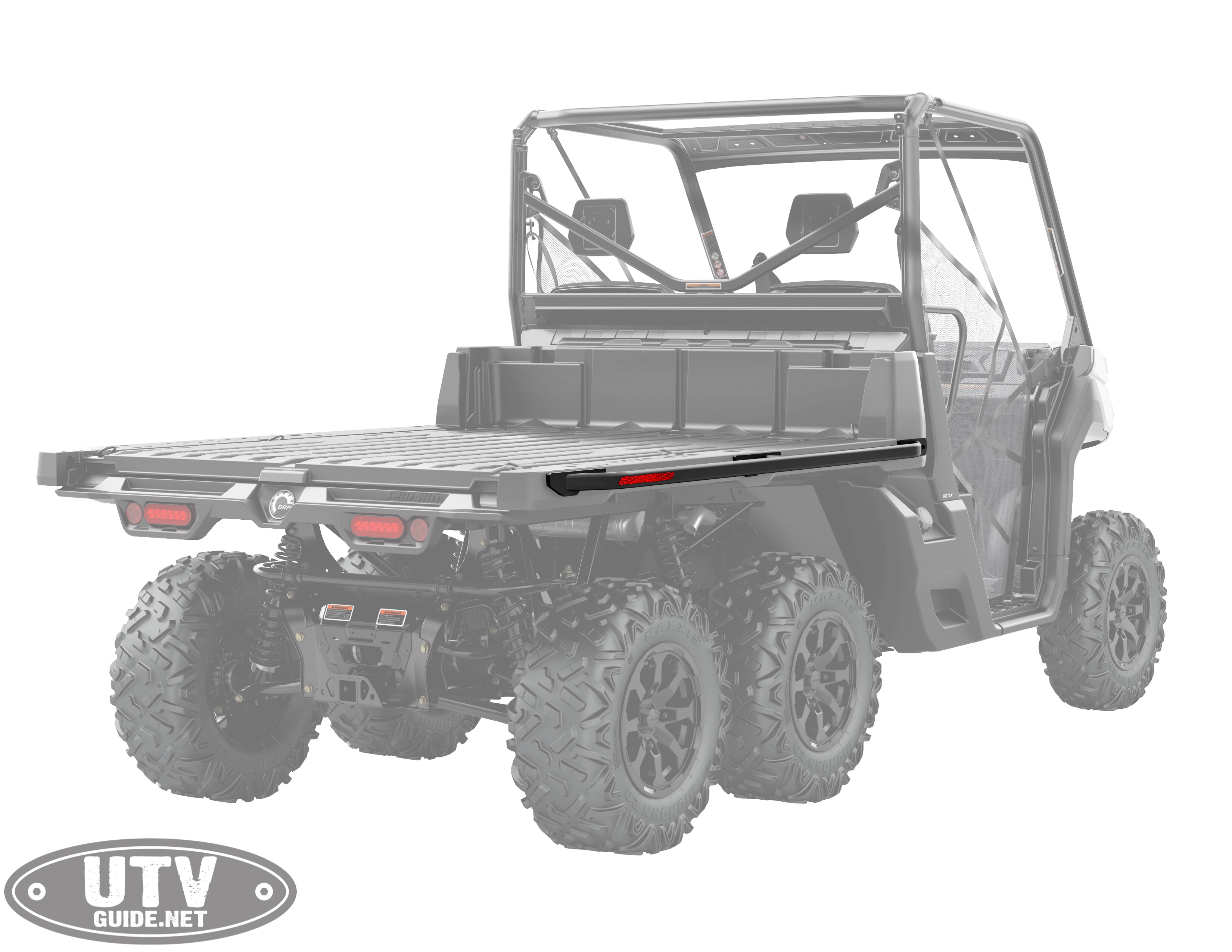
The Defender 6×6’s 72-by-54.5-inch cargo box is one of the most useful features I have encountered on a production utility UTV. The side panels and tailgate can be removed without turning the conversion into a major project, leaving a large flatbed for oversized or unusually shaped cargo.

Can-Am Defender 6x6 cargo box converted into a flatbed

Can-Am Defender 6×6 cargo box converted into a flatbed

The bed is rated to carry up to 1,000 pounds, although the California specification for this original model was limited to 600 pounds. The Defender 6×6 also has a 2-inch receiver and a 3,000-pound towing rating.

That combination gives it a useful middle ground between a conventional UTV and a full-size pickup. It can transport a substantial load while reaching work areas where a truck may be too wide, heavy or difficult to maneuver.

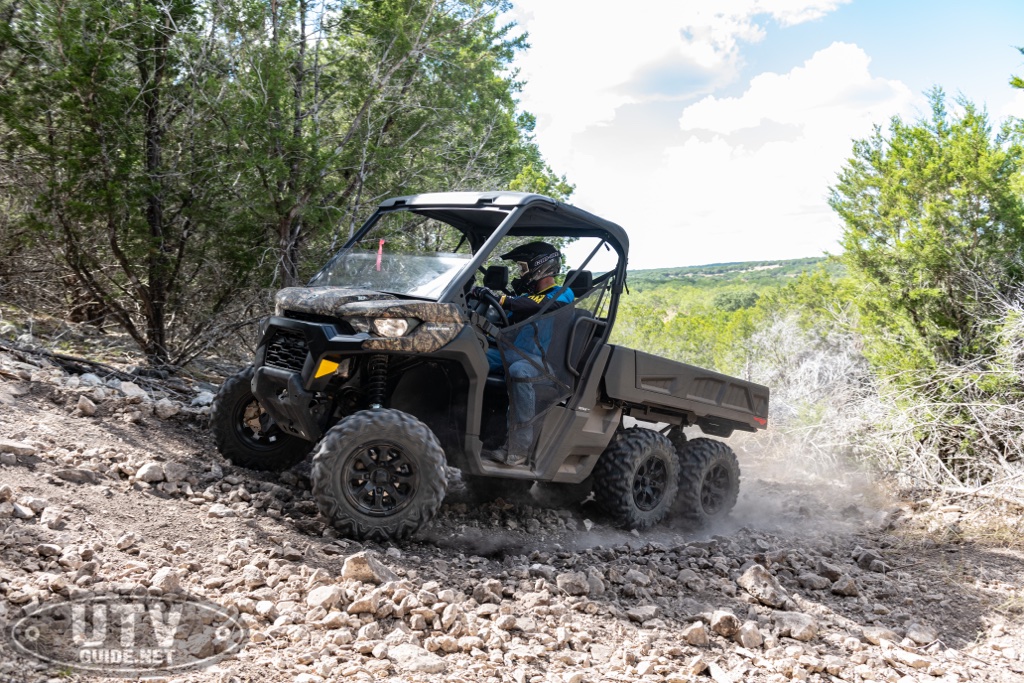
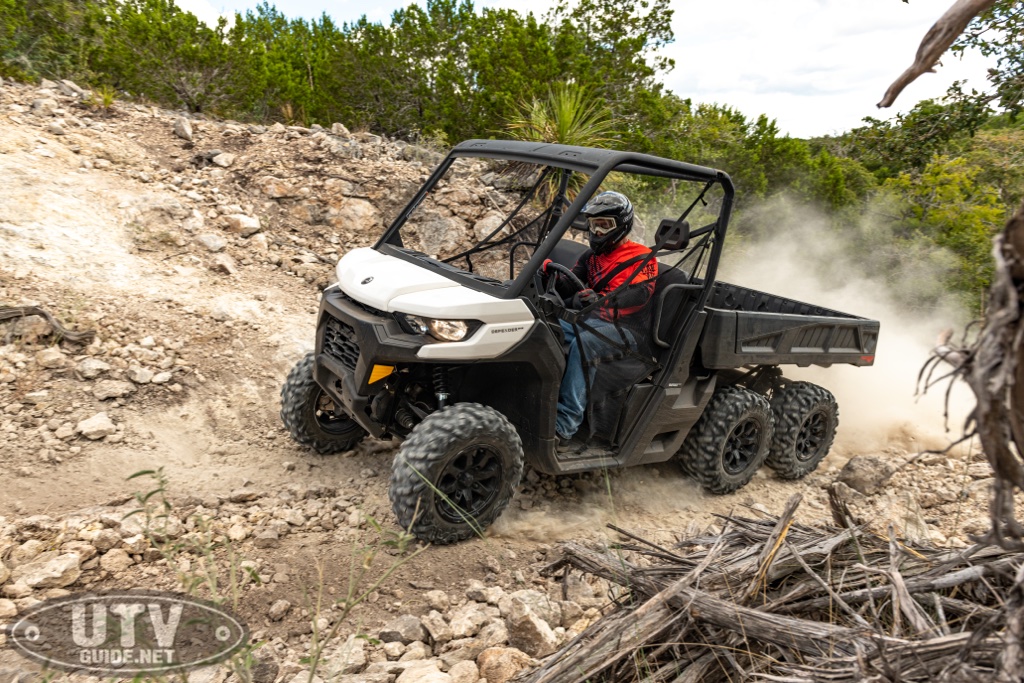
2020 Can-Am Defender 6x6 DPS HD10 on a ranch trail

The Defender 6×6 combines a long cargo bed with selectable six-wheel drive

Testing the Defender 6×6 in Texas

We tested the then-new Defender 6×6 at Y.O. Ranch Headquarters in Texas Hill Country. With more than 10,000 acres available, the ranch gave us room to drive the Defender over graded roads, uneven trails and terrain representative of the places where a six-wheel utility vehicle would actually work.

The first surprise was how nimble it felt. The Defender 6×6 measures 153.4 inches long and rides on a 115.5-inch wheelbase. Add the third axle, and it looks like it should drive like a tank—but it doesn’t.

You remain aware of the vehicle’s length in tight spaces, but its steering and chassis make it considerably easier to place than its size suggests. It feels like a purpose-built utility vehicle rather than an oversized novelty.

Ride Quality Improves With Weight in the Bed

With only a driver and passenger aboard, the suspension felt firmer than I would prefer. That is understandable because the springs must support a cargo rating of up to 1,000 pounds. A suspension tuned solely for a plush unloaded ride would struggle when the bed was filled to capacity.

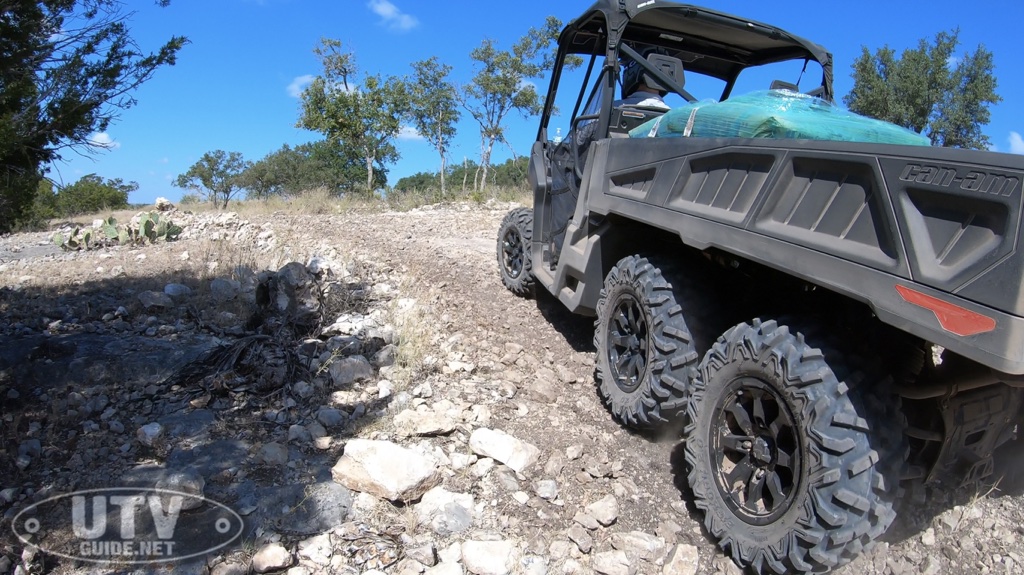
We loaded the Defender with approximately 1,000 pounds of concrete to see how it handled a realistic maximum load. The additional weight settled the rear suspension and noticeably improved the ride.

Can-Am Defender 6x6 carrying approximately 1000 pounds of concrete

Testing the Defender 6×6 with approximately 1,000 pounds in the cargo bed

Even with that load, we did not experience suspension bottoming during the test. The machine felt more composed with weight in the rear, although the suspension naturally settled farther into its travel.

This remains one of the central compromises of the Defender 6×6. One fixed spring-and-shock package must work with an enormous range of payloads. A factory-adjustable load-leveling system—whether using air springs, helper springs or self-leveling shocks—would make the platform even more versatile.

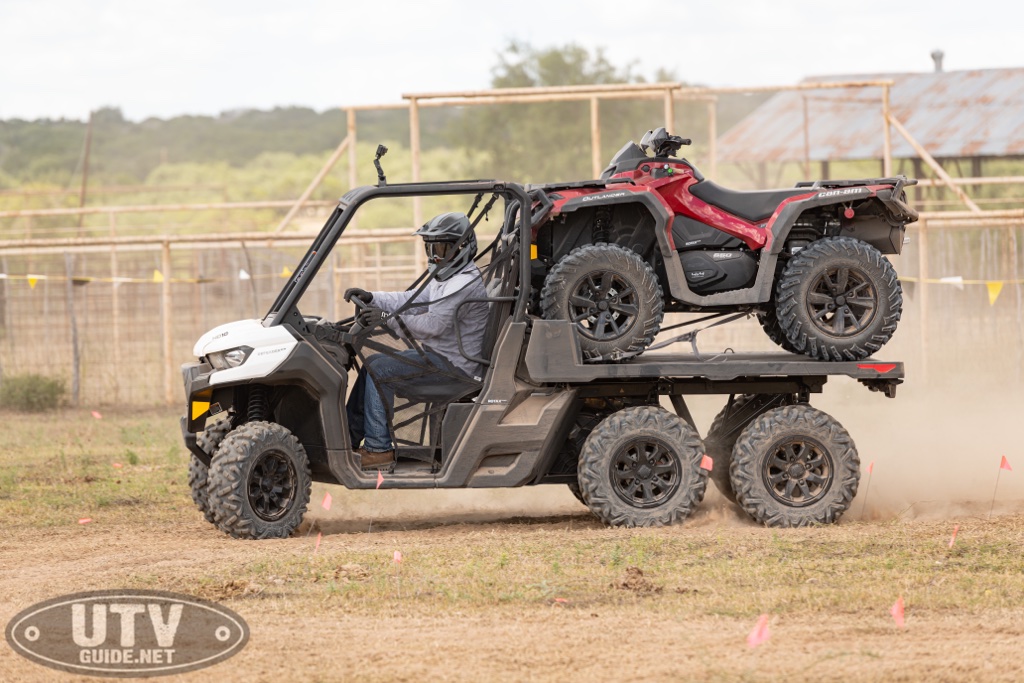
Hauling a Can-Am Outlander ATV

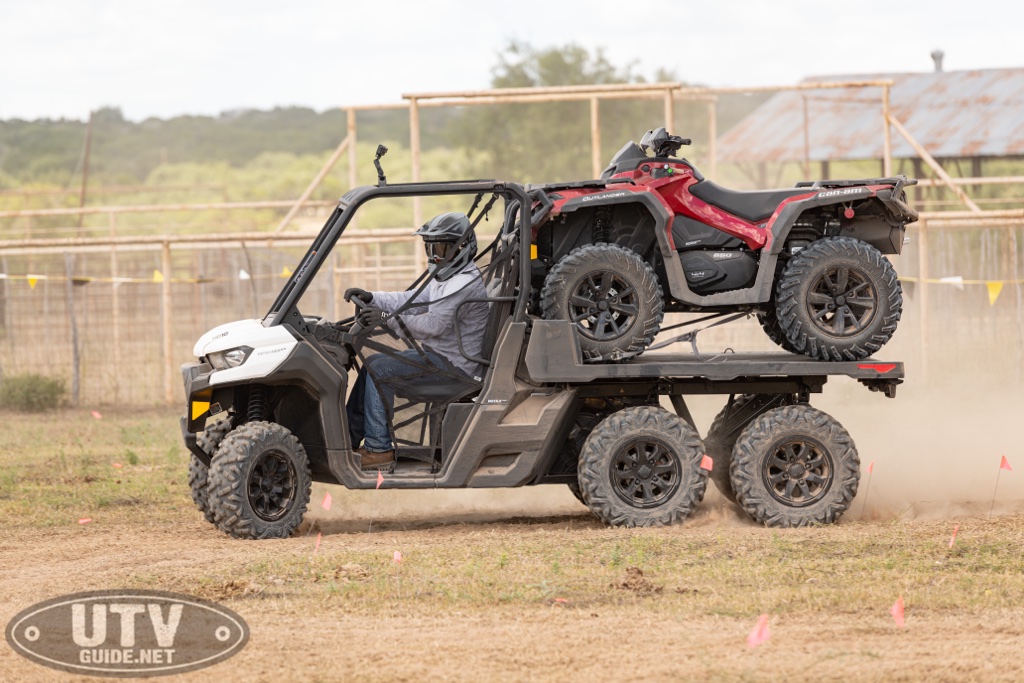
Removing the bed sides allowed us to load a Can-Am Outlander 4×4 ATV onto the flatbed. This test demonstrated why the convertible bed is more than a specification-sheet talking point.

Can-Am Defender 6x6 hauling a Can-Am Outlander ATV on its flatbed

A Can-Am Outlander ATV loaded onto the Defender 6×6 flatbed

A ranch, utility crew or emergency-response organization may need to carry pumps, tanks, sprayers, generators or equipment that will not fit neatly between conventional cargo-box sides. The Defender’s flatbed conversion provides a much more adaptable foundation for those applications.

Six-Wheel Traction

The Defender 6×6 lets the driver select either 4×6 or 6×6 operation. In 4×6 mode, the two rear axles drive the vehicle. Selecting 6×6 adds the front wheels when maximum traction is required.

The additional driven axle increases the number of tires available to transfer power to the ground. It can also help distribute the machine’s weight over soft surfaces. Those qualities are particularly useful when carrying cargo through mud, snow, sand or uneven ranch terrain.

More driven wheels do not make the Defender invincible, and the extra length still matters when crossing abrupt terrain changes. Nevertheless, its combination of traction, carrying capacity and ground clearance gives it access to places where a loaded pickup may struggle—or simply may not fit.

2020 Defender Chassis and Powertrain

The original Defender 6×6 launched with the updated 82-horsepower Rotax HD10 V-twin producing 69 lb-ft of torque. It also received the broader 2020 Defender family improvements, including revised CVT calibration, a quieter exhaust system, a lighter and stronger dual-phase steel frame, and improved front and rear sealing intended to reduce cab noise, heat and dust.

Can-Am Defender 6x6 HD10 driving across Texas ranch terrain

The Defender 6×6 felt more maneuverable than its dimensions suggested

The rear suspension uses Can-Am’s Double Torsional Trailing Arm Independent design to control the four rear wheels. Despite the long wheelbase and third axle, the Defender maintained predictable handling throughout our test.

2026 Can-Am Defender 6×6 Update

The Defender family underwent another major expansion for 2026, led by the redesigned Can-Am Defender HD11 and its 95-horsepower inline-three engine. However, the distinction is important: the 2026 Defender 6×6 does not move to the new HD11 platform.

The 2026 Defender 6×6 continues with the proven 976cc Rotax HD10 V-twin producing 82 horsepower and 69 lb-ft of torque. Its fundamental strengths also remain familiar:

  • Selectable 4×6 and 6×6 operation
  • 72-by-54.5-inch modular cargo box
  • Convertible flatbed configuration
  • Up to 1,000 pounds of cargo-box capacity
  • 3,000-pound towing capacity
  • Extra-low gearing for heavy work

For 2026, buyers can choose DPS, XT and Limited 6×6 configurations. The XT adds work-focused equipment including a roof, front bumper, full skid plate, winch and power-tilt bed.

The biggest evolution is the 2026 Can-Am Defender 6×6 Limited. It combines the six-wheel HD10 platform with a fully enclosed cab, heat and air conditioning, power windows and a power-tilt cargo bed. That answers two of the suggestions from my original test: factory HVAC and power assistance for the enormous bed.

Keeping the HD10 also makes sense for owners who value an established engine and predictable low-speed power delivery over having the newest horsepower number. Buyers specifically looking for the new three-cylinder engine and redesigned chassis should consider the HD11 models, but those machines do not offer the Defender 6×6’s third axle and six-foot bed.

What the Defender 6×6 Does Well

  • It feels smaller from the driver’s seat: The long wheelbase and third axle are less cumbersome than expected.
  • The convertible flatbed is genuinely useful: Removable sides make it easier to carry oversized cargo or install specialized equipment.
  • The cargo area is enormous: Its six-foot bed is twice as long as the standard Defender cargo box.
  • It can handle serious work: A 1,000-pound bed rating and 3,000-pound towing capacity put it well beyond most conventional utility UTVs.
  • Six-wheel drive adds capability: The third driven axle helps the vehicle move heavy loads through soft or uneven terrain.
  • The 2026 Limited addresses comfort: Factory HVAC makes the platform much more practical for year-round professional use.

What Could Be Better

  • Unloaded ride quality: The suspension feels firm when the bed is empty because it must also support a four-figure cargo load.
  • Load leveling: A factory-adjustable or self-leveling rear suspension would improve its ability to handle widely varying payloads.
  • Overall size: It drives smaller than it looks, but its 153.4-inch length still requires planning in confined spaces and on tight trails.
  • No HD11 option for 2026: Buyers wanting the new 95-horsepower engine cannot currently combine it with the 6×6 chassis.

Can-Am Defender 6×6 Review Verdict

The Defender 6×6 is not simply a standard Defender with another axle attached. Its huge convertible bed, 3,000-pound towing rating and selectable six-wheel drive give it a distinct purpose.

Our test showed that it could carry approximately 1,000 pounds without bottoming the suspension, transport a full-size ATV on its flatbed and still feel more maneuverable than its dimensions suggested. Its firm unloaded ride is the clearest compromise, but that is inseparable from the work capacity built into the chassis.

The 2026 lineup makes the platform more appealing without changing its core formula. The HD10 remains in place, while the XT and Limited packages add features—particularly the power-tilt bed and factory HVAC—that make the 6×6 better suited to long workdays and specialized commercial applications.

If your priorities are maximum cargo space, traction and the ability to carry substantial equipment into terrain a pickup cannot easily reach, the Can-Am Defender 6×6 remains one of the most specialized and useful utility UTVs available.

You Might Also Like