


For 2013, Arctic Cat expanded the color and equipment choices for its original two-seat Wildcat 1000. The mechanical foundation remained centered on a 951cc V-twin engine, a 64-inch-wide chassis and the long-travel suspension that helped distinguish the Wildcat when it entered production for 2012.
The initial 2013 lineup consisted of the standard Wildcat 1000 and the better-equipped Wildcat 1000 Limited. Arctic Cat later expanded the model-year family with the four-seat Wildcat 4 and the higher-output Wildcat X.
2013 Wildcat 1000 Models and Colors
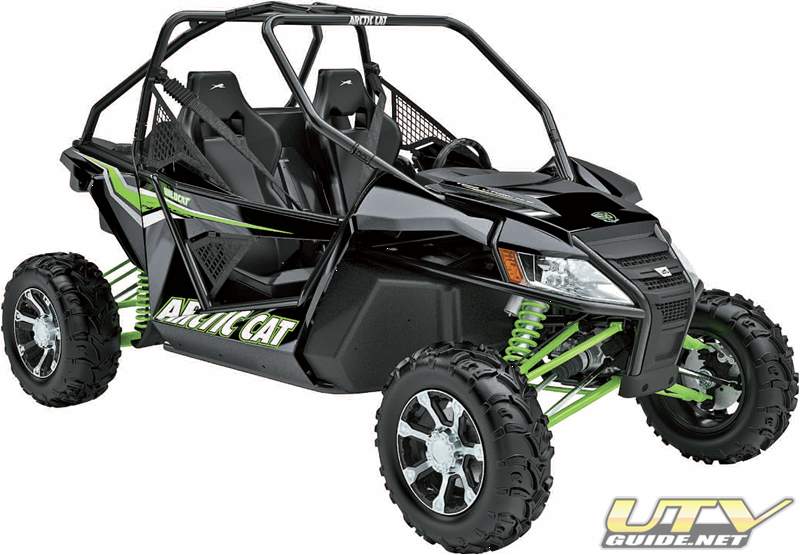
The standard 2013 Arctic Cat Wildcat 1000 was offered in three painted finishes:
- Black Metallic
- Green Metallic
- Orange Metallic
The Wildcat 1000 Limited added more distinctive finishes and additional factory equipment. It was available in Vibrant Red Metallic or White Metallic with Orange accents.
Limited models also received color-matched seats and front and rear aluminum sport bumpers. These additions gave buyers a more complete package without immediately turning to the aftermarket.
951cc V-Twin Engine
Power came from Arctic Cat’s liquid-cooled 951cc SOHC V-twin four-stroke engine with electronic fuel injection. Dual 50mm throttle bodies, an updated intake system and a ceramic-coated 2-into-1 exhaust helped produce the strong low- and midrange torque expected from the large-displacement twin.
The engine was positioned near the middle of the chassis. This helped centralize mass while allowing Arctic Cat to provide a relatively roomy cockpit for the driver and passenger.
A continuously variable transmission provided Park, Reverse, Neutral, High and Low ranges. A dashboard switch controlled two-wheel drive, four-wheel drive and four-wheel drive with the front differential locked.
Long-Travel Wildcat Suspension
The Wildcat’s defining feature was its suspension. Double A-arms provided 17 inches of front-wheel travel, while Arctic Cat’s five-link trailing-arm rear suspension delivered 18 inches of travel.
Walker Evans Racing remote-reservoir shocks with dual-rate springs and adjustable compression damping controlled the suspension. The five-link rear design was intended to limit camber change and axle plunge as the wheels moved through their travel.
With 13 inches of ground clearance and a 64-inch stance, the Wildcat was designed primarily for open desert, dunes and other terrain where its suspension travel could be used effectively.
Full-Perimeter Chassis
The Wildcat used a full-perimeter frame constructed from high-strength low-alloy steel. Its approximately 40/60 front-to-rear weight distribution and low seating position were intended to provide stable handling while reducing how much movement the occupants experienced as the suspension worked through rough terrain.
Variable-assist electronic power steering was standard equipment. Steering assistance was available at low speed and varied according to vehicle speed, steering input and resistance at the front tires.
Interior and Cargo Capacity
High-back bucket seats, three-point seat belts and rear-hinged tube-frame doors with integrated nets formed the core of the two-seat cockpit. For 2013, Arctic Cat added a revised passenger handhold to improve passenger security over rough terrain.
A centrally mounted digital and analog gauge displayed vehicle information without substantially obstructing the driver’s forward view. The interior also included a locking glovebox, two cup holders, tilt steering and a 12-volt accessory outlet.
Behind the passenger compartment, the rear cargo box was rated to carry as much as 300 pounds. LED headlights and taillights were also standard.
Later 2013 Wildcat Additions
Arctic Cat continued developing the platform after this initial 2013 lineup was announced. The company subsequently introduced the longer-wheelbase Wildcat 4 for four occupants and the Wildcat X with more than 90 claimed horsepower.
The later 2013.5 updates also brought Team Industries Rapid Response clutches, a lighter crankshaft, FOX Podium shocks and a rear sway bar to portions of the Wildcat family. Those changes should not be confused with the specifications of the two models announced in August 2012.
Why the 2013 Wildcat Matters
The 2013 lineup represented the first expansion of Arctic Cat’s original long-travel sport UTV. Although the initial updates were largely centered on colors, interior details and the Limited package, the model year soon grew into a broader family with four-seat and higher-output versions.
That development helped establish the Wildcat as more than a single model and prepared the platform for the additional Wildcat variants that followed. See our complete Arctic Cat Wildcat 1000 history, specifications and model guide for the evolution of the original full-size Wildcat family.


