


By Jon Crowley
The 2020 Polaris RZR PRO XP Ultimate proved surprisingly capable during our rock-crawling test on California’s Rubicon Trail. Its 64-inch width, longer wheelbase, tight turning radius, high-clearance suspension and improved clutch calibration created a good technical-trail package. However, its relatively tall Low-range gearing and light factory underbody protection kept it from being a purpose-built rock crawler in stock form.
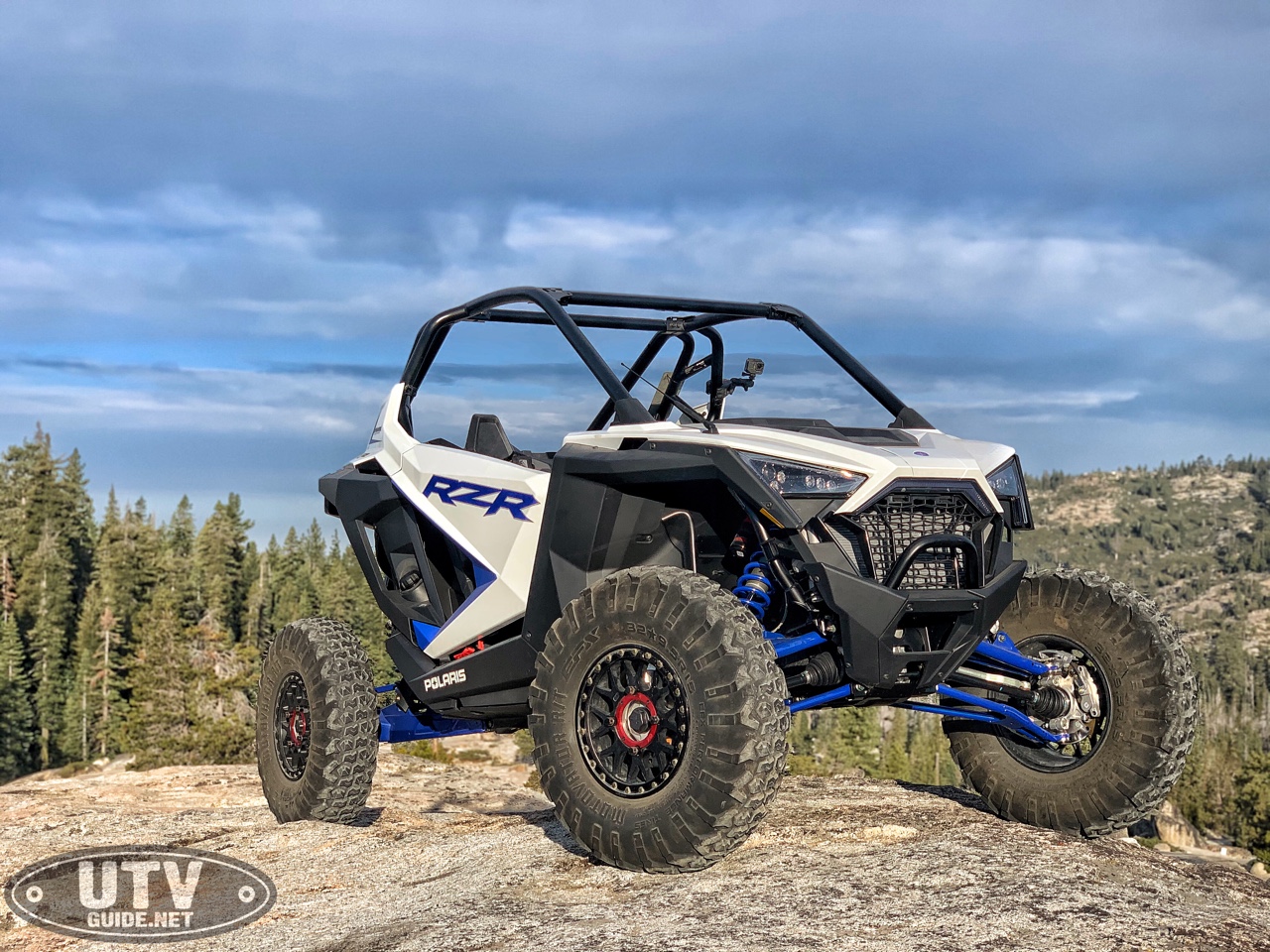
Except for 32-inch EFX MotoVator R/T tires mounted on 15-inch KMC Grenade beadlock wheels, our early-production PRO XP Ultimate was stock. That made this trip a useful test of what Polaris’ completely redesigned RZR platform could do on demanding terrain without extensive modifications.

Our 2020 Polaris RZR PRO XP Ultimate on the Rubicon Trail.
The 2020 model introduced a stronger one-piece chassis, 181-horsepower turbocharged engine, redesigned clutch, roomier cockpit and 96-inch wheelbase. For a complete examination of the platform, see our 2020 Polaris RZR PRO XP overview, specifications and technical details.
Testing the RZR PRO XP on the Rubicon Trail
The Rubicon Trail is an excellent place to expose the strengths and weaknesses of a sport UTV. Large rocks, stair-step ledges, tight turns and uneven lines demand slow-speed control, useful ground clearance and a chassis that can remain composed while the suspension works independently at each corner.
I had already spent considerable time driving and modifying the 72-inch RZR Turbo S, including changing its transmission gearing to improve technical performance. That experience made the Turbo S a natural comparison point for the new PRO XP.
Although the PRO XP was six inches narrower than the Turbo S, it had a six-inch-longer wheelbase. On paper, that combination raised an important question: Would the additional length help it climb ledges, or make it cumbersome in tight rocks?
After several hours on the Rubicon, the answer was clear. The extra wheelbase improved stability on stair-step obstacles, yet the revised steering geometry gave the PRO XP an impressively tight turning radius. It could work through narrow lines and around rocks without requiring as many multi-point turns as its length might suggest.
32-Inch EFX MotoVator R/T Tires and KMC Beadlocks
Before the trip, we replaced the stock 30-inch tires and 14-inch wheels with 32-inch EFX MotoVator R/T tires mounted on 15-inch KMC Grenade beadlock wheels. At the time, a 32-inch tire was quickly becoming the practical starting point for serious UTV rock crawling.
The larger tires increased ground clearance while giving us a tougher, more aggressive tread for the granite. Other than the tire-and-wheel package, the PRO XP remained stock.

The only modifications were 32-inch EFX MotoVator R/T tires and 15-inch KMC Grenade beadlock wheels.
Traction was excellent. Even with approximately 15 psi in the tires, the MotoVator R/Ts gripped in places where I expected some wheelspin. They climbed cleanly over the rocks and also worked well during previous trail rides in the Eastern Sierra.
Their performance made them a good all-around choice for a vehicle expected to cover rocks, dirt trails and mixed terrain rather than being built exclusively for crawling.
Low-Range Gearing and Clutch Control
Low-range gearing was my biggest concern going into the test. The RZR Turbo S was geared too tall for the type of slow, controlled driving I prefer in technical rocks. We had previously opened the transmissions in both our two-seat and four-seat Turbo S models and installed lower gearing, which produced a substantial improvement.
The original PRO XP’s Low range was similarly taller than ideal. Left completely to the gearing, the vehicle still wanted to travel faster than I would prefer on difficult obstacles.
The important difference was the PRO XP’s redesigned clutch. It engaged earlier and provided much better control at very low speeds than the Turbo S. Instead of needing additional momentum or a more aggressive throttle input to climb an obstacle, the PRO XP could creep forward and pull itself over technical sections with considerably more control.
The clutch did not replace genuinely lower gearing, but it made the tall Low range much less troublesome. For moderate rock crawling, the combination worked better than expected. A dedicated crawler would still benefit from lower transmission gearing, particularly when running larger tires.
Longer Wheelbase Without Sacrificing Maneuverability
The PRO XP used a 96-inch wheelbase, six inches longer than the preceding two-seat RZR XP platform. That extra length was noticeable in a positive way when climbing stair steps and crossing uneven ledges.
A longer wheelbase can help a UTV bridge gaps and remain more stable as the front tires climb an obstacle before the rear tires begin their ascent. The PRO XP felt planted and predictable in those situations.
Polaris compensated for the added length with more steering angle. On the Rubicon, the resulting turning radius was one of the vehicle’s strongest attributes. The PRO XP remained nimble and could sneak between rocks without excessive backing and repositioning.
It was an effective combination: more stability from the longer wheelbase without the awkward low-speed maneuverability sometimes associated with a longer chassis.
High-Clearance Suspension Components
High-clearance suspension components helped the PRO XP negotiate the rocks. Up front, arched A-arms provided more room around obstacles than conventional straight arms. At the rear, the arched lower radius rods offered useful clearance and appeared substantially built.
After several hours on the trail, the lower rear links showed little evidence of contact. That was impressive considering the size and frequency of the rocks we crossed.

High-clearance suspension components helped the PRO XP work through the Rubicon’s rocks.
The lower front A-arms were more concerning. Their relatively small-diameter tubing looked light for repeated hard use in large rocks. Owners planning serious rock crawling may want stronger aftermarket A-arms along with A-arm guards to protect the tubes and vulnerable suspension hardware.
Skid Plate and Underbody Protection
The stock skid plate provided good coverage from the front of the vehicle to the rear, but the material was thinner than I would want for frequent hard rock crawling. It was suitable for general trail use, but repeated contact with sharp ledges could eventually damage the skid or the components above it.
A full UHMW skid plate, trailing-arm guards and additional suspension protection would be high on my upgrade list before regularly tackling extreme trails.
I was also concerned about the exposed hardware around the trailing-arm mounting area. Its location kept the mount tucked close to the frame, but a direct impact could potentially catch the washer or bolt. More substantial protection would provide additional confidence when sliding over large rocks.
DYNAMIX 2.0 Suspension in the Rocks
Our PRO XP Ultimate was equipped with DYNAMIX 2.0 active suspension and RIDE COMMAND. Polaris revised the Comfort, Sport and Firm calibrations compared with the system used on the Turbo S.
Comfort mode felt more compliant in the rocks than the Turbo S calibration. It allowed the suspension to move over uneven terrain without making the vehicle feel uncontrolled or excessively soft. Even during faster sections of the trail, it retained enough compression resistance to keep the suspension from using all its travel too easily.
Firm mode added damping and could also help hold the vehicle higher in its suspension, producing a little more usable clearance in certain situations. However, the PRO XP’s Firm setting was noticeably stiffer than the Turbo S setting and was not especially comfortable for sustained rock crawling.
The steering-wheel-mounted controls were a major convenience. The driver could switch among Comfort, Sport and Firm without taking a hand far from the wheel or navigating through several display menus.
The red X button temporarily commanded maximum firmness from all four shocks. That feature was more useful at speed than while crawling, but it could prepare the suspension for an unexpected impact, deep G-out or abrupt ledge. Releasing the button returned the shocks to their previous setting.
Roomier and More Adjustable Cockpit
The PRO XP cockpit represented a major improvement over previous RZR designs. Polaris lowered the seats and added legroom, creating a more spacious and comfortable driving position.
At 6 feet 1 inch tall, I could slide the seat rearward and still have plenty of room around my legs. The steering wheel offered both tilt and telescoping adjustment, allowing me to bring it closer without compromising legroom. That was particularly helpful for a taller driver with long legs.
The seats were supportive and reasonably comfortable for factory equipment. Polaris’ retractable Click-6 harnesses allowed the occupants to move naturally and lean forward for a better look at the trail without being held tightly against the seatback.
The six-point arrangement used separate straps around each leg and felt unusual at first, but the retractors made it more convenient than a conventional fixed racing harness. Openings between the seat cushions also increased airflow, although their shape took some time to get used to.
Door Coverage Could Be Better
The factory doors were one of my least-favorite parts of the PRO XP. Polaris appeared to prioritize styling and airflow, leaving several large openings in the door panels.
For rock crawling, I would prefer more complete coverage from the upper door panel down to the rocker area. Full-coverage doors help keep sticks, rocks, mud and other debris outside the cockpit while creating a more finished appearance.
The openings also made it more difficult for aftermarket manufacturers to add simple lower-door inserts without working around the original styling lines. Better factory coverage would have been appropriate on a high-end sport UTV.
A More Solid RZR Chassis
The PRO XP’s one-piece welded chassis felt noticeably more rigid than earlier RZR platforms assembled from multiple bolted frame sections. While traveling quickly through rough portions of the trail, the vehicle produced fewer of the squeaks, rattles and movements we had experienced in some previous Polaris models.
The chassis felt solid as the suspension articulated through the rocks. That structural improvement was an important part of the new platform and helped the vehicle feel more refined and substantial.
The rollover structure also attached to the frame at multiple points. However, owners planning competition use or extreme rock crawling should still install a properly designed aftermarket cage appropriate for that use.
The longer, more rigid PRO XP chassis felt stable and composed in technical terrain.
Early Test-Unit Issues
Our early-production test vehicle was not completely trouble-free. It stalled twice without an obvious cause, and the shift linkage was not adjusted correctly when we received it. The improper adjustment allowed the transmission to ratchet when High range was selected.
Those problems raised understandable quality-control concerns, but they should be viewed as observations from this specific early unit rather than proof that every PRO XP experienced the same issues. Correct shift-linkage adjustment is particularly important because an incompletely engaged transmission can damage internal components.
What We Liked
- Excellent turning radius despite the longer wheelbase
- Added stability on stair-step obstacles
- Improved slow-speed clutch engagement compared with the Turbo S
- High-clearance front A-arms and arched rear radius rods
- DYNAMIX 2.0 suspension with steering-wheel controls
- Comfortable, roomy and highly adjustable cockpit
- Tilt-and-telescoping steering wheel
- Retractable Click-6 harnesses
- Solid-feeling one-piece chassis
- Good forward sightlines
- Large cargo bed
- Proven Turbo S-based front differential
What We Would Change
- Lower the Low-range gearing for better technical control
- Add stronger front A-arms for extreme rock use
- Install a thicker UHMW skid plate and suspension guards
- Provide more complete factory door coverage
- Include a roof on higher trim levels
- Allow the engine to be started in gear with the brake applied
- Improve pre-delivery inspection and shift-linkage adjustment
2020 RZR PRO XP Rock-Crawling Verdict
The 2020 Polaris RZR PRO XP was not designed as a dedicated rock crawler, but it performed remarkably well on the Rubicon Trail. Its 64-inch width helped it fit through tight sections, while the 96-inch wheelbase added stability and the revised steering geometry preserved maneuverability.
The factory Low range remained taller than ideal, especially after installing 32-inch tires. However, the redesigned clutch engaged earlier and more smoothly than the Turbo S system, allowing the PRO XP to crawl through technical sections with much better control than its gearing suggested.
For occasional rock crawling, a set of capable 32-inch tires, beadlock wheels and stronger underbody protection would create a versatile trail package. For repeated use on extreme terrain, lower gearing, upgraded front A-arms, a full UHMW skid plate, trailing-arm guards and more complete doors would be worthwhile additions.
Most importantly, this test showed that the new PRO XP platform offered more than horsepower. Its improved chassis, longer wheelbase, tighter steering, better cockpit and refined clutch made it a meaningful step forward in the history of the Polaris RZR.
More Polaris RZR PRO XP Videos
This technical walkaround examines the engineering details introduced with the original 2020 RZR PRO XP platform:
This additional overview covers the PRO XP’s features and place within the RZR lineup:
2020 Polaris RZR PRO XP Rock-Crawling FAQ
Is the 2020 Polaris RZR PRO XP a good rock crawler?
Yes, the PRO XP is a capable recreational rock crawler. Its 64-inch width, 96-inch wheelbase, tight turning radius, high-clearance suspension and improved clutch engagement worked well on the Rubicon Trail. Its tall factory Low-range gearing and relatively light underbody protection are its main limitations in extreme terrain.
What size tires did UTV Guide use on the PRO XP?
We installed 32-inch EFX MotoVator R/T tires on 15-inch KMC Grenade beadlock wheels. The original 2020 PRO XP came with 30-inch Maxxis Carnivore tires on 14-inch wheels.
Does the 2020 RZR PRO XP have Low range?
Yes. Its PVT transmission includes High and Low ranges. However, we found the original Low-range gearing taller than ideal for controlled rock crawling, particularly with larger tires.
How does the PRO XP crawl compared with the RZR Turbo S?
The PRO XP’s redesigned clutch engaged more smoothly and provided better low-speed control than the Turbo S we had previously tested. The PRO XP was also six inches narrower and had a tighter turning radius, although the Turbo S offered a wider stance and additional suspension capability for high-speed terrain.
What should be upgraded before serious rock crawling?
Our priorities would be a full UHMW skid plate, trailing-arm and suspension guards, stronger front A-arms and lower transmission gearing. More complete doors and a purpose-built roll cage may also be appropriate depending on the difficulty of the terrain.
Did the longer wheelbase hurt maneuverability?
No. The 96-inch wheelbase improved stability on stair-step obstacles, while the increased steering angle gave the PRO XP a surprisingly tight turning radius. It remained nimble in the tighter portions of the Rubicon Trail.


