By Jon Crowley
By now, most everyone has got a look at the new Kawasaki Teryx KRX 1000. Unveiled on October 7, 2020 and at many dealers that same day or at least the same week. Other manufacturers should take note, this is how to introduce a new model!
I had the opportunity along with other media and dealers to test the KRX 1000 at a test track built on private property two days after the unveil. If you haven’t see our First Impressions from this ride, check it out:
This week, Kawasaki invited a few media outlets out to beautiful Moab Utah for a more thorough test drive of the KRX 1000. On day one we hit Seven Mile Rim which is more of a fast paced ride with some whoops and g-outs, with just a little bit of rock crawling mixed in. On day two, we did Poison Spider with a bit of Golden Spike and Where Eagles Dare. This trail has much more rock crawling with just a few high speed sections.
While neither of these trails are extreme rock crawling trails, it was enough to give us a taste of how well the KRX 1000 can rock crawl. At these manufacturer rides, we cannot disconnect sway bars, drop air pressure to 5 psi or pick trails that suited my interest, so please take that into consideration.
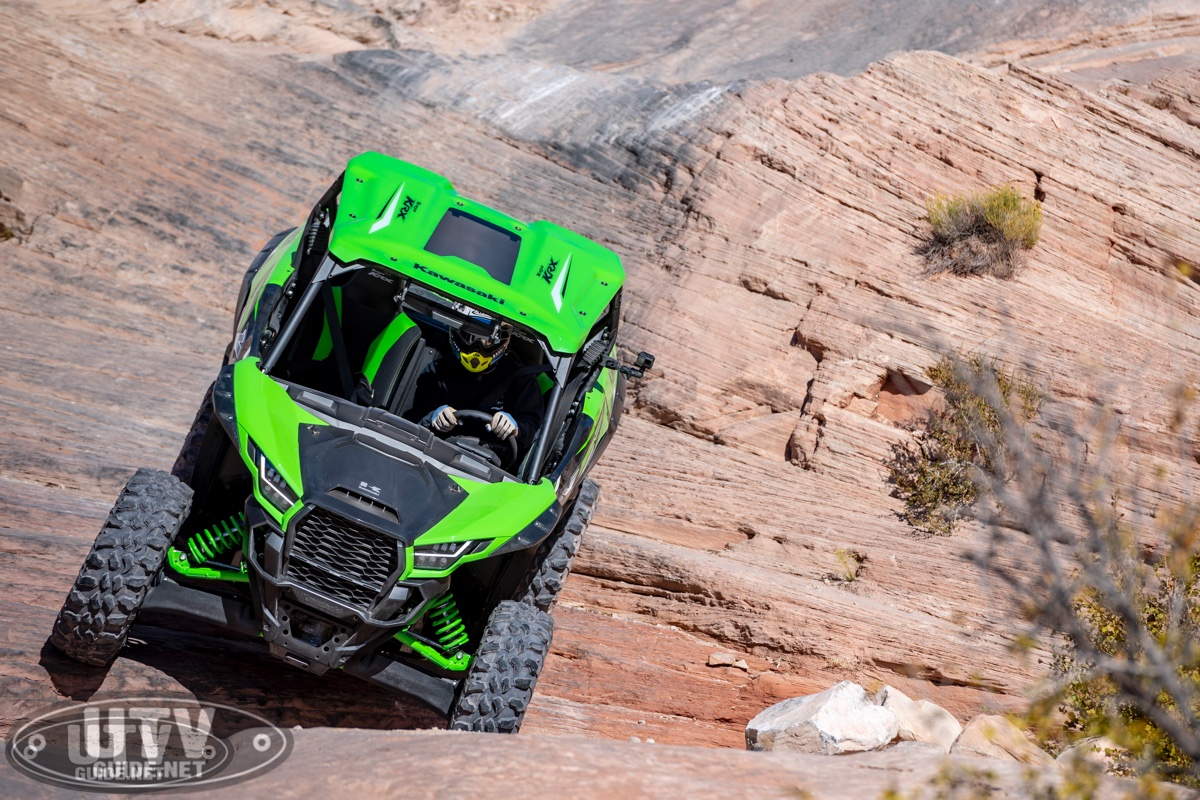
Working the suspension on the Kawasaki Teryx KRX 1000 – 19/21 inches of wheel travel
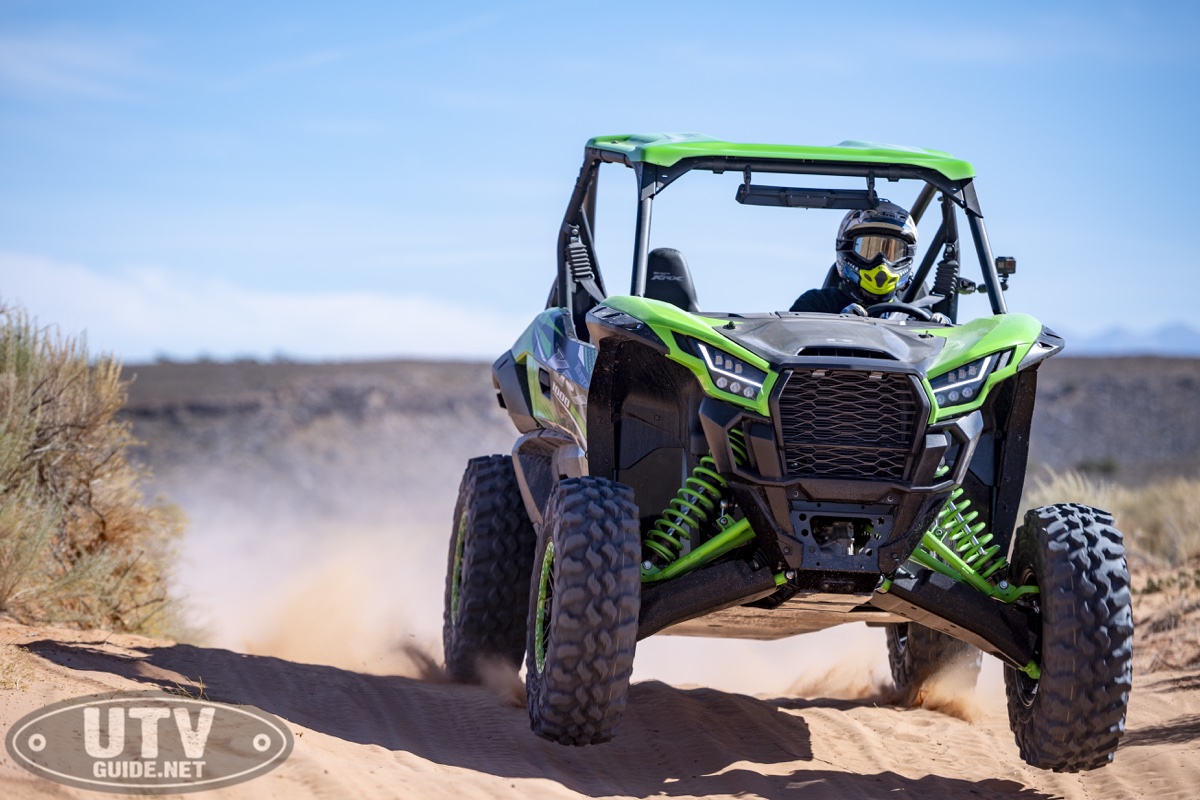
High Speed Driving
For the faster paced testing, I found that the KRX 1000 suspension handled whoops and g-outs very well. Shocks were in the factory settings and air pressure was set to 12PSI front and 17PSI rear.
The longer wheelbase really helped keep the KRX planted and aimed where we pointed. The rear end did not buck although we did have a spare in the back so that may have helped a bit. With just me in the car, it did not bottom out over high speed g-outs so that was great. At 114HP and 1900 lbs, the KRX 1000 certainly doesn’t win drag races and it is a bit sluggish off the line.
The factory speed is limited to 68MPH by the ECU by that should be easy to remove with a reflash once the tuning companies get their hands on them.
The KRX 1000 comes with dual-rate springs which improves shock performance and is great to see on a factory unit. Only downside I experienced with this setup is the clunking noise when the crossover rings are hit as the shocks cycle through the travel.
I would not suggest buying this unit if you feel the need to do 80MPH in the desert or if you plan to hit the sand dunes very often. That being said, K&T Performance is already well underway in developing a bolt-on turbo kit if that is your thing. No word on a factory turbo offering at this time.
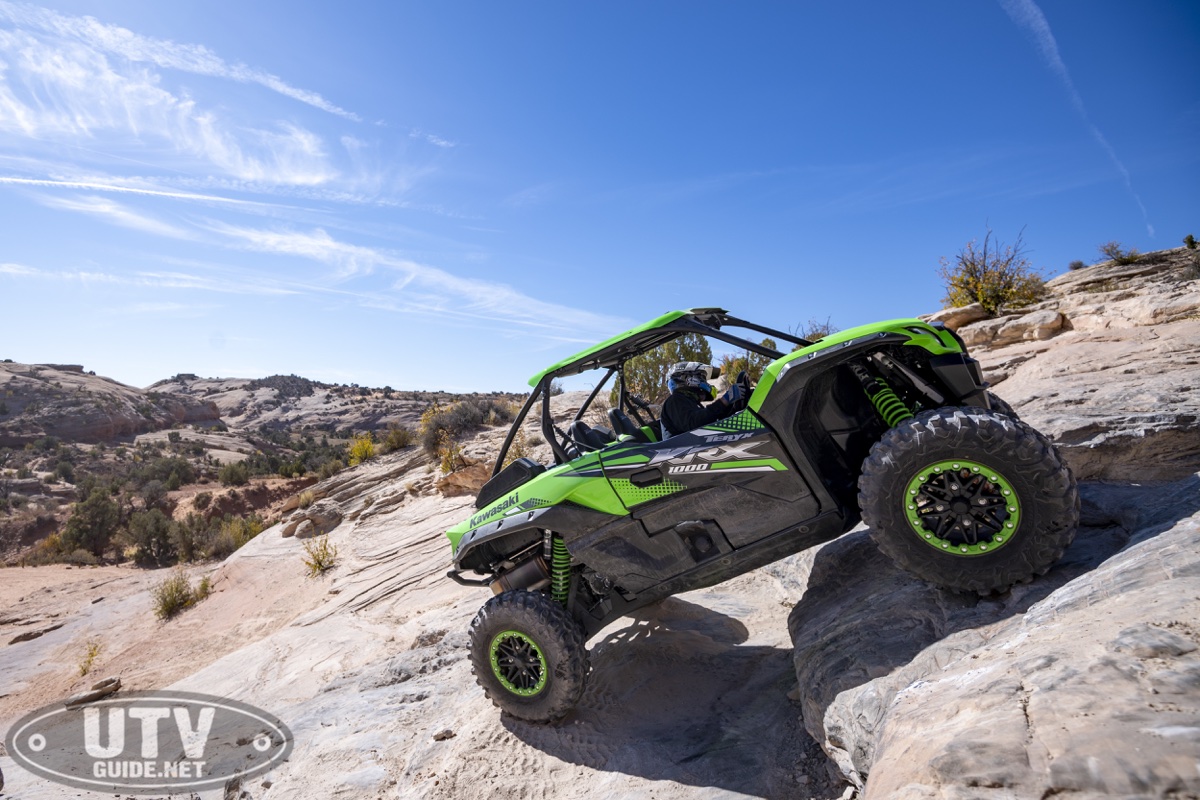
Rock Crawling with the Kawasaki Teryx KRX 1000
Rock Crawling
As I mentioned, we did get a taste of how the KRX 1000 can rock crawl in Moab, but the trails we were on certainly weren’t that extreme. But I did get a good enough feeling to tell you I think the KRX 1000 will be a very solid performer if rock crawling is your thing.
Low range gearing is sufficiently low to allow the driver to take on obstacles at slow speed with great control. The centrifugal clutch works very well and I never once felt and belt slip. Pretty sure I could have run Poison Spider in high range (not recommended) without blowing a belt.
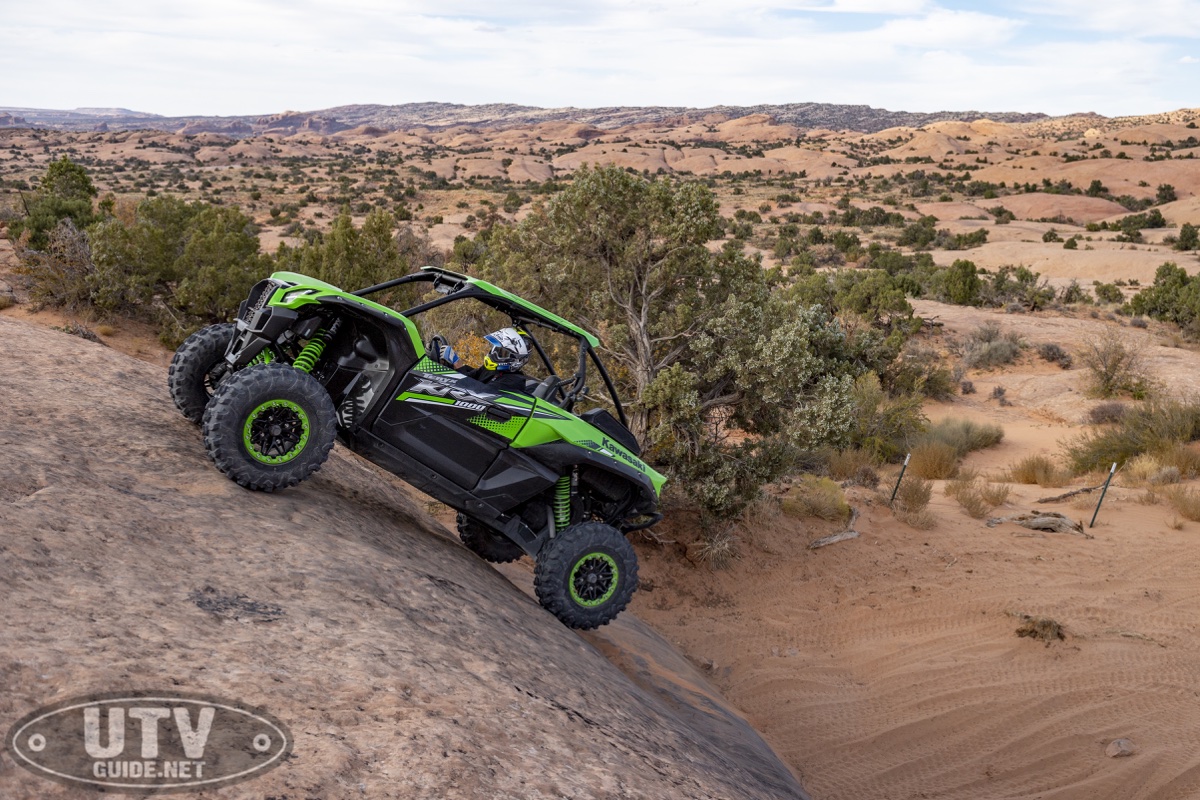
The Kawasaki Teryx KRX 1000 has an excellent low range and centrifugal clutch that handles steep terrain without belt slip
Front differential has a manually actuated locker that fully locks the front axles. On the plus side, this system fully locks the front. The only negative is you have to think about it and activate it when needed. Some people prefer that, and others don’t. It is kind of a personal preference thing, but the good news is it works great and the steering isn’t overly impacted when actuated.
The KRX 1000 comes with 31-inch which work decently well in the rocks. If you’d like to go bigger, I am sure a 32-inch tire will clear in all situations. For rock crawling only, I wouldn’t be afraid to run a 35-inch tire with probably minor clearance issues and I think the clutch and drivetrain could handle that.
Approach and departure angles are excellent because the tires stick out front and behind and body or frame.
The factory skid plate on the KRX 1000 is steel and plastic. Not up to the task for rock crawling, but a Kawasaki Genuine Accessory HMW skid already exists, along with rocker guard, a-arm guard and trailing arm guards. All of our test units in Moab had these skids on them and I’d recommend them before hitting the rocks in your new KRX 1000.
Sight line over the hood isn’t that great on the KRX 1000. Not bad in the middle of the hood, but excessively high on the fenders. I found myself looking out the side of the vehicle to try to get a better view in technical situations.
Suspension is all high clearance and stout enough that I’d feel comfortable running trails at Hammers without spending on aftermarket arms. That being said, if you want to get stronger and wider, HCR Racing already has a long travel 72-inch suspension available.
General
The cab on the KRX 1000 is quite roomy. I am 6’ 1” and had decent leg room. Both driver and passenger seats are adjustable without tools.
Glove box is on the small side.
The KRX 1000 does not come with a roof, but I highly recommend the Kawasaki Genuine Accessory roof if you are keeping the stock cage. Our units were all equipped with these roofs.
Seats are decent, but do not have much bolstering. Three-point seat belts come stock, and there isn’t a visible bar behind the seats to wrap 5-point harnesses around. Pretty sure a box tube lies behind the plastic and that may be able to be used to bolt harnesses to though. Otherwise I am sure the aftermarket guys will come out with a bolt-on harness bar fairly quick.
Factory ROPS cage mounts to the frame is 8 locations: A, B and C pillars plus an addition bar on each side that attaches to the b-pillar and dies into the chassis where the rear upper shock mount is located. Nice touch.
Bed is large – full-sized 31-inch spare tire fits flat and there is also a Kawasaki Genuine Accessory for a spare tire rack above the bed if you want to carry a spare and have lots of room for gear.
The radiator cooling fan turns on at 188F and off at 183F and I really prefer that over some other sport UTVs that don’t turn on until above 205F.
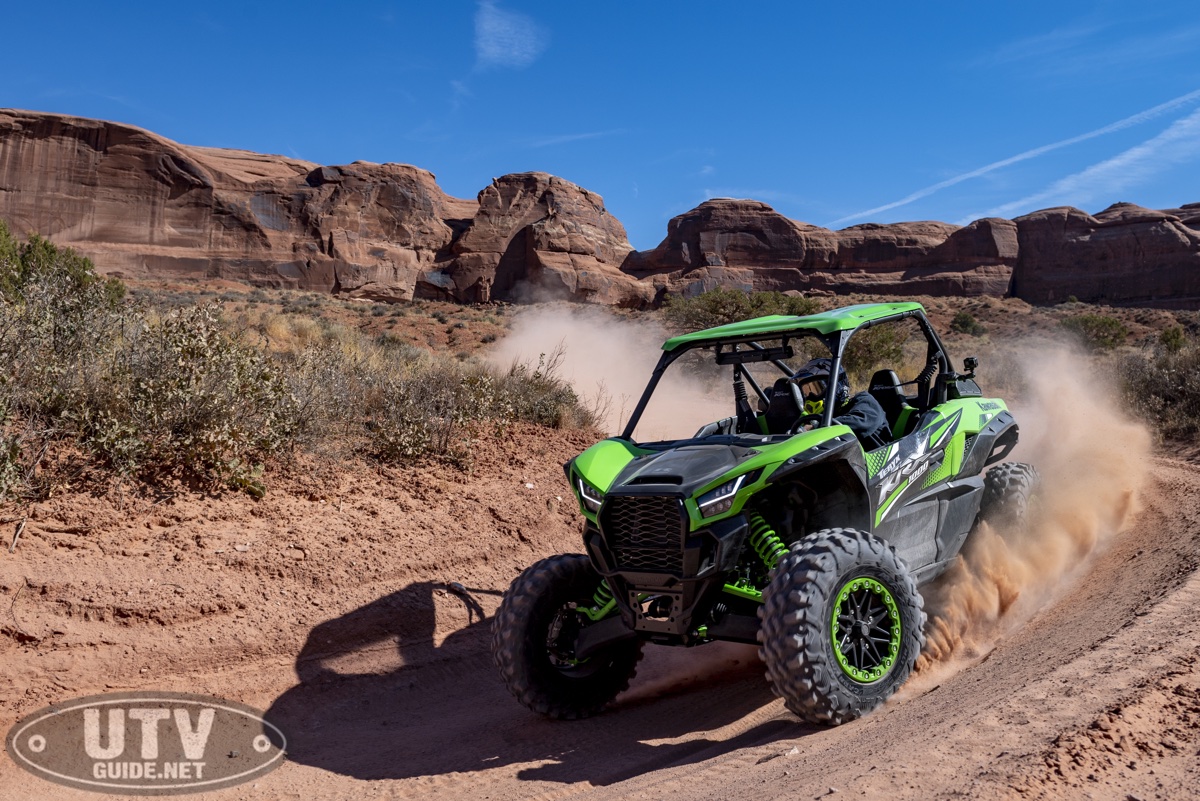
Kawasaki Teryx KRX 1000
Summary
The KRX 1000 is heavy side at 1900 lbs. Extra weight affects performance and I felt this when testing acceleration, etc. But on the plus side, the KRX 1000 is built like a tank. I’d have no problem running any trail at the Hammers with a stock unit except for the addition of skid and roof. I also believe the entire chassis and drivetrain will last for 1000’s of miles without worry and without additional gussets, plates or shock bracing.
When buying a new sport UTV, think hard about where and how you ride. If you feel a turbo is not crucial, and you want a well built, reliable vehicle with good suspension and adequate power, take a hard look at the KRX 1000.
The KRX 1000 is perfectly suited for Seven Mile Rim and Poison Spider in Moab, and I am happy that Kawasaki brought us here to test. I hope to get some more seat time soon to expand on this.
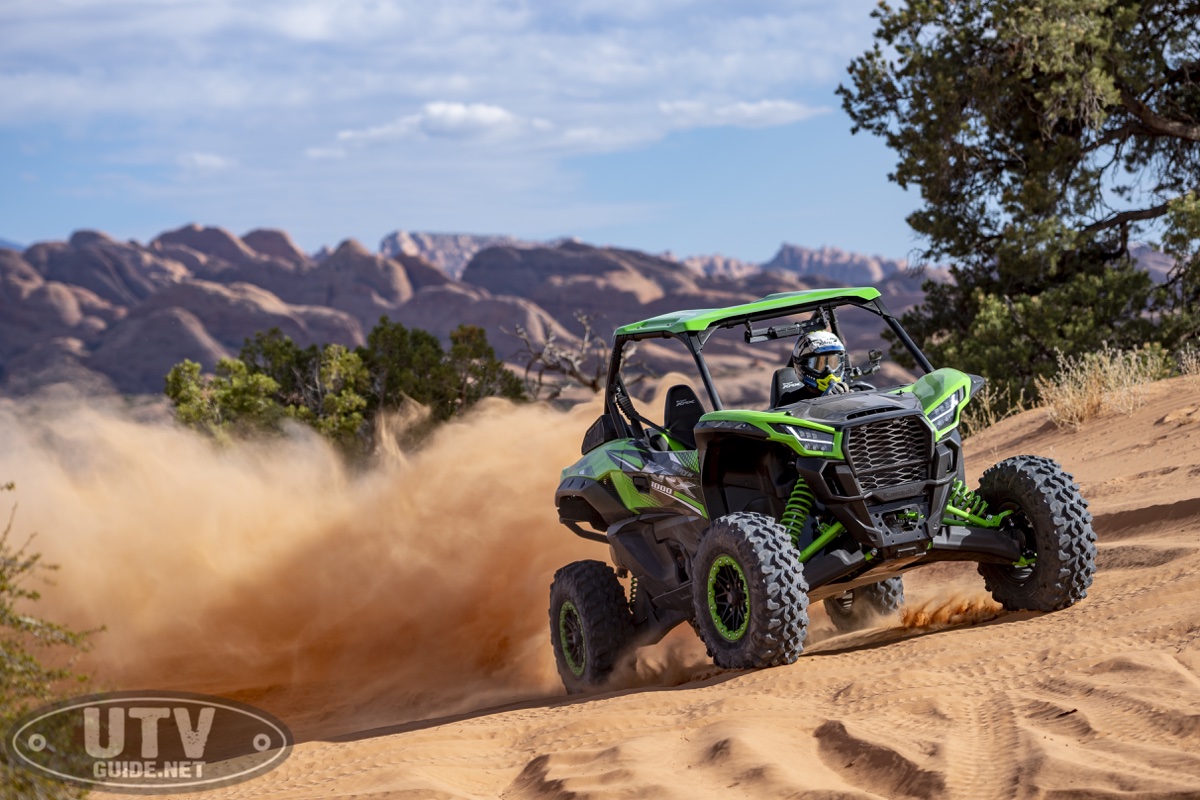
Kawasaki Teryx KRX 1000