


By Jon Crowley
Originally published following the 2018 Can-Am Maverick Trail introduction. Updated in 2026 with current model information and additional buyer guidance.
The Can-Am Maverick Trail approaches the 50-inch side-by-side category differently than most narrow UTVs. Instead of building the shortest machine possible, Can-Am paired its trail-restricted width with a long 90.6-inch wheelbase, a roomy cockpit and predictable handling.
I traveled to Bear River Lodge in northern Utah to drive the original 2018 Maverick Trail 1000 DPS on forest roads and narrow mountain trails. Two days behind the wheel showed that the extended wheelbase is more than a specification—it defines how the Maverick Trail rides, corners and accommodates taller drivers.
Quick verdict: The Maverick Trail is one of the most comfortable and stable choices in the 50-inch UTV class. Its long wheelbase improves legroom and rough-trail composure, although it also produces a wider turning circle and reduces breakover clearance compared with a shorter machine.
Best for: Riders who need a true 50-inch UTV but prioritize comfort, stability and longer trail rides over maximum maneuverability in extremely tight terrain.
Can-Am Maverick Trail Review Video

A frosty morning with the Can-Am Maverick Trail at Bear River Lodge.
What Is the Can-Am Maverick Trail?
Can-Am introduced the Maverick Trail for the 2018 model year as its first entry in the 50-inch recreational side-by-side category. You can read more about the original models in our 2018 Can-Am Maverick Trail first look.
A 50-inch width is important because many public trail systems restrict vehicles to 50 inches or less. The category was established by the original Polaris RZR 800 and later expanded to include machines such as the Arctic Cat Wildcat Trail and Honda Pioneer 500. Our 50-inch trail-capable UTV comparison provides additional historical context.
The original Maverick Trail lineup included 800 and 1000 models, with and without Dynamic Power Steering. I selected the 75-horsepower Maverick Trail 1000 DPS for the first portion of our Utah test.
Testing the Maverick Trail in Northern Utah
Bear River Lodge sits at approximately 8,000 feet in the Uinta-Wasatch-Cache National Forest. Its location provides access to hundreds of miles of OHV routes ranging from maintained forest roads to narrow, steep trails with 50- and 60-inch width restrictions.
That variety made it an ideal place to evaluate a 50-inch UTV. We arrived in early October, but snow was already on the ground and the temperature reached only about 35 degrees during the first day. Conditions ranged from frozen terrain to loose dirt, rocks, water crossings and narrow wooded sections.

Riding the Can-Am Maverick Trail in the Uinta-Wasatch-Cache National Forest.

Early-season snow added another element to our Maverick Trail test.


The Long Wheelbase Defines the Maverick Trail
The first thing I noticed was how long the Maverick Trail looked for a 50-inch UTV. Its 90.6-inch wheelbase was nearly 12 inches longer than the contemporary Polaris RZR 900, while its overall length was slightly more than a foot longer.
Can-Am used some of that additional length to create more cockpit space. At 6 feet 1 inch tall, I immediately appreciated the legroom.
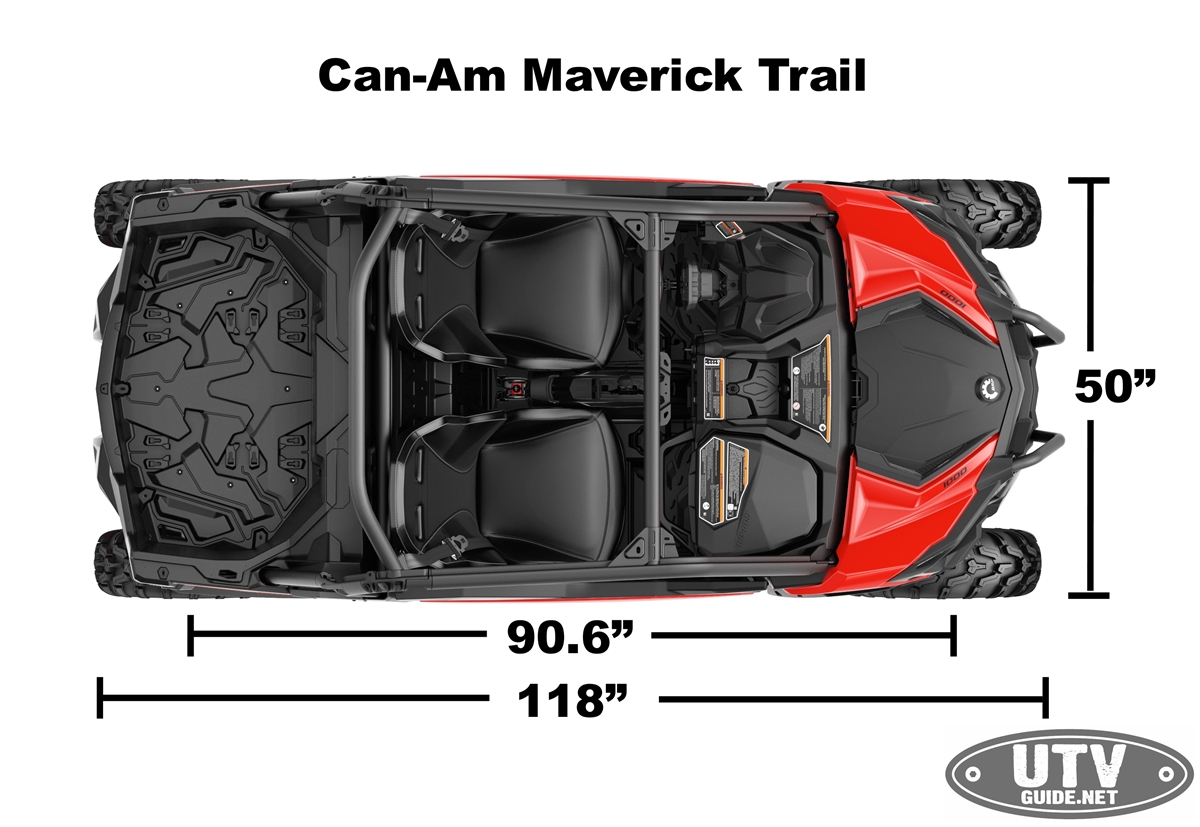
The Maverick Trail measures 50 inches wide and has a 90.6-inch wheelbase.
In my opinion, the wheelbase remains the single biggest differentiator between the Maverick Trail and shorter 50-inch UTVs. It gives the Can-Am three important characteristics:
- More legroom: Taller occupants do not feel as folded into the cockpit.
- A smoother ride: The chassis feels less busy as the front and rear suspension cross successive bumps.
- Greater stability: The Maverick Trail feels planted and predictable during acceleration and faster cornering.
There are tradeoffs. A longer machine generally needs more room to turn, and its increased distance between the tires reduces the breakover angle. That can matter when crossing sharp ridges, logs or closely spaced ledges.
Handling and Stability
The Maverick Trail’s cornering ability was the biggest surprise of the test. I could drive confidently into a corner and apply the throttle without the machine feeling as tippy or nervous as its 50-inch width might suggest.
No narrow UTV can overcome the basic physics of a limited track width, and drivers still need to respect off-camber terrain. However, the long wheelbase helps slow the vehicle’s reactions and makes it easier to anticipate what the chassis will do next.
This is especially useful on flowing forest trails and rough two-track routes. The Maverick Trail feels more like a conventional recreational UTV that happens to be 50 inches wide than a compact vehicle designed solely to fit through a width gate.
On extremely tight trails, that same length becomes less advantageous. Closely spaced trees, switchbacks and dead-end turnarounds favor a shorter machine. Buyers should consider the actual trail system they ride rather than selecting a UTV based on width alone.

The 50-inch Maverick Trail is at home on narrow wooded routes.
Engine Performance: Maverick Trail 1000
The original Maverick Trail 1000 used a 976cc liquid-cooled Rotax V-twin producing 75 horsepower. That engine provided considerably more performance than most compact trail UTVs available at the time.
Throttle response was strong enough to make the Trail entertaining without overwhelming its narrow chassis. The power felt particularly useful when climbing at elevation, accelerating out of corners and maintaining momentum through rough terrain.
The Trail was never intended to compete with the wider, long-travel Can-Am Maverick performance models. Its mission is narrower and more practical: deliver meaningful recreational performance while remaining legal for trail systems with a 50-inch restriction.
The CVT includes low and high ranges, neutral, reverse and park. The extra-low gearing helps the Trail operate at slower speeds without relying excessively on the drive belt when climbing or negotiating technical terrain.
Suspension and Ground Clearance
The Maverick Trail uses double A-arms with a sway bar and 10 inches of travel in front. At the rear, Can-Am’s TTA trailing-arm design provides 10.5 inches of travel. Twin-tube gas-charged shocks are used at all four corners.
The suspension is tuned more for trail comfort and predictable control than aggressive jumping. It worked well on the rocky, uneven forest trails around Bear River Lodge, particularly when combined with the long wheelbase.
Ground clearance is 10 inches. That is adequate for typical trail riding, but it is not generous by modern recreational UTV standards. The long wheelbase also makes careful tire placement important when crossing sharp crests or large obstacles.
DPS, Four-Wheel Drive and Turf Mode
I generally prefer power steering, so the DPS model was my favorite. Dynamic Power Steering reduces effort during slow, technical riding and helps limit steering-wheel kickback when the front tires strike rocks or roots.
The non-DPS model was still manageable and had reasonably balanced steering effort, but power steering becomes more valuable during long rides, repeated tight turns and technical terrain.
The original DPS models also offered four selectable traction configurations through a lockable rear differential:
- Two-wheel drive with the rear differential open
- Two-wheel drive with the rear differential locked
- Four-wheel drive with the rear differential open
- Four-wheel drive with the rear differential locked
Opening the rear differential allows the inside rear tire to rotate at a different speed while turning. That can tighten the turning path, reduce damage to lawns and prevent the tires from chirping on hard surfaces. Locking it provides better traction when both rear tires need to pull together.
Cockpit Comfort and Interior Space
Keeping a UTV at 50 inches wide makes interior packaging difficult. Can-Am found useful legroom by extending the chassis, but the cabin still cannot offer the shoulder and elbow room of a 60- or 64-inch UTV.

A 50-inch UTV cannot provide the elbow room of a wider recreational side-by-side.
I preferred the DPS model’s half doors to the nets fitted to the original base versions. The doors give the cockpit a more finished feel and provide better separation from brush, mud and trail debris.
Elbow room remained limited for a larger driver, but that is a compromise shared across the 50-inch class. Within the available width, Can-Am used the space effectively.
Cab Storage and Cargo Capacity
Interior storage is one of the Maverick Trail’s stronger practical features. A large passenger-side glove box is joined by a smaller driver-side compartment suitable for a phone, wallet, glasses and other frequently used items.

The Maverick Trail includes several useful storage areas inside the cockpit.
Total enclosed storage is rated at 5.3 gallons. Behind the seats, the cargo area can carry up to 300 pounds. A 2-inch receiver and 1,500-pound rated towing capacity add utility for moving a small trailer around private property or transporting trail equipment where permitted.
Accessories and LinQ Mounting
Can-Am designed the Maverick Trail with accessory installation in mind. LinQ mounting points allow compatible cargo boxes, bags, racks and other equipment to be installed or removed without a complicated mounting process.
Available accessories have included windshields, roofs, bumpers, protection, storage systems, lighting, gun racks and weather-related equipment. Anyone shopping for a used Maverick Trail should inspect how accessories were installed, particularly wiring, roof mounts and any holes added to the body or cage.
Can-Am Maverick Trail Pros and Cons
Advantages
- True 50-inch width for restricted trail systems
- Stable and predictable handling
- Excellent legroom for a narrow UTV
- Strong 75-horsepower 1000 engine
- Useful cockpit storage
- 300-pound cargo capacity
- 1,500-pound towing rating
- Good factory accessory support
Tradeoffs
- Longer turning path than some shorter 50-inch UTVs
- Limited elbow and shoulder room
- Only 10 inches of ground clearance
- Long wheelbase reduces breakover clearance
- Basic twin-tube shocks limit aggressive suspension performance
- Not intended to match wider sport UTVs in rough terrain
2018 Can-Am Maverick Trail Specifications
The following specifications apply to the original four-model lineup tested for this review. Prices are original 2018 suggested retail prices and should not be interpreted as current market values.
| Specification | Trail 800 | Trail 1000 | Trail 800 DPS | Trail 1000 DPS |
|---|---|---|---|---|
| Engine | 799.9cc Rotax V-twin | 976cc Rotax V-twin | 799.9cc Rotax V-twin | 976cc Rotax V-twin |
| Horsepower | 51 hp | 75 hp | 51 hp | 75 hp |
| Power steering | No | No | DPS | DPS |
| Rear differential | Locked | Locked | Selectable open/locked | Selectable open/locked |
| Doors | Nets | Nets | Half doors | Half doors |
| Dry weight | 1,314 lb. | 1,349 lb. | 1,331 lb. | 1,364 lb. |
| Original MSRP | $10,999 | $12,999 | $12,999 | $14,799 |
Shared 2018 Specifications
| Width | 50 in. |
|---|---|
| Overall dimensions | 118 x 50 x 69 in. |
| Wheelbase | 90.6 in. |
| Ground clearance | 10 in. |
| Front suspension | Double A-arm with sway bar; 10 in. travel |
| Rear suspension | TTA-T with sway bar; 10.5 in. travel |
| Tires | 26 x 8-12 front; 26 x 9-12 rear Carlisle ACT |
| Cargo capacity | 300 lb. |
| Towing capacity | 1,500 lb. |
| Fuel capacity | 10 gal. |
2026 Can-Am Maverick Trail Update
The Maverick Trail remains in Can-Am’s lineup for 2026, demonstrating the durability of the original platform. Its fundamental dimensions are unchanged: 50 inches wide, 118 inches long and a 90.6-inch wheelbase, with 10 inches of front suspension travel and 10.5 inches in the rear.
The biggest powertrain change is the entry-level engine. The original 51-horsepower 800 V-twin has been replaced by a 52-horsepower, 650cc Rotax ACE single-cylinder engine marketed as the 700. The Maverick Trail 1000 continues with the 75-horsepower, 976cc Rotax V-twin.
| 2026 Specification | Maverick Trail DPS 700 | Maverick Trail DPS 1000 |
|---|---|---|
| Engine | 650cc Rotax ACE single-cylinder | 976cc Rotax V-twin |
| Output | 52 hp / 42 lb-ft | 75 hp |
| Transmission | pDrive primary CVT; L/H/N/R/P | QRS CVT; Extra-L/H/N/R/P |
| Power steering | DPS | DPS |
| Estimated dry weight | 1,290 lb. | 1,383 lb. |
| Width / wheelbase | 50 in. / 90.6 in. | |
| Suspension travel | 10 in. front / 10.5 in. rear | |
| Cargo / towing | 300 lb. / 1,500 lb. | |
Although the powertrains and some details have changed, the traits observed during our original test remain relevant. The current Maverick Trail still uses the same basic dimensions, suspension travel and long-wheelbase approach that made the 2018 model distinctive.
Which Maverick Trail Should You Buy?
The 700 makes sense for riders focused on casual trail exploration, moderate speeds and lower initial cost. Its 52-horsepower single-cylinder engine nearly matches the output of the original 800, although it will not have the same sound or power delivery as a V-twin.
The 1000 is the better choice for riders who regularly climb at elevation, carry additional cargo or simply want stronger acceleration. Its 75-horsepower V-twin also matches the engine configuration tested in this review.
Power steering is highly desirable on either model. It reduces fatigue, improves control in rocky terrain and makes the Maverick Trail easier to maneuver at low speed. On the used market, I would generally favor a well-maintained DPS model with half doors over a base machine with nets.
What to Inspect on a Used Maverick Trail
- CVT belt and clutch operation: Look for slipping, unusual noises, delayed engagement or signs that the belt housing has ingested water.
- Suspension bushings and wheel bearings: Lift the vehicle safely and check for excessive movement.
- Skid plates and chassis: The long wheelbase can lead to contact near the center of the vehicle on sharp obstacles.
- Doors and latches: Verify that both doors remain aligned and close securely.
- Steering components: Check tie-rod ends, steering play and DPS operation.
- Air-filter maintenance: Inspect the filter and intake tract, especially on machines used in heavy dust.
- Accessory wiring: Look for unprotected connections, overloaded accessory circuits and poorly routed wiring.
- Recall status: Ask a Can-Am dealer to check the VIN for outstanding safety campaigns or service updates.
Final Verdict
The Can-Am Maverick Trail successfully combines a true 50-inch width with the comfort and handling character of a larger recreational UTV. Its extended wheelbase provides meaningful legroom for taller drivers and makes the vehicle feel stable, smooth and predictable when the trail opens up.
The added length is not ideal for every situation. Riders who spend most of their time weaving between closely spaced trees or making extremely tight switchbacks may prefer a shorter machine. Ground clearance and breakover angle also require attention in rocky terrain.
For longer trail rides, mixed forest routes and width-restricted trail systems, however, the Maverick Trail remains a comfortable and capable choice. The fact that Can-Am has retained the same underlying dimensions into 2026 reinforces what our original test revealed: the long-wheelbase, 50-inch formula works.
Can-Am Maverick Trail FAQ
Is the Can-Am Maverick Trail really 50 inches wide?
North American Maverick Trail models are specified at 50 inches wide, allowing them to fit many trail systems restricted to vehicles no wider than 50 inches. Riders should still confirm local trail rules and measure any modified vehicle because aftermarket wheels, tires and suspension parts can increase its actual width.
How much horsepower does the Maverick Trail have?
The original 2018 Maverick Trail 800 produced 51 horsepower, while the Trail 1000 produced 75 horsepower. For 2026, the Maverick Trail DPS 700 is rated at 52 horsepower and 42 pound-feet of torque, while the 1000 remains rated at 75 horsepower.
Is the Maverick Trail good for tall drivers?
Yes. The 90.6-inch wheelbase gives the Maverick Trail more fore-and-aft cockpit room than many compact UTVs. At 6 feet 1 inch tall, I found its legroom to be one of the vehicle’s strongest features, although elbow room remains limited by the 50-inch width.
How fast is the Can-Am Maverick Trail 1000?
Can-Am does not base the Trail’s appeal on a published top-speed claim. Actual speed can vary with elevation, tire size, load, belt condition and electronic calibration. More important for trail use, the 75-horsepower 1000 provides strong acceleration and useful climbing performance.
Is the Maverick Trail better with DPS?
For most riders, yes. Dynamic Power Steering reduces steering effort and kickback, making the vehicle more comfortable during long rides and easier to control in rocks, roots and tight turns.
Can the Maverick Trail tow a trailer?
The Maverick Trail is rated to tow up to 1,500 pounds and includes a 2-inch receiver. Owners should follow Can-Am’s loading instructions and remember that terrain, braking distance and tongue weight all affect safe towing.


