


We installed a set of Camoplast T4S tracks on a 2015 Polaris RZR XP 1000 FOX Edition and headed into the Sierra Nevada to find out how a sport UTV performs on snow. This original test covers installation, compatibility, traction, flotation and the practical tradeoffs of converting a RZR from tires to tracks.
Editor’s note: This test was conducted in 2015 using the Camoplast T4S system available at the time. Camoplast’s powersports track business later became known as Camso, and current track systems, mounting kits, pricing and vehicle compatibility may differ. Always verify that a track system and its vehicle-specific mounting hardware are approved for your exact RZR model and suspension configuration.
Why Put Tracks on a Polaris RZR?
Living close to the Sierra Nevada in Northern California, we usually have opportunities to take UTVs into the snow. The limitation with conventional tires is that once the machine sinks far enough for the chassis or skid plate to drag, forward progress ends quickly. Digging a UTV out of deep snow can turn a fun ride into several hours of work.
Access is another consideration. Some winter recreation areas are restricted to over-snow vehicles to reduce resource damage and preserve the trail surface. A wheeled UTV may not qualify even when it can physically travel across the snow. Riders should always check current land-management rules before unloading.
A snowmobile remains the purpose-built choice for this terrain, but I did not want to take on an entirely different powersports hobby. Installing tracks on a UTV offered another way to use a machine already in the garage.
Choosing the RZR XP 1000
Tracks add considerable rotating mass and rolling resistance, so I wanted a UTV with enough power to handle them. The 2015 Polaris RZR XP 1000 produced a claimed 110 horsepower, making it an appealing platform for the project.
My original plan was to install the tracks on the RZR XP 1000 project we called the “Instigator” long-travel build. TMW Off-Road built that machine with Cognito Motorsports long-travel suspension, FOX internal-bypass shocks and an SSV Works audio system.

Why We Selected Camoplast T4S Tracks
I investigated several track systems, including products from Camoplast, Mattracks and TJD. Track systems represented a major investment even in 2015, when a complete setup could cost approximately $4,000 to $5,000. At that price, buying a used snowmobile might have appeared more practical, but versatility was the objective of this project.
After researching the available systems and reading owner experiences, I selected the Camoplast T4S. Camoplast was an established Canadian manufacturer with experience producing tracks for snowmobiles, ATVs, UTVs and other specialized vehicles.
Long-Travel Suspension Compatibility Problem
The tracks arrived in late January, but we encountered an important compatibility issue before installation. Although each track mounts to the RZR’s wheel studs, the complete system also uses vehicle-specific brackets, anti-rotation components and steering limiters. Those parts were engineered around the factory suspension arms and geometry.
Our Cognito-equipped Instigator had long-travel suspension rather than stock A-arms, so the supplied hardware would not attach and operate as intended. This is a critical lesson for anyone considering UTV tracks: matching the wheel-bolt pattern is not enough. The mounting kit must be compatible with the machine’s suspension arms, steering geometry and model year.

Installing the Tracks on a RZR XP 1000 FOX Edition
Fortunately, a new 2015 RZR XP 1000 FOX Edition demo unit was scheduled to arrive at my dealer in February. Because it retained its factory suspension, it gave us a compatible platform and saved the snow-track project.
We began installing the tracks almost immediately after the RZR arrived. The process was more involved than simply removing the wheels and bolting the track assemblies in their place. The vehicle-specific brackets and adjusters had to be installed and set correctly to control each track’s angle of attack and movement.
Overall installation took approximately four to five hours. No unusual specialty tools were required, and we were impressed with the quality of the components and instructions. After installation, we drove the RZR briefly on pavement to confirm that everything operated correctly, then inspected the system and rechecked the fastener torque.


Finding Snow Near Lake Tahoe
With the installation finished, our next challenge was finding enough snow for a meaningful test. Northern California was in a drought, storms had arrived with unusually high snow levels and there was very little coverage below approximately 8,000 feet.
We eventually chose Tahoe Meadows near Lake Tahoe. The area is west of the Mount Rose Summit on Nevada State Route 431 within the Humboldt-Toiyabe National Forest. Because winter access regulations and designated riding areas can change, riders should confirm current rules, boundaries and vehicle requirements before visiting.
My son and I loaded the RZR and left at 6 a.m. on the Sunday of Presidents Day weekend. We arrived at approximately 8:30 a.m. and found only one other trailer in the parking area. The riders there gave us some helpful information about the access trail, surrounding hills and the views toward Lake Tahoe.
First Impressions on Camoplast Tracks
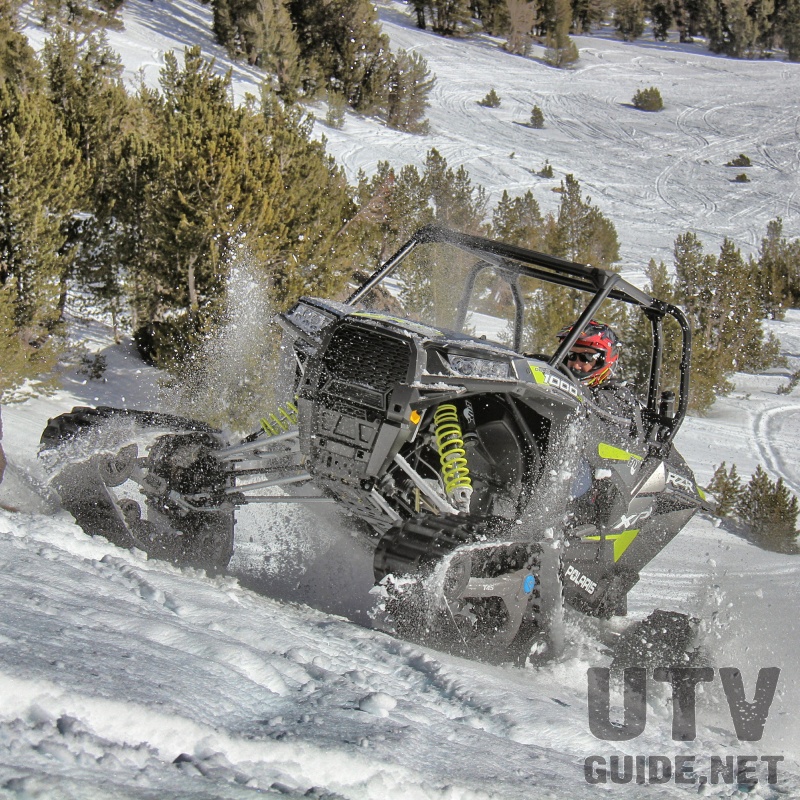
The first climb from the parking area immediately demonstrated the primary benefits of tracks. The much larger contact patches spread the vehicle’s weight across the snow, providing substantially more flotation than tires. Traction was also excellent, and the RZR powered up the climb without difficulty.
The track system effectively lowered the final-drive ratio, which meant the speedometer indicated considerably more speed than the RZR was actually traveling. That gearing reduction helped the XP 1000 turn the tracks, but it also reduced its usable top speed.

Snow Whoops and Hill Climbs
Once we reached the main access route, I was surprised to find that it was heavily whooped. The most recent snowfall had occurred about a week earlier, and the limited snow elsewhere had concentrated winter recreation traffic at Tahoe Meadows.
We left the main route and explored the surrounding area. The snow was mostly packed rather than fresh, deep powder, but it provided a useful demonstration of the track system’s traction. Even on a steep climb, the RZR maintained forward momentum and reached the top without struggling.
From the ridge, we were rewarded with a spectacular view of Lake Tahoe. Gusty wind prevented us from safely flying the quadcopter, so we continued testing the tracks across different slopes and snow conditions.

Low Range, Speed and Fuel Consumption
We operated primarily in low range. The RZR could pull the tracks in high range across flatter terrain, but this system was intended for deliberate over-snow travel rather than high-speed driving.
Anyone expecting snowmobile performance will be disappointed. The tracked RZR was considerably slower than it was on tires, and fuel consumption increased because of the additional weight, friction and resistance. The advantages were flotation, traction, an enclosed side-by-side cockpit and the ability to repurpose the UTV for another season.
Low range also reduces the load placed on the RZR’s CVT belt during slow, demanding operation. Smooth throttle use and careful monitoring of drivetrain load are especially important when turning four track assemblies through deep or heavy snow.
Camoplast T4S Track Performance
Overall, I was impressed with the Camoplast T4S system. The tracks were expensive, but the hardware felt well engineered and delivered excellent traction and flotation in the conditions we encountered.
The system allowed the RZR XP 1000 to climb and travel across snow that would quickly stop a comparable machine on conventional tires. It did not make the RZR a snowmobile, but it substantially expanded where the UTV could travel during winter.
What We Learned
- Verify suspension compatibility: Vehicle-specific brackets may require factory suspension arms and geometry.
- Plan for lower speeds: Tracks change the effective gearing and are designed for controlled travel.
- Expect increased fuel use: The drivetrain works harder to turn four track assemblies.
- Use low range: Low range is the better choice for slow travel, climbs and demanding snow conditions.
- Recheck the installation: Inspect adjustment, alignment and fastener torque after the initial test.
- Confirm winter access: Local regulations may distinguish between wheeled UTVs, tracked UTVs and snowmobiles.
Winter Riding Safety
We made this particular ride by ourselves, but traveling alone in a tracked UTV is not the smartest approach. A mechanical failure or immobilized machine can leave occupants a long distance from the tow vehicle in conditions where walking is extremely difficult.
For a similar trip, I would travel with another vehicle and carry appropriate winter survival equipment. At a minimum, consider bringing:
- A shovel
- A winch and suitable recovery gear
- Basic tools and track-system spare parts
- Snowshoes for every occupant
- Warm clothing, gloves and extra layers
- Food, water and emergency shelter
- A first-aid kit
- Navigation and a satellite communication device where cellular coverage is unreliable
Conditions in the mountains can change quickly, and a tracked UTV is still capable of getting stuck or suffering a mechanical problem. Preparation matters just as much as traction.
Final Thoughts
Installing tracks gave the RZR XP 1000 an entirely new capability. The conversion came with significant cost, slower travel and higher fuel consumption, but the added flotation and traction opened winter terrain that would have been inaccessible on tires.
For owners who regularly encounter deep snow and understand the limitations, tracks can make a powerful UTV considerably more versatile. Just make sure the system matches the exact vehicle, suspension and intended terrain before buying.
For more background on the machine itself, read our Polaris RZR XP 1000 review.


